Icodextrin
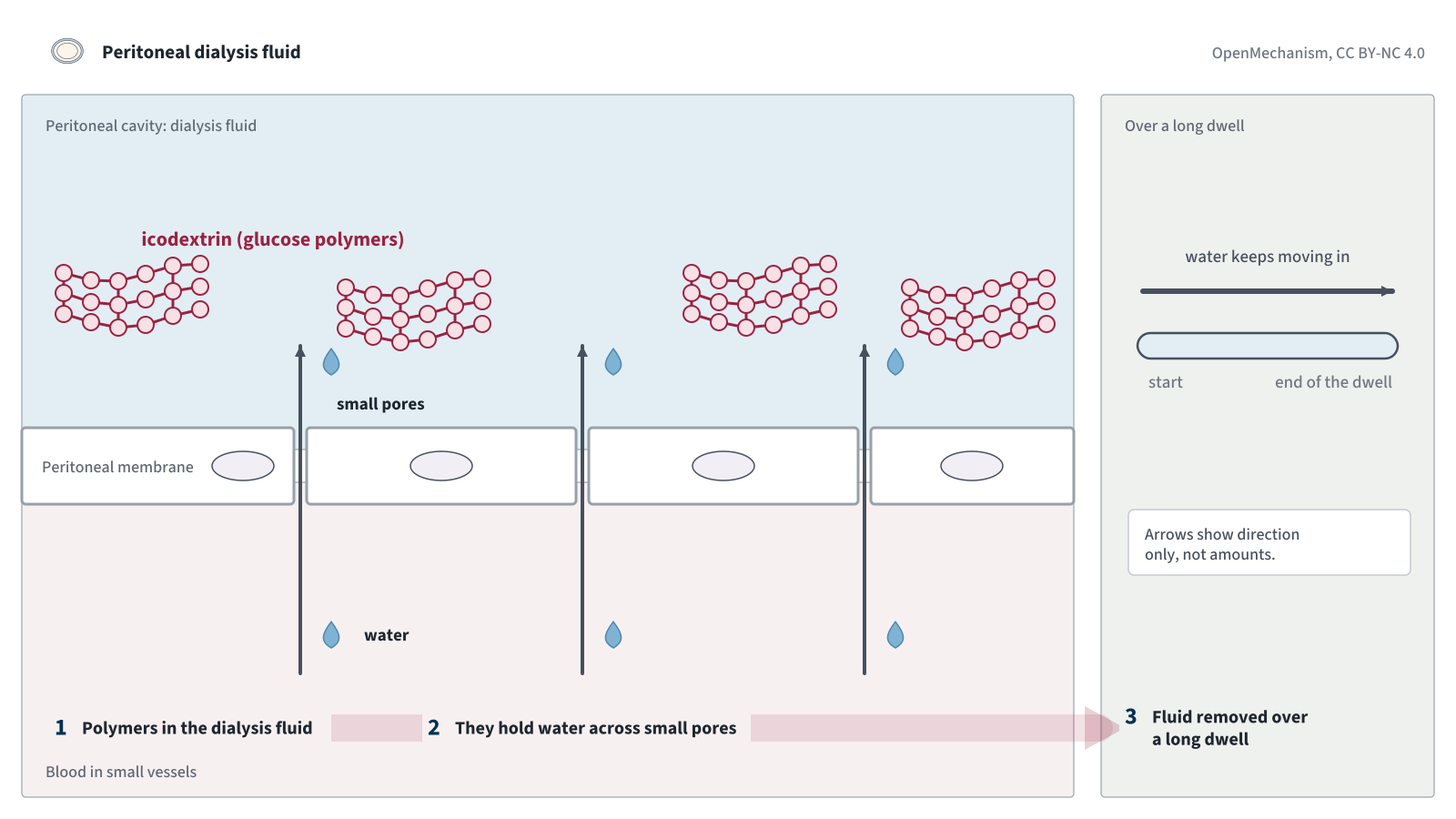
In peritoneal dialysis, icodextrin is the main osmotic agent in the dialysis fluid. Its glucose polymers pull fluid out of nearby blood vessels into the abdomen across small pores, throughout a long dwell.
- Acts on
- Water, glucose polymer
- Where
- Peritoneal dialysis fluid
- Medicine type
- Unknown
- Used for
- Kidney & electrolytes
How it works
Polymers in the dialysis fluid. The isosmotic peritoneal dialysis fluid uses icodextrin glucose polymers as its primary osmotic agent.1
They hold water across small pores. The polymer acts in the peritoneal cavity across small intercellular pores.1
Fluid removed over a long dwell. This pressure produces ultrafiltration throughout a long dialysis dwell.1
For teachers: download this drawing or build a slide deck.
See also
Condition pages: chronic kidney disease.
Body system: kidney.
Sources
- 1
- 2ChEMBL CHEMBL1201472Target and action classification: Osmotic agent
Spotted a mistake? Report an error (hello@openmechanism.com). Since launch, every published error we fix is listed on the corrections page.
Notes and limits
- A schematic teaching drawing: not to scale, not exact structures, binding poses or a complete pathway, and not a guide to dosing, treatment or how a person will respond.
- Other medicines in the same family may not follow every step or share the same clinical endpoint.
- The steps are in the order that explains them; one step is said to cause the next only where the source says so.
- Water-flow arrows express the label route qualitatively, not a numerical permeability or complete dialysis simulation.
All recorded limits are on the evidence page, and notes that apply to every page are on How to read a page. Version 1.0.0, not yet medically reviewed.
Cite this page
Tran D. Icodextrin [Internet]. OpenMechanism; 2026 [updated 2026 Oct 15; cited 2026 Oct 15]. Available from: https://openmechanism.com/medicines/icodextrin