We’re looking for volunteer reviewers in pharmacy, medicine and pharmacology. How to volunteerWe’re looking for volunteer reviewers.

Inside the kidney

From the whole kidney down to one transporter: normal, with high blood glucose, and with empagliflozin.

Zoom
Compare

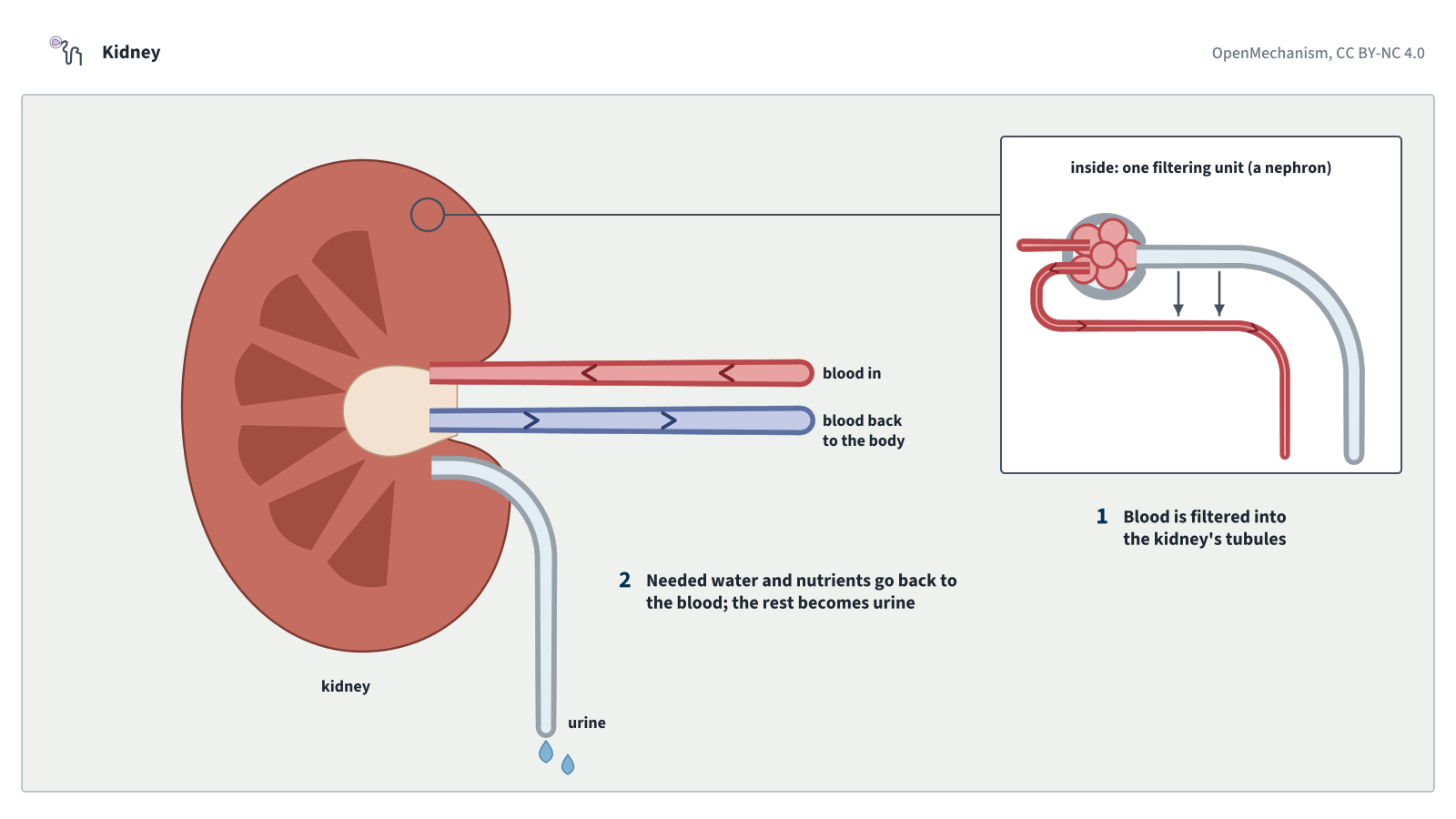
The whole kidney, normal biology

Drawing: The whole kidney, normal biology. 1: Blood is filtered into the kidney's tubules. 2: Needed water and nutrients go back to the blood; the rest becomes urine.
Schematic, not to scale. License CC BY-NC 4.0.

For teachers: download this drawing.

  1. Blood is filtered into the kidney's tubules. Glomerular filtration transfers small solutes and water from blood into the tubule.1

  2. Needed water and nutrients go back to the blood; the rest becomes urine. Tubular reabsorption returns needed water and nutrients to blood; the remaining fluid becomes urine.1

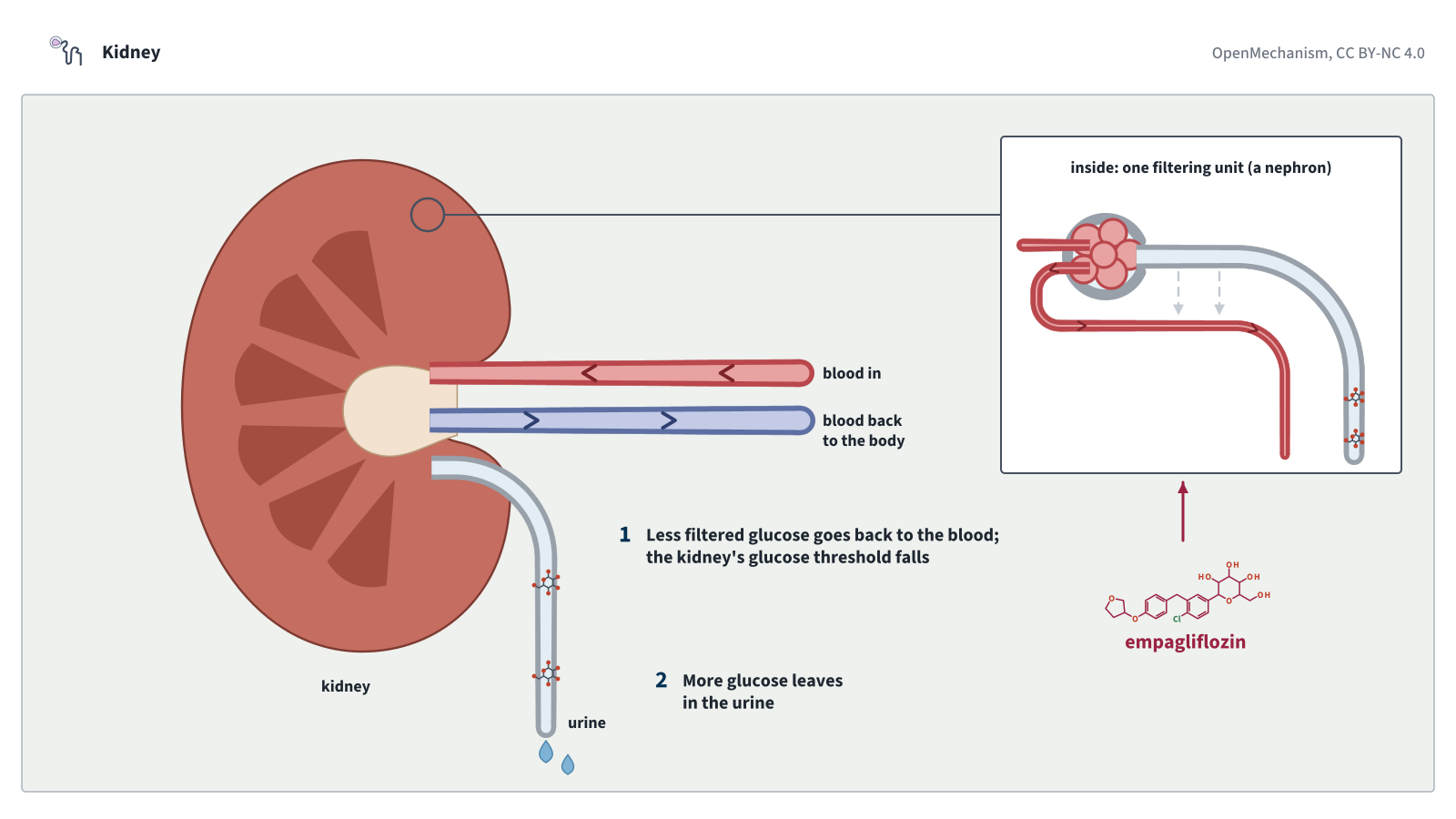
The whole kidney, with empagliflozin

Drawing: The whole kidney, with empagliflozin. 1: Less filtered glucose goes back to the blood; the kidney's glucose threshold falls. 2: More glucose leaves in the urine.
Schematic, not to scale. License CC BY-NC 4.0.

For teachers: download this drawing.

  1. Less filtered glucose goes back to the blood; the kidney's glucose threshold falls. Less filtered glucose returns to the circulation and the renal glucose threshold falls.3

  2. More glucose leaves in the urine. More glucose is excreted in urine.3

More on the medicine: empagliflozin.

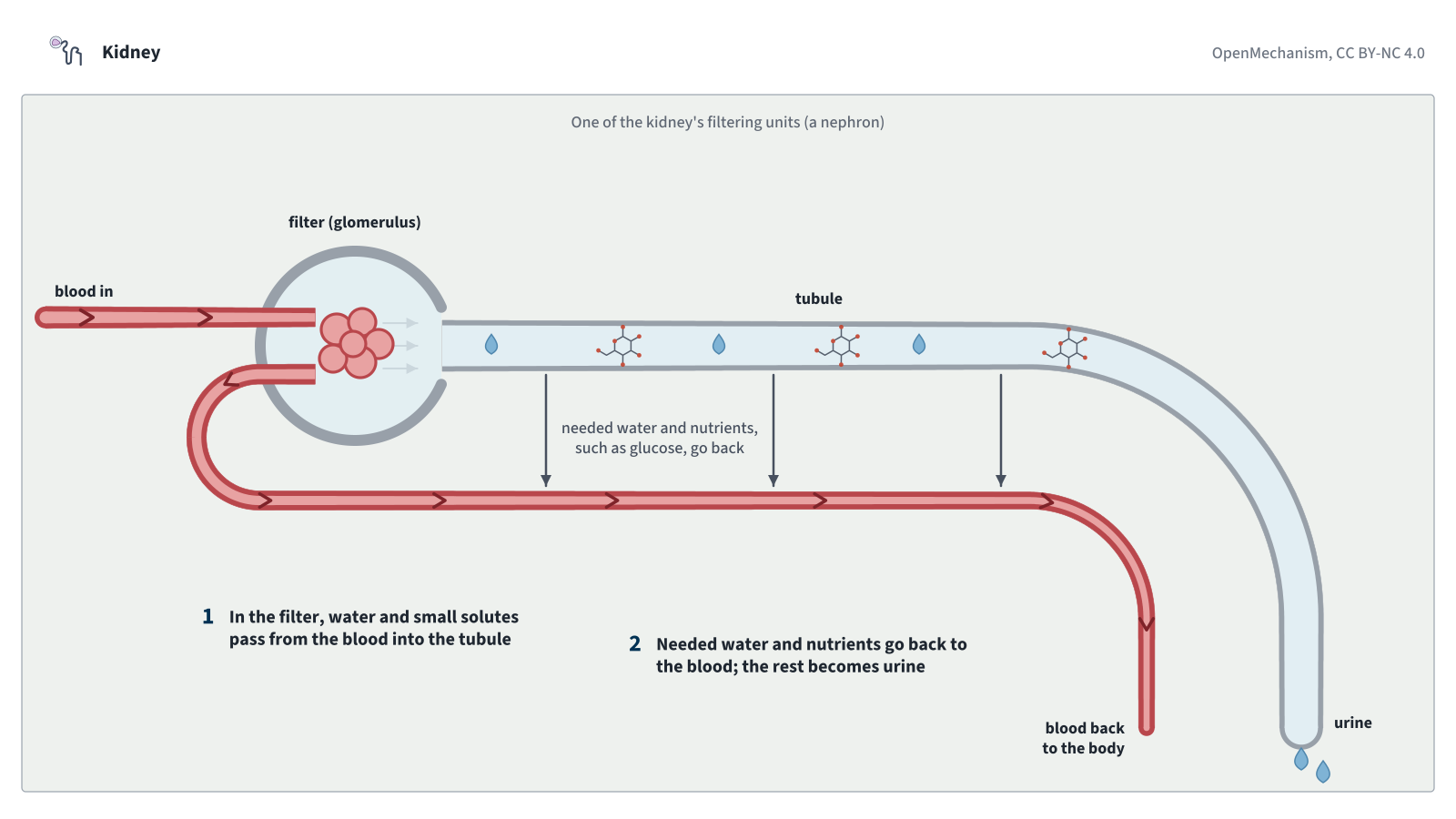
One filtering unit (a nephron), normal biology

Drawing: One filtering unit (a nephron), normal biology. 1: In the filter, water and small solutes pass from the blood into the tubule. 2: Needed water and nutrients go back to the blood; the rest becomes urine.
Schematic, not to scale. License CC BY-NC 4.0.

For teachers: download this drawing.

  1. In the filter, water and small solutes pass from the blood into the tubule. Glomerular filtration transfers small solutes and water from blood into the nephron tubule.1

  2. Needed water and nutrients go back to the blood; the rest becomes urine. Tubular reabsorption returns needed water and nutrients to blood; the remaining fluid becomes urine.1

One filtering unit (a nephron), with empagliflozin

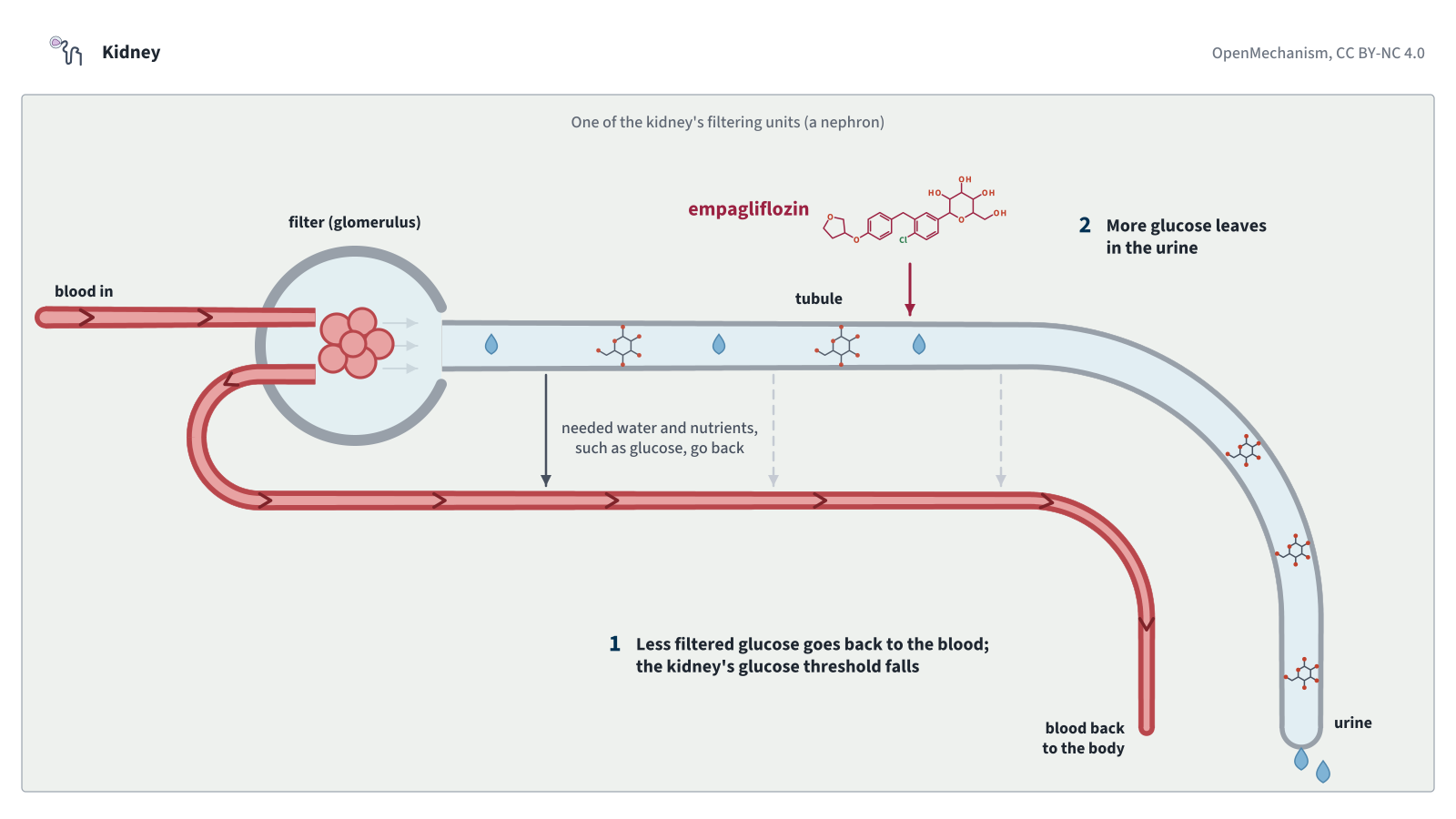
Drawing: One filtering unit (a nephron), with empagliflozin. 1: Less filtered glucose goes back to the blood; the kidney's glucose threshold falls. 2: More glucose leaves in the urine.
Schematic, not to scale. License CC BY-NC 4.0.

For teachers: download this drawing.

  1. Less filtered glucose goes back to the blood; the kidney's glucose threshold falls. Less filtered glucose returns to the circulation and the renal glucose threshold falls.3

  2. More glucose leaves in the urine. More glucose is excreted in urine.3

More on the medicine: empagliflozin.

A tubule cell, normal biology

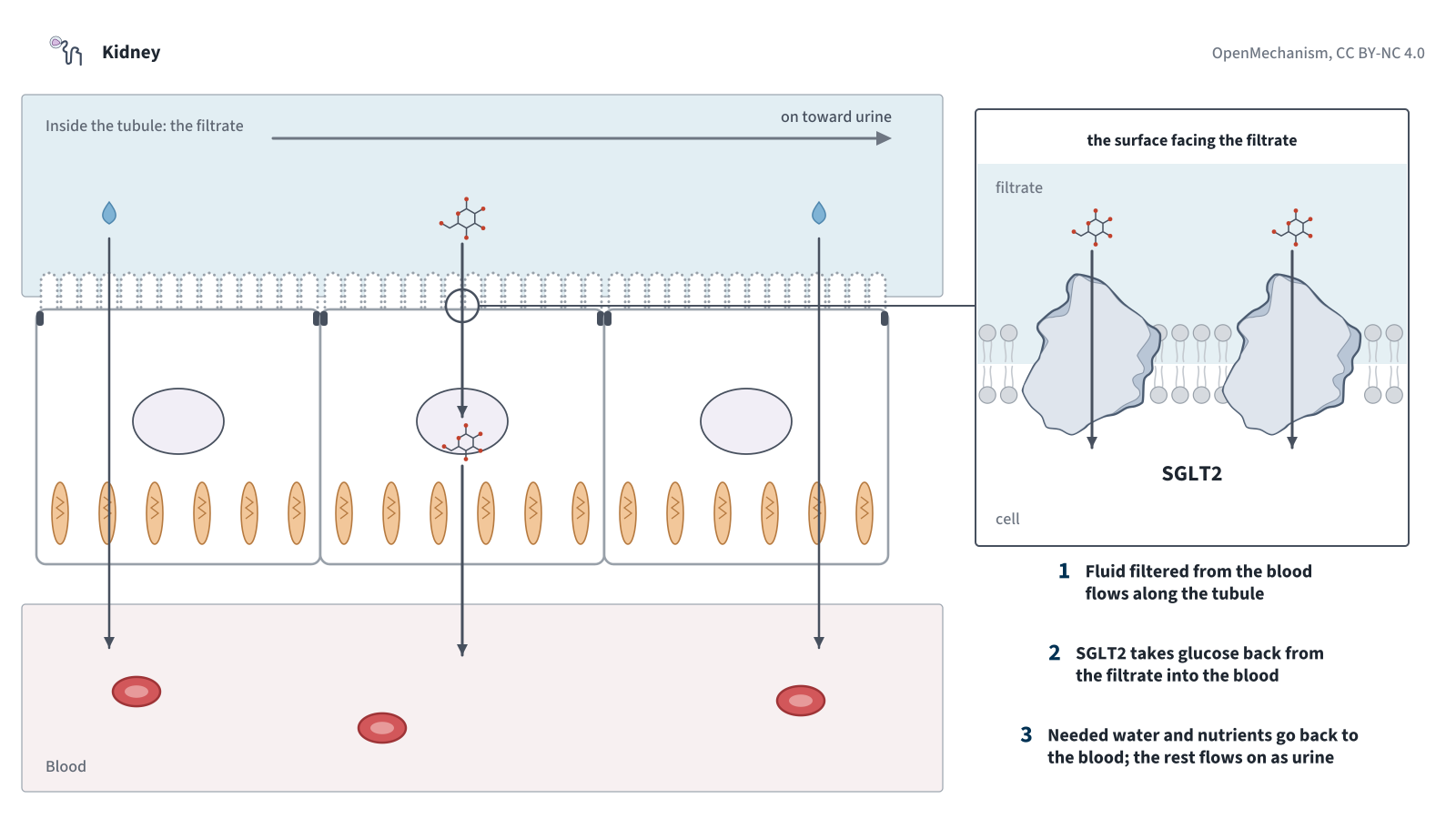
Drawing: A tubule cell, normal biology. 1: Fluid filtered from the blood flows along the tubule. 2: SGLT2 takes glucose back from the filtrate into the blood. 3: Needed water and nutrients go back to the blood; the rest flows on as urine.
Schematic, not to scale. License CC BY-NC 4.0.

For teachers: download this drawing.

  1. Fluid filtered from the blood flows along the tubule. Glomerular filtration transfers small solutes and water from blood into the nephron tubule.1

  2. SGLT2 takes glucose back from the filtrate into the blood. normally reabsorbs glucose from glomerular filtrate into the circulation.3

  3. Needed water and nutrients go back to the blood; the rest flows on as urine. Tubular reabsorption returns needed water and nutrients to blood; the remaining fluid becomes urine.1

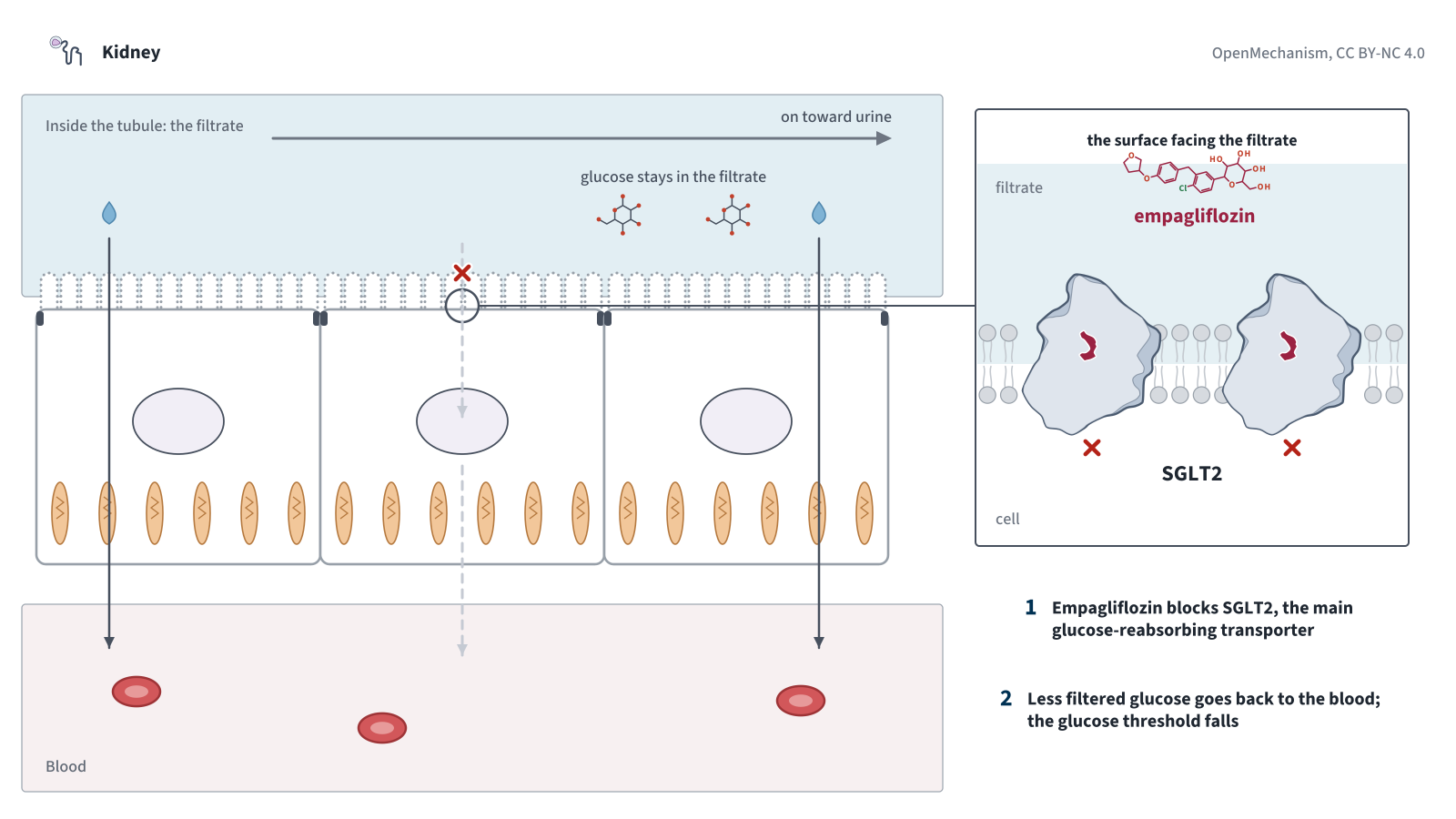
A tubule cell, with empagliflozin

Drawing: A tubule cell, with empagliflozin. 1: Empagliflozin blocks SGLT2, the main glucose-reabsorbing transporter. 2: Less filtered glucose goes back to the blood; the glucose threshold falls.
Schematic, not to scale. License CC BY-NC 4.0.

For teachers: download this drawing.

  1. Empagliflozin blocks SGLT2, the main glucose-reabsorbing transporter. Empagliflozin inhibits the predominant renal glucose-reabsorption transporter.3

  2. Less filtered glucose goes back to the blood; the glucose threshold falls. Less filtered glucose returns to the circulation and the renal glucose threshold falls.3

More on the medicine: empagliflozin.

The SGLT2 transporter, normal biology

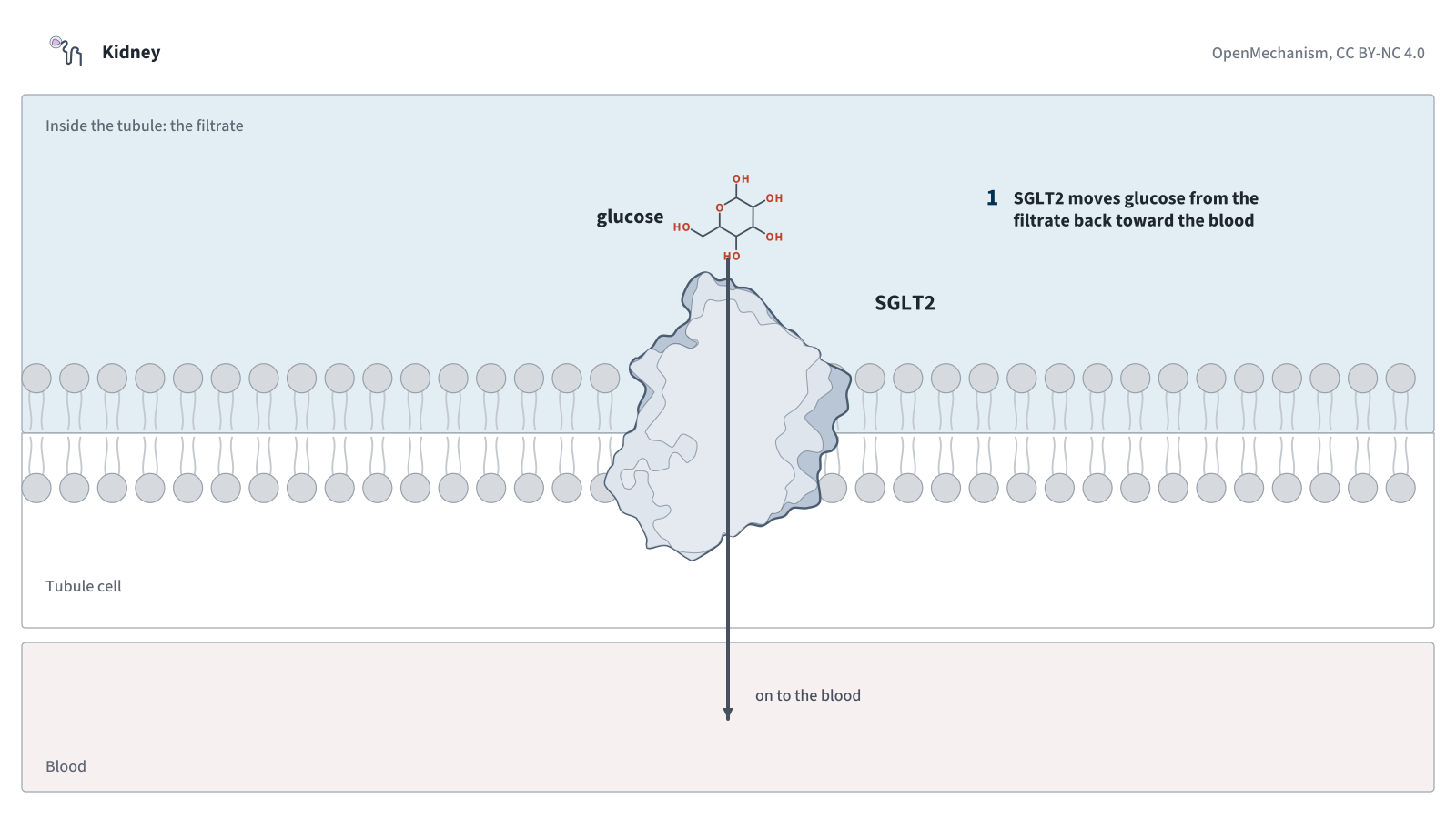
Drawing: The SGLT2 transporter, normal biology. 1: SGLT2 moves glucose from the filtrate back toward the blood.
Schematic, not to scale. License CC BY-NC 4.0.

For teachers: download this drawing.

  1. SGLT2 moves glucose from the filtrate back toward the blood. SGLT2 normally reabsorbs glucose from glomerular filtrate into the circulation.3

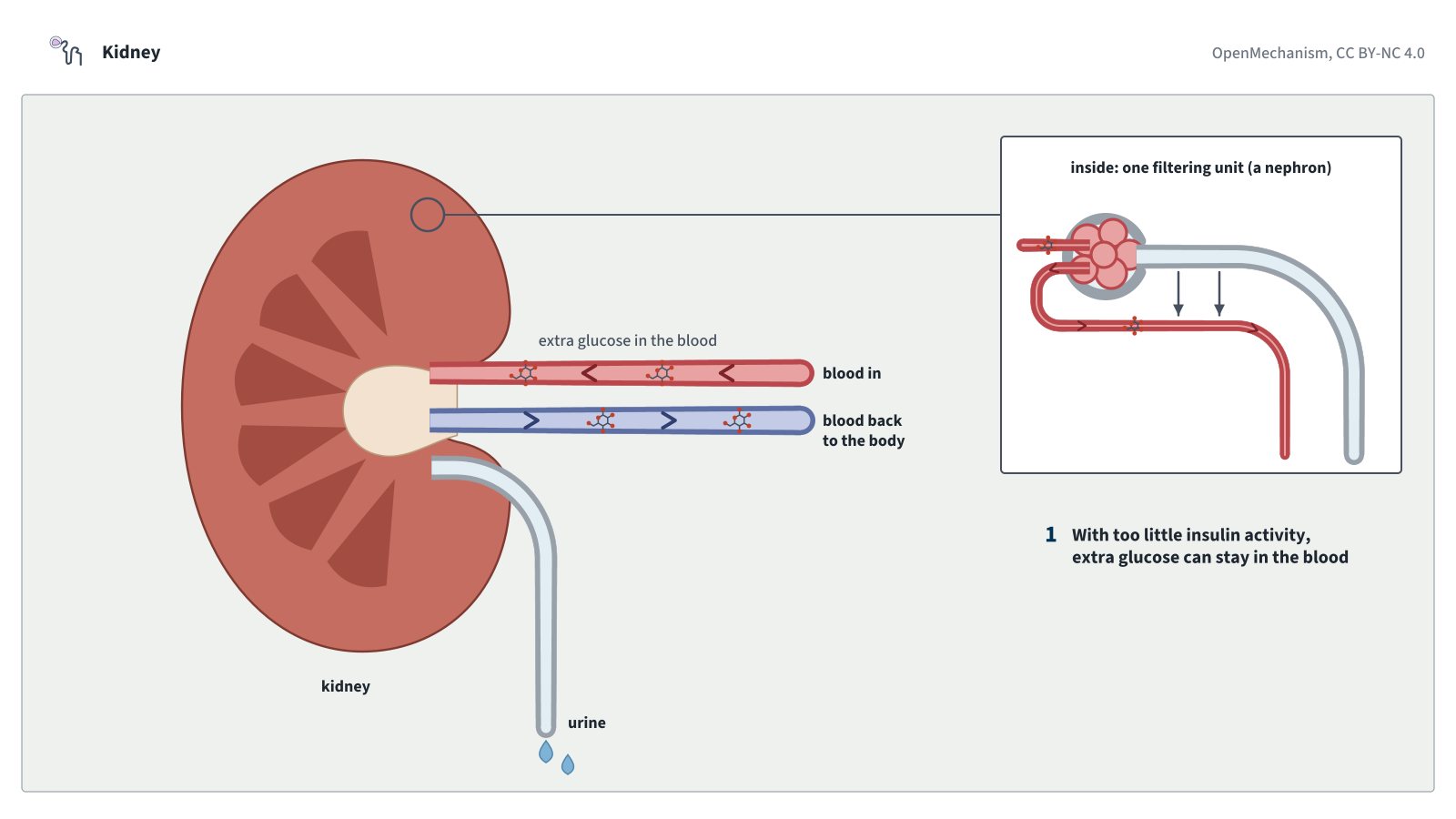
The SGLT2 transporter, high blood glucose

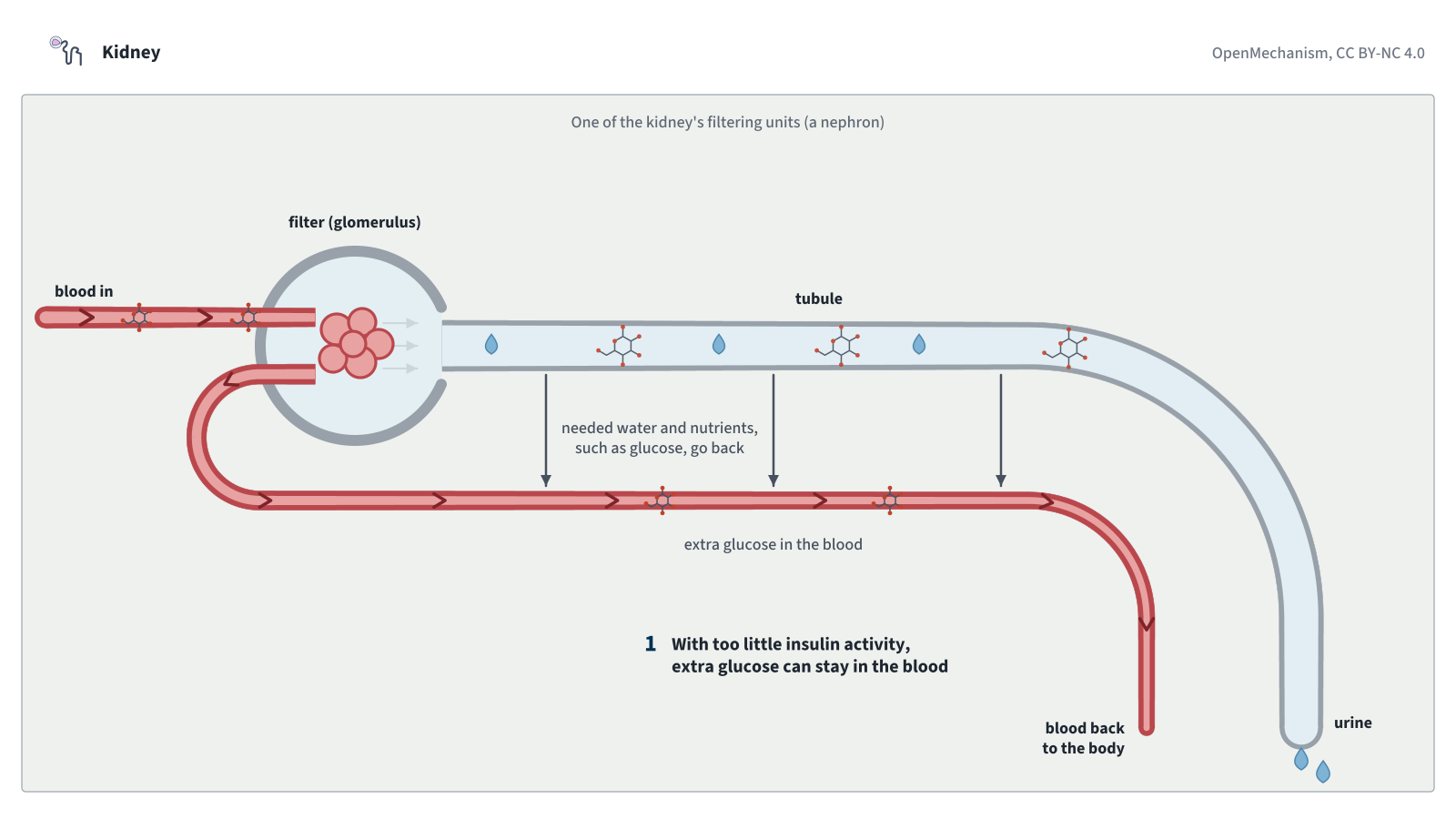
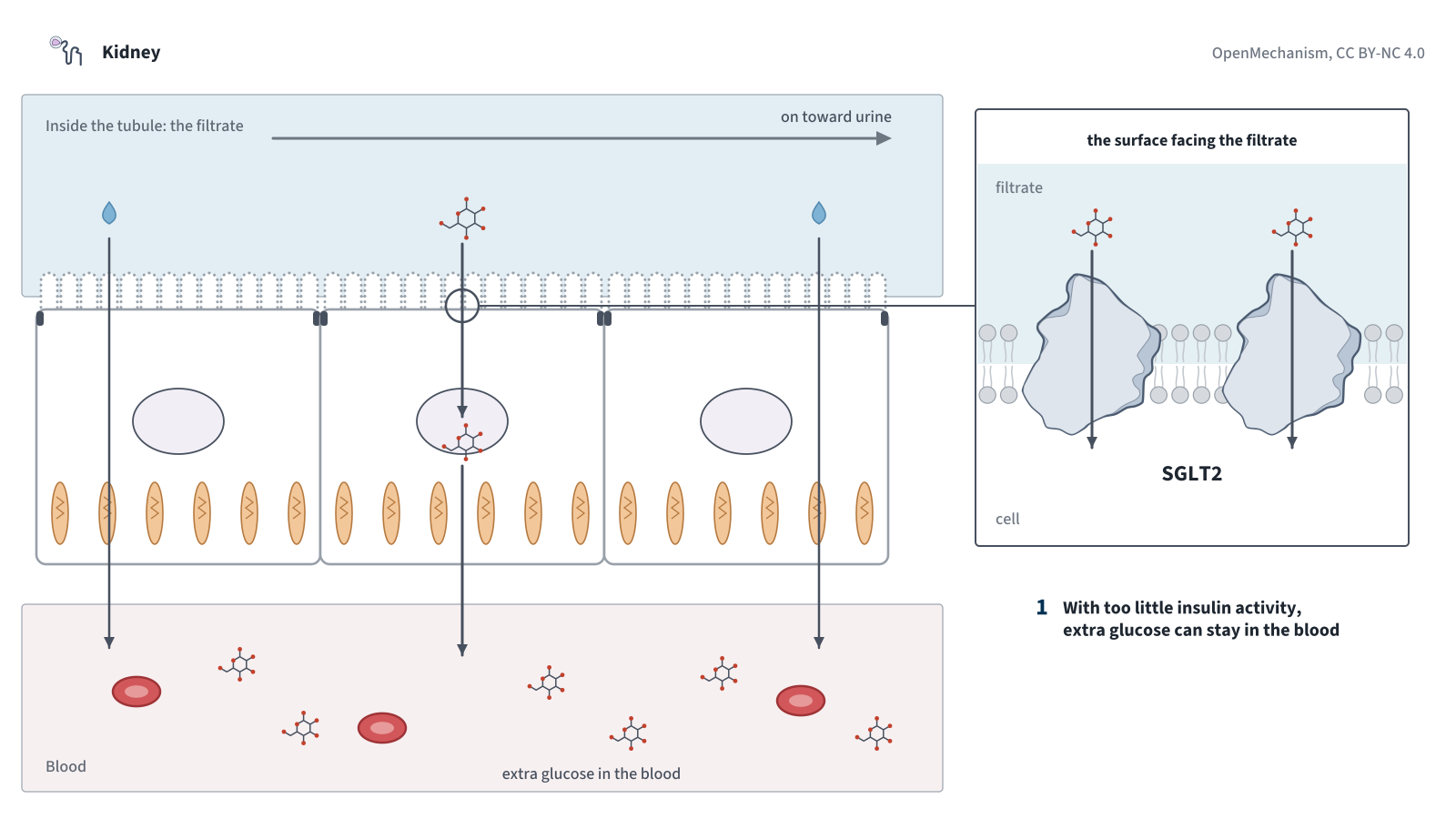
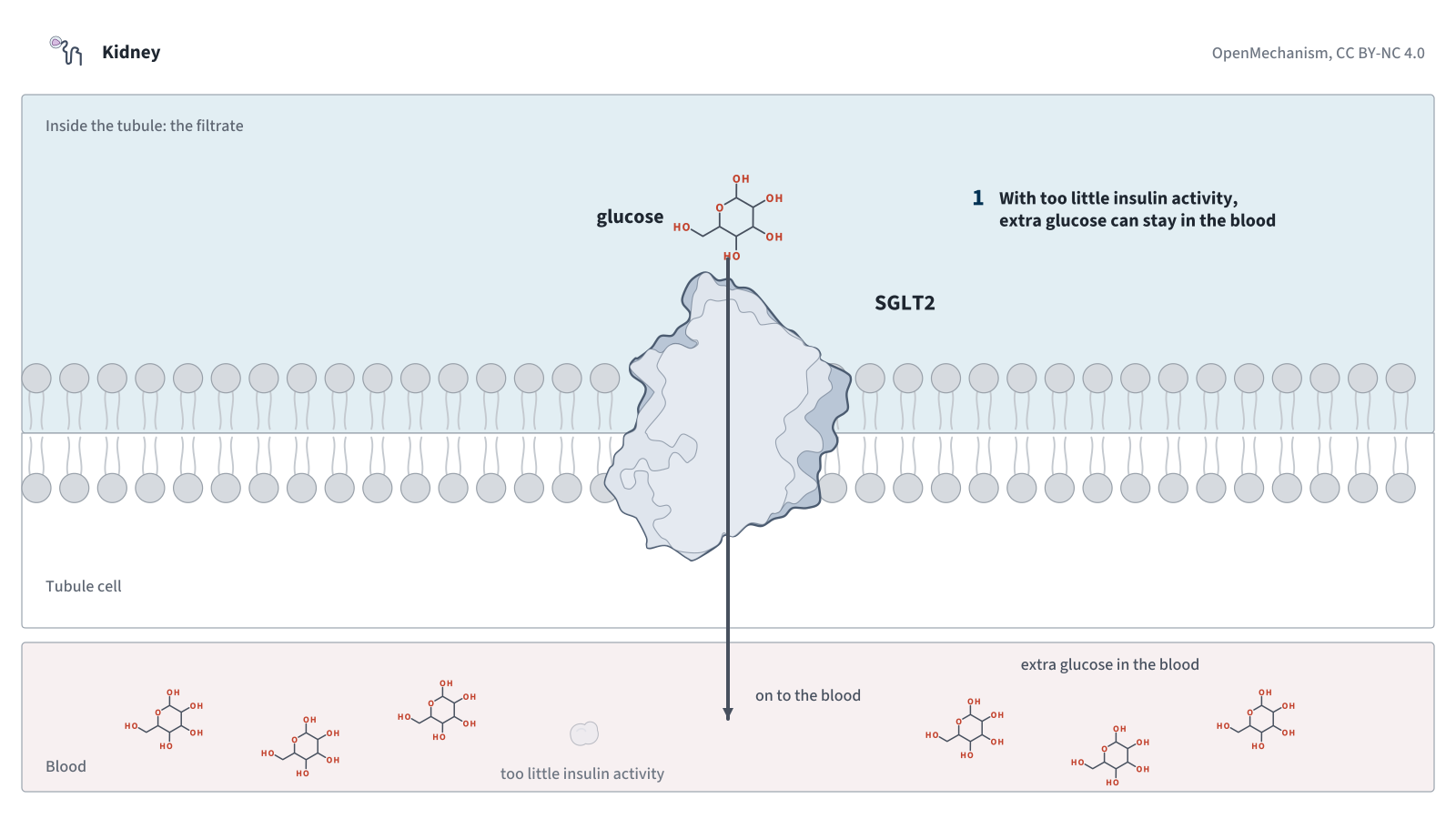
Drawing: The SGLT2 transporter, high blood glucose. 1: With too little insulin activity, extra glucose can stay in the blood.
Schematic, not to scale. License CC BY-NC 4.0.

For teachers: download this drawing.

  1. With too little insulin activity, extra glucose can stay in the blood. With insufficient insulin activity, excess glucose can remain in blood.2

More on the condition: type 2 diabetes.

The SGLT2 transporter, with empagliflozin

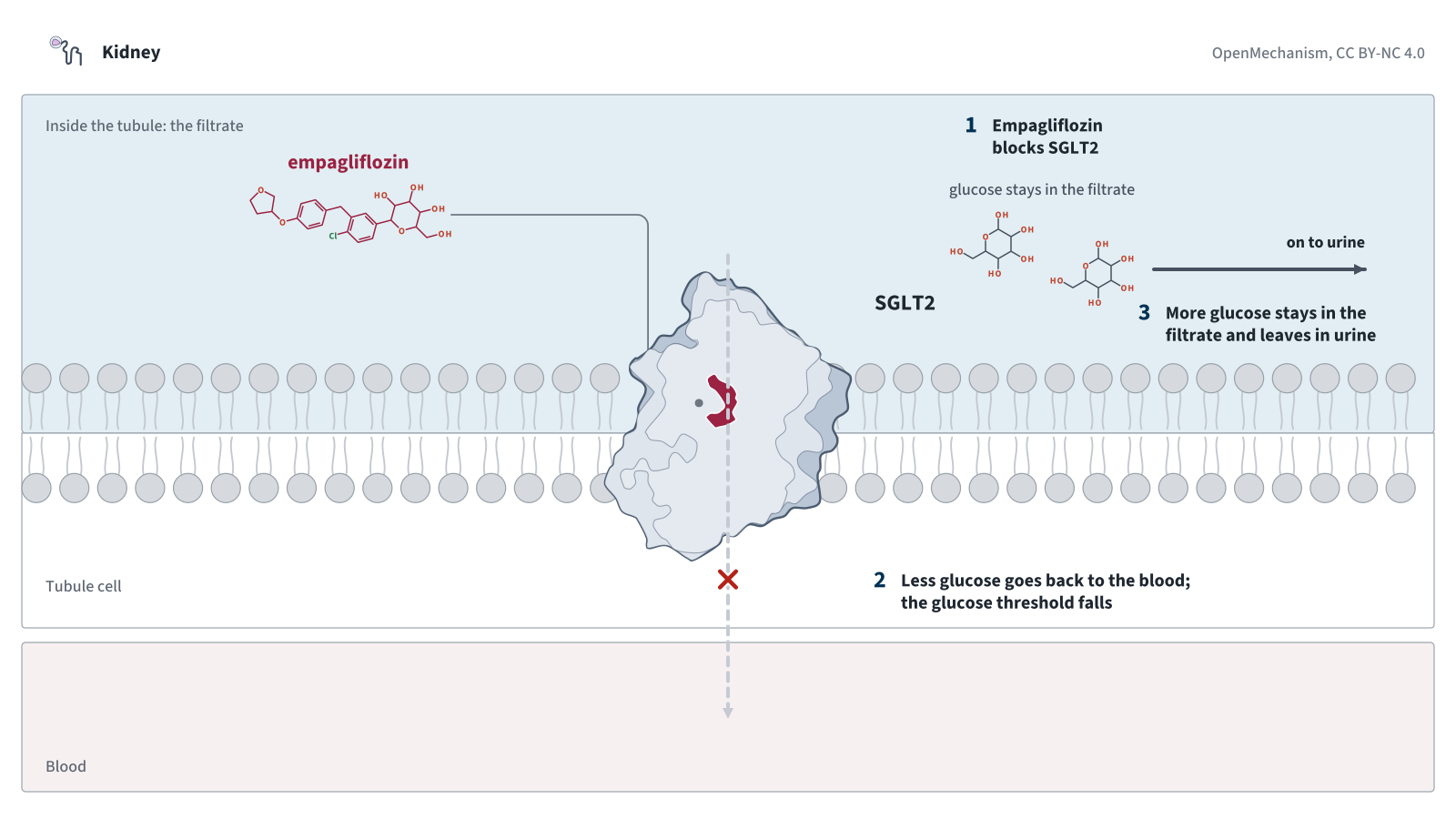
Drawing: The SGLT2 transporter, with empagliflozin. 1: Empagliflozin blocks SGLT2. 2: Less glucose goes back to the blood; the glucose threshold falls. 3: More glucose stays in the filtrate and leaves in urine.
Schematic, not to scale. License CC BY-NC 4.0.

For teachers: download this drawing.

  1. Empagliflozin blocks SGLT2. Empagliflozin inhibits the predominant renal glucose-reabsorption transporter.3

  2. Less glucose goes back to the blood; the glucose threshold falls. Less filtered glucose returns to the circulation and the renal glucose threshold falls.3

  3. More glucose stays in the filtrate and leaves in urine. More glucose is excreted in urine.3

More on the medicine: empagliflozin.

Key terms in these drawings

glomerulus
Glomerulus. The filter at the start of each nephron: it passes water and small solutes from the blood into the nephron's tubule.
nephron
Nephron. One of the kidney's filtering units: a glomerulus, which filters the blood, and the tubule the filtrate runs into.
SGLT2
Sodium-glucose cotransporter 2. The kidney's main transporter for taking glucose back from the filtrate into the blood.

See also

Body system: kidney.

Condition: type 2 diabetes.

Medicine: empagliflozin.

Animations: glucose in the kidney.

Sources

  1. 1
    NIDDK · Your Kidneys & How They WorkHow do my kidneys work? Glomerulus and tubule subsections. Our notes on this source
  2. 2
    NIDDK · What Is Diabetes?Introduction; Type 1 diabetes; Type 2 diabetes. Our notes on this source
  3. 3
    Jardiance (empagliflozin): FDA label12.1 Mechanism of Action. Saved copy
  4. 4
    Human SGLT2 (with its partner MAP17) bound to empagliflozinPDB 7VSI; Niu, Y. et al. Nature 2022;601:280-284. The SGLT2 outline in the drawings is traced from this structure. Saved copy
Notes and limits
  • Selected qualitative comparison, schematic and not to scale; not a complete physiological or treatment model.
  • The glucose-transport intervention does not demonstrate every downstream cardiorenal benefit or repair all causes of kidney disease.
  • Selected human physiology / official human drug label; qualitative comparison only.
  • Source-backed teaching figure.
  • Schematic; not to scale. Four scales are explanatory contexts, not continuous measured zoom or complete anatomy.
  • Source art is unchanged reference context. Separate actor cards carry state observations; art shape does not depict measured disease changes.
  • Solid arrows mean only the qualified selected source relation; dashed lines mean association. Row order and cross-scale navigation do not create a causal chain.
  • No dosing, diagnosis, treatment selection, response prediction, molecular pose or quantitative clinical model.
  • Disease state here is insufficient-insulin / hyperglycemia context; it does not assert nephron injury or that empagliflozin repairs kidney anatomy.
  • The renal source picture depicts nephron topology, not measured renal shape, segment length or nephron class proportions.
  • The drawings are schematic and not to scale; each shows only what the statements under it say.

Spotted a mistake? Report an error (hello@openmechanism.com). Since launch, every published error we fix is listed on the corrections page.

Cite this page

Tran D. Inside the kidney [Internet]. OpenMechanism; 2026 [updated 2026 Oct 16; cited 2026 Oct 16]. Available from: https://openmechanism.com/body/scales/kidney