High blood potassium
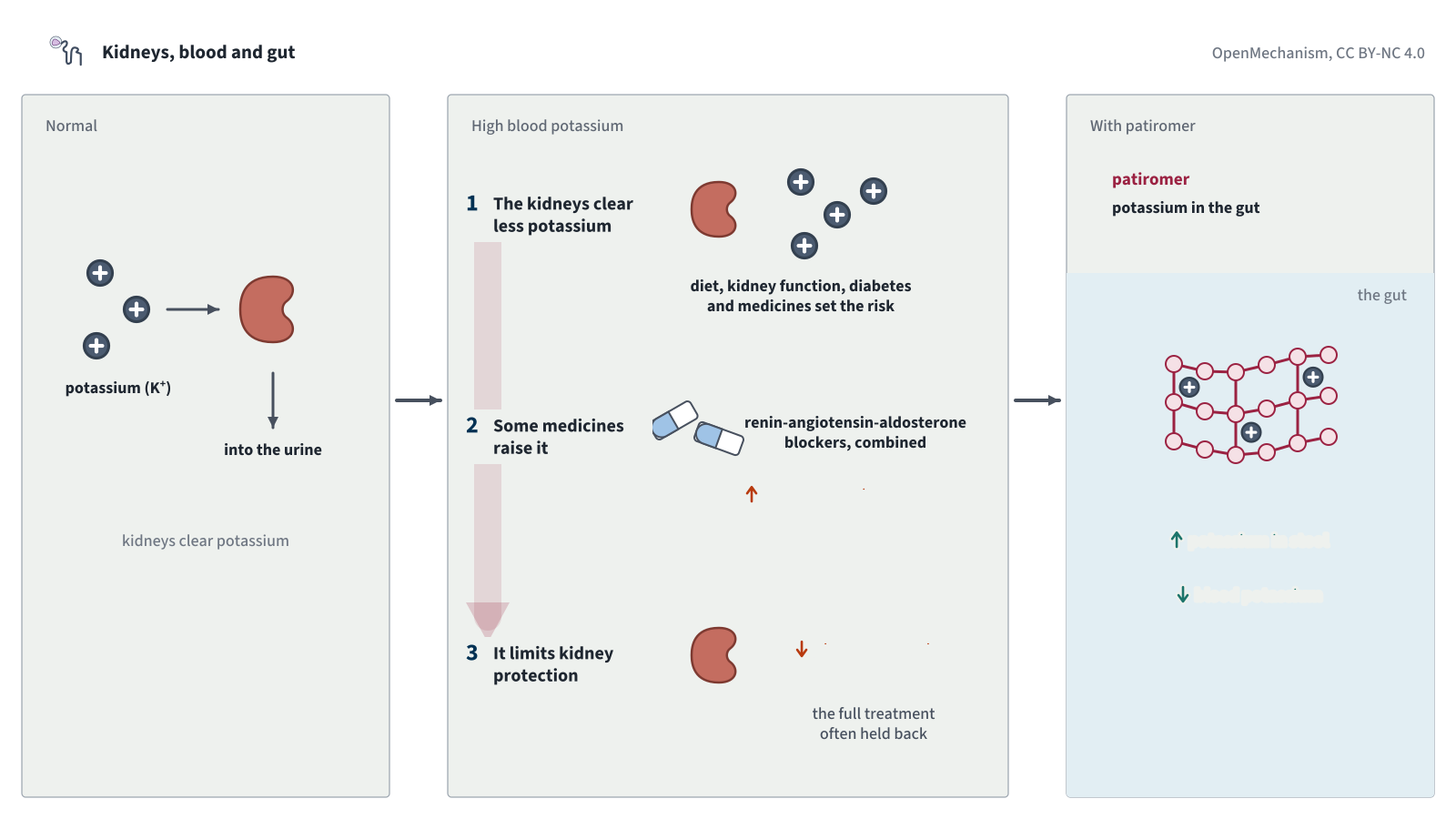
High blood potassium () depends on potassium in the diet, kidney function, conditions such as diabetes and medicines that affect potassium excretion. Combining medicines that block the renin-angiotensin-aldosterone system markedly raises the risk in chronic kidney disease, so high potassium often limits the treatment that protects the kidneys. Patiromer binds potassium in the gut.
- Where
- Kidneys, blood and gut
- Body system
- Kidney
- Medicines
- 1 medicine
For teachers: download this drawing.
What goes wrong
The kidneys clear less potassium. The risk of high potassium depends on potassium in the diet, kidney function, conditions such as diabetes and medicines that affect potassium excretion.1
What the source says
“The risk of hyperkalemia is linked to dietary potassium intake, level of kidney function, concomitant diseases that may affect potassium balance such as diabetes, and use of medications that influence potassium excretion.”
Source 1Some medicines raise it. Combining medicines that block the renin-angiotensin-aldosterone system (, angiotensin receptor blockers, or blockers) markedly raises the risk in chronic kidney disease.1
What the source says
“Dual RAAS blockade involving any combination of an angiotensin-converting enzyme inhibitor, angiotensin-receptor blocker, renin inhibition, or aldosterone-receptor blocker markedly increases the risk of hyperkalemia in patients with stage 3 or higher CKD.”
Source 1It limits kidney protection. High potassium often stops people with chronic kidney disease getting the full treatment that slows it.1
What the source says
“Hyperkalemia commonly limits optimizing treatment to slow stage 3 or higher chronic kidney disease (CKD) progression.”
Source 1
Where medicines act
- A
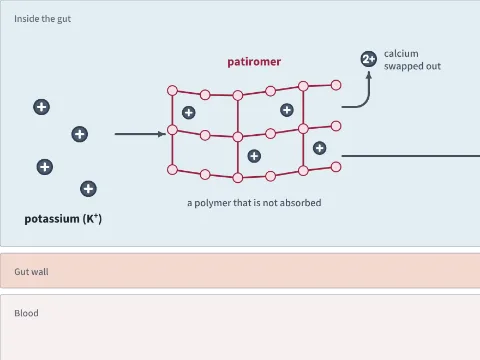
Patiromer: potassium bound in the gut
Patiromer, a non-absorbed polymer, binds potassium in the gut so more leaves in the stool and blood potassium falls.2
See also
Body system: kidney.
Can raise or cause it: spironolactone (“Concomitant administration of ALDACTONE with … drugs that can increase potassium, including ACE inhibitors, angiotensin II antagonists … may lead to severe hyperkalemia”3); finerenone (“Kerendia can cause hyperkalemia”4); captopril (“Elevations in serum potassium have been observed in some patients treated with ACE inhibitors, including captopril.”5); losartan (“Coadministration of losartan with other drugs that raise serum potassium levels may result in hyperkalemia.”6); aliskiren (“Dual blockade of the RAS with angiotensin receptor blockers, ACE inhibitors, or aliskiren is associated with increased risks of hypotension, hyperkalemia, and changes in renal function”5); and potassium chloride (“The administration of oral potassium salts to persons with normal excretory mechanisms for potassium rarely causes serious hyperkalemia. However, if excretory mechanisms are impaired, potentially fatal hyperkalemia can result”7).
Other conditions: digoxin toxicity, low blood potassium (hypokalemia), chronic kidney disease, high blood pressure, heart failure and fluid retention.
Interactions: ACE inhibitors and spironolactone.
Side effects: why insulin and albuterol can lower potassium; why trimethoprim can raise potassium; and why heparin can raise potassium.
Sources
- 1Prediction and management of hyperkalemia across the spectrum of chronic kidney diseaseLazich I, Bakris GL. Semin Nephrol 2014 (abstract). Saved copy
- 2Veltassa (patiromer): FDA label1 Indications and Usage; 12.1 Mechanism of Action. Saved copy
- 3Aldactone (spironolactone): FDA label12.3 Pharmacokinetics (Drug Interaction Studies). Saved copy
- 4Kerendia (finerenone): FDA label5.1 Hyperkalemia. Saved copy
- 5Captopril tablets: FDA labelPrecautions. Saved copy
- 6Cozaar (losartan potassium): FDA label7.1 Agents Increasing Serum Potassium. Saved copy
- 7
Notes and limits
- Patiromer acts slowly and is not an emergency treatment for life-threatening high potassium.2
Notes that apply to every page are on How to read a page.
Spotted a mistake? Report an error (hello@openmechanism.com). Since launch, every published error we fix is listed on the corrections page.
Cite this page
Tran D. High blood potassium [Internet]. OpenMechanism; 2026 [updated 2026 Oct 29; cited 2026 Oct 29]. Available from: https://openmechanism.com/conditions/high-blood-potassium