Calcitriol
The liver and then the kidney turn vitamin D into its active form, calcitriol. Failing kidneys cannot make enough, and the low blood calcium and overactive parathyroid glands that follow are a major cause of their bone disease. Calcitriol, given as a medicine, is the most active form of vitamin D at moving calcium in from the gut; its benefit appears to come from correcting the low calcium and the parathyroid overactivity.
- Acts on
- The gut and bone (its two known sites of action)
- Where
- Gut and bone
- Medicine type
- Small molecule
- Used for
- Hormones & metabolism
- Drug class
- Vitamin D and its active forms
Step 4: appears to
The calcitriol oral solution label says: The beneficial effect of calcitriol in renal osteodystrophy appears to result from correction of hypocalcemia and secondary hyperparathyroidism.
Source 1: Calcitriol oral solution: FDA label, Clinical Pharmacology (Pharmacodynamics); Indications and Usage
Clinical study: In a double-blind trial of low-dose calcitriol against placebo in 30 people with chronic kidney failure not yet on dialysis, followed for 8 months: Serum PTH, urinary cAMP excretion, and bone resorption indices decreased in the treatment group, indicating suppression of parathyroid hyperfunction.
Nordal KP, Dahl E, J Clin Endocrinol Metab 1988 (PMID 3182964)
This study was picked with a literature search and is not yet checked by our reviewer.
How it works
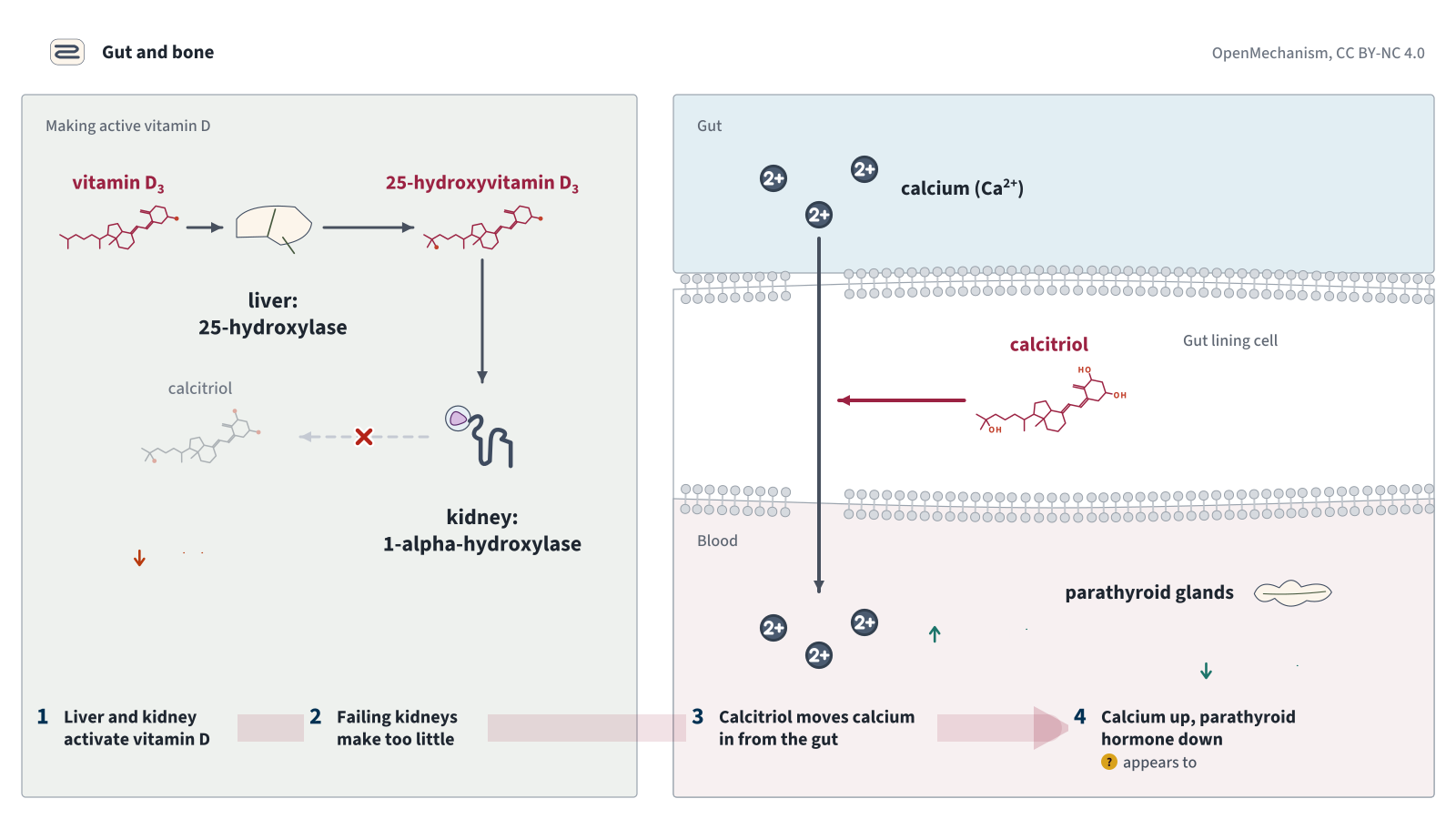
Liver and kidney activate vitamin D. Vitamin D3 must be activated before it is fully active: a 25-hydroxylase in the liver makes 25-hydroxyvitamin D3, and the kidney's 1-alpha-hydroxylase then makes 1,25-dihydroxyvitamin D3 (calcitriol), the active form.1
Failing kidneys make too little. The kidneys of people with kidney failure (uremia) cannot make enough calcitriol; the resulting low blood calcium (hypocalcemia) and secondary hyperparathyroidism are a major cause of the bone disease of kidney failure, though other substances that build up, such as aluminum, may also contribute.1
Calcitriol moves calcium in from the gut. Calcitriol is the most active known form of vitamin D3 in stimulating calcium transport across the gut; its two known sites of action are the gut and bone, and it may also act on the kidney and the parathyroid glands.1
Calcium up, parathyroid hormone down. The benefit of calcitriol in the bone disease of kidney failure appears to come from correcting low blood calcium and secondary hyperparathyroidism; it is uncertain whether it has other independent benefits.1
For teachers: download this drawing.
See also
Condition pages: chronic kidney disease, hypoparathyroidism, secondary hyperparathyroidism and X-linked hypophosphatemia.
Other vitamin D and its active forms: ergocalciferol (vitamin D2).
Body system: kidney.
Sources
- 1Calcitriol oral solution: FDA labelClinical Pharmacology (Pharmacodynamics); Indications and Usage
- 2ChEMBL CHEMBL846Target and action classification: Vitamin D receptor agonist
- 3Low dose calcitriol versus placebo in patients with predialysis chronic renal failureNordal KP, Dahl E. J Clin Endocrinol Metab 1988 (abstract)
Spotted a mistake? Report an error (hello@openmechanism.com). Since launch, every published error we fix is listed on the corrections page.
Notes and limits
- A schematic teaching drawing: not to scale, not exact structures, binding poses or a complete pathway, and not a guide to dosing, treatment or how a person will respond.
All recorded limits are on the evidence page, and notes that apply to every page are on How to read a page. Version 1.0.0, not yet medically reviewed.
Cite this page
Tran D. Calcitriol [Internet]. OpenMechanism; 2026 [updated 2026 Oct 13; cited 2026 Oct 13]. Available from: https://openmechanism.com/medicines/calcitriol