Primary aldosteronism
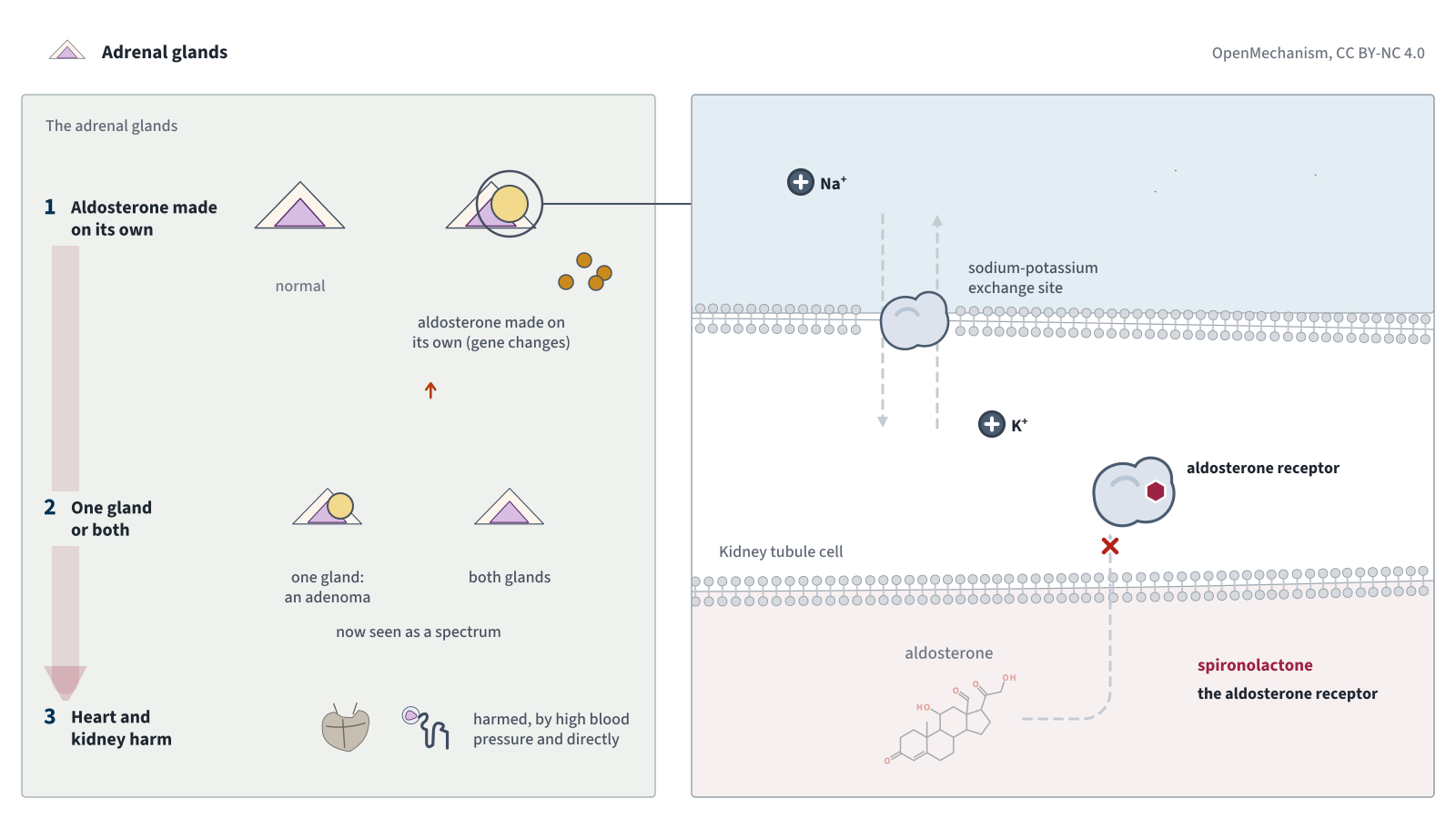
In primary aldosteronism the adrenal glands make aldosterone on their own, a common cause of high blood pressure. It comes from one gland (often an adenoma) or both, and raises the risk of heart and kidney disease. It is rarely tested for: fewer than 2% of people at risk ever are. Spironolactone blocks aldosterone's receptor.
- Where
- Adrenal glands
- Body systems
- Heart, vessels & cholesterol; Hormones & metabolism; Kidney
- Medicines
- 1 medicine
For teachers: download this drawing.
Key terms in this drawing
- aldosterone
- Aldosterone. Released by the adrenal glands, it helps the body keep sodium and fluid; angiotensin II stimulates its release.
What goes wrong
Aldosterone made on its own. The adrenal glands make on their own, driven in most adenomas by gene changes in the tumor. It is a common cause of high blood pressure.1,2
One gland or both. It was long split into one-sided disease (an aldosterone-making adenoma) and disease of both glands (bilateral hyperplasia); it is now seen as a spectrum.1,2
Heart and kidney harm. It raises the risk of heart and kidney disease, both through high blood pressure and by direct harm to organs.1
What the source says
“is a risk factor for cardiovascular and renal morbidity and mortality, via mechanisms mediated by both hypertension and direct insults to target organs.”
Source 1
Where medicines act
- A
Spironolactone: aldosterone blocked
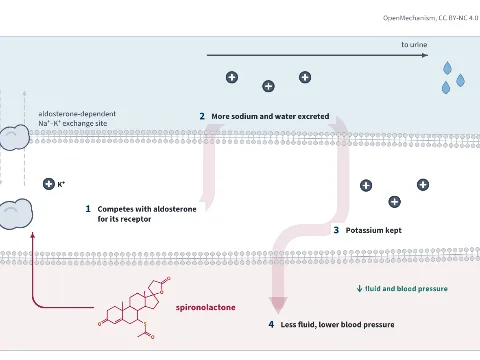
Spironolactone blocks aldosterone's receptors in the kidney tubule, so more sodium and water leave and potassium is kept. It treats primary aldosteronism, including disease of both glands; disease of both glands is treated mainly with this kind of medicine.2,3
What the source says
“Spironolactone and its active metabolites are specific pharmacologic antagonists of aldosterone, acting primarily through competitive binding of receptors at the aldosterone-dependent sodium-potassium exchange site in the distal convoluted renal tubule.”
Source 3“Long-term maintenance therapy for patients with bilateral micro or macronodular adrenal hyperplasia”
Source 3“Bilateral forms are treated mainly with mineralocorticoid receptor antagonists.”
Source 2
See also
Body systems: heart, vessels & cholesterol; hormones & metabolism; and kidney.
Other conditions: adrenal insufficiency, fluid retention, heart failure, high blood pressure and high blood potassium.
Sources
- 1Primary aldosteronism: a multidimensional syndromeTurcu AF et al. Nat Rev Endocrinol 2022 (abstract). Saved copy
- 2Diagnosis and treatment of primary aldosteronismReincke M et al. Lancet Diabetes Endocrinol 2021 (abstract). Saved copy
- 3Aldactone (spironolactone): FDA label1.4 Primary Hyperaldosteronism; 12.1 Mechanism of Action. Saved copy
Notes and limits
- It has no specific, easy-to-spot sign, so it is often missed.2
- For disease of one gland, surgery offers the possibility of cure.2
Notes that apply to every page are on How to read a page.
Spotted a mistake? Report an error (hello@openmechanism.com). Since launch, every published error we fix is listed on the corrections page.
Cite this page
Tran D. Primary aldosteronism [Internet]. OpenMechanism; 2026 [updated 2026 Oct 20; cited 2026 Oct 20]. Available from: https://openmechanism.com/conditions/primary-aldosteronism