ANCA vasculitis
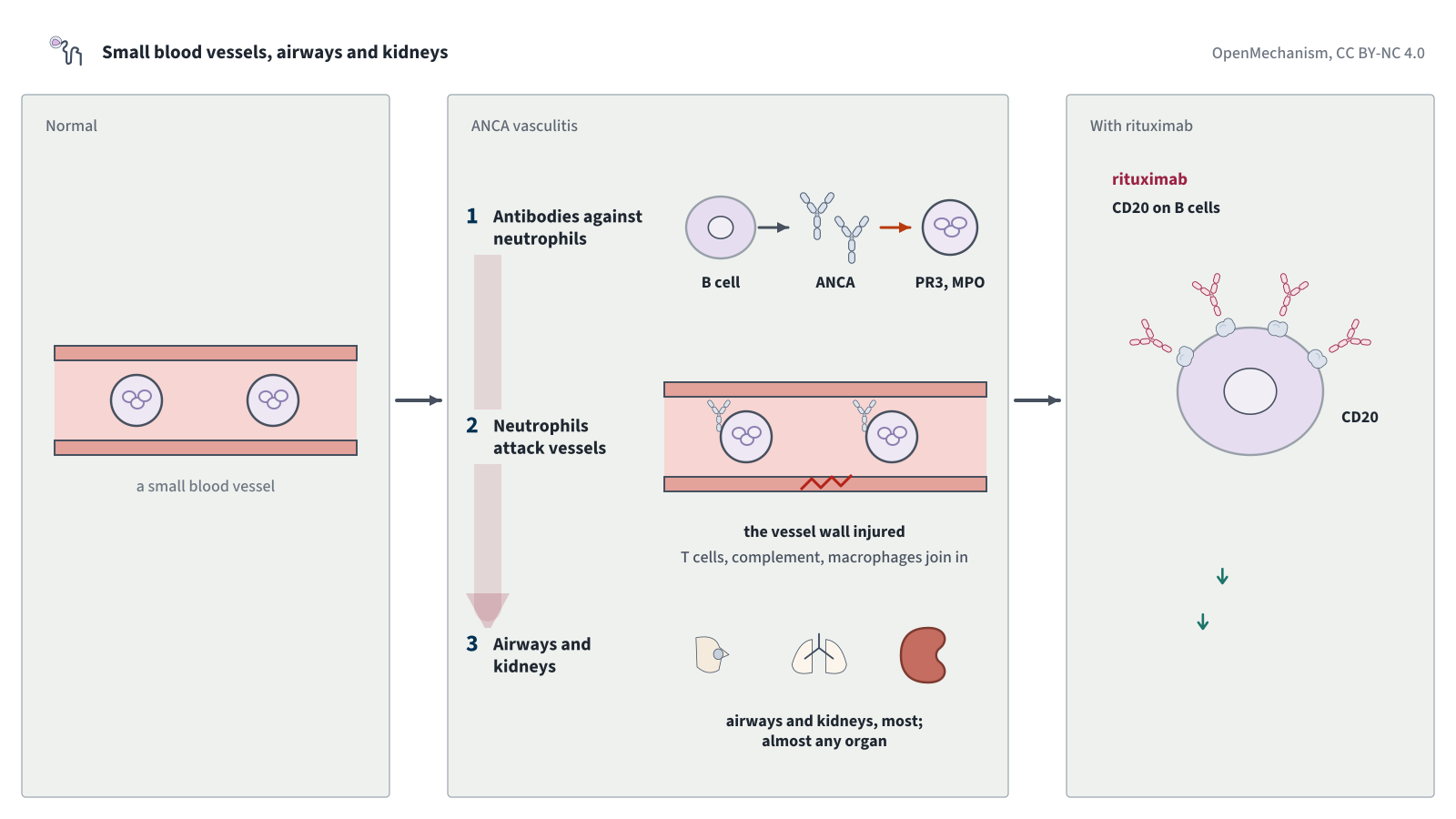
ANCA-associated vasculitis is mainly two diseases, granulomatosis with polyangiitis (GPA) and microscopic polyangiitis (MPA). The immune system loses tolerance to two neutrophil proteins; autoantibodies against them (ANCA), made by B cells, switch neutrophils on so they injure small blood vessels, hitting the airways and kidneys most often and hardest. Without treatment the outlook is poor. Rituximab removes B cells.
- Where
- Small blood vessels, airways and kidneys
- Body systems
- Immune system, Kidney, Lungs & airways
- Medicines
- 1 medicine
For teachers: download this drawing.
Key terms in this drawing (6)
- ANCA
- Antineutrophil cytoplasmic antibodies. Autoantibodies against the neutrophil proteins proteinase 3 (PR3) or myeloperoxidase (MPO); ANCA vasculitis is marked by them.
- CD20
- CD20 antigen. A molecule on the surface of B cells that rituximab targets.
- complement
- Complement. A set of blood proteins that can kill a cell an antibody has marked.
- MPO
- Myeloperoxidase. A neutrophil protein that ANCA autoantibodies can target (MPO-ANCA).
- PR3
- Proteinase 3. A neutrophil protein that ANCA autoantibodies can target (PR3-ANCA).
- T cell
- T lymphocyte. A white blood cell of the immune system.
What goes wrong
Antibodies against neutrophils. The immune system loses tolerance to two proteins of neutrophils (white blood cells), proteinase 3 () and myeloperoxidase (), and makes autoantibodies against them, called . The ANCA come from B cells.1,2
What the source says
“characterized by the development of autoantibodies to the neutrophil proteins leukocyte proteinase 3 (PR3-ANCA) or myeloperoxidase (MPO-ANCA)”
Source 1“evidence for a loss of tolerance to neutrophil proteins”
Source 1“The pathogenesis of AAV is strongly associated with B cell-derived ANCAs”
Source 2Neutrophils attack vessels. ANCA switch neutrophils on and draw them in, and they injure the vessel. , the system, monocytes and macrophages join in and keep the inflammation going, damaging organs.1,3
What the source says
“which leads to ANCA-mediated neutrophil activation, recruitment and injury, with effector T cells also involved”
Source 1“activation of the alternative complement pathway, neutrophil activation via complement receptors, and the influx of inflammatory cells, including monocytes and macrophages. These cells perpetuate inflammation and lead to organ damage.”
Source 3Airways and kidneys. The result is severe inflammation of small blood vessels (vasculitis) that can reach almost any organ. The upper and lower airways and the kidneys are hit most often and hardest; skin, eyes and nerves can be affected too.1,3
What the source says
“a group of disorders involving severe, systemic, small-vessel vasculitis”
Source 1“Although any tissue can be involved in AAV, the upper and lower respiratory tract and kidneys are most commonly and severely affected.”
Source 1“The diseases commonly affect the kidneys, lungs, upper respiratory tract, skin, eyes, and peripheral nerves.”
Source 3
Where medicines act
- A
Rituximab: B cells removed
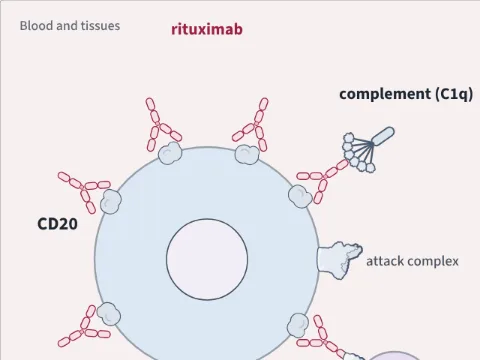
Rituximab binds on B cells and destroys them, and ANCA come from B cells. With glucocorticoids, it treats GPA and MPA in adults and children aged 2 and over, in new and in relapsing disease.2,4
What the source says
“Rituximab is a monoclonal antibody that targets the CD20 antigen expressed on the surface of pre-B and mature B-lymphocytes. Upon binding to CD20, rituximab mediates B-cell lysis.”
Source 4“Granulomatosis with Polyangiitis (GPA) (Wegener's Granulomatosis) and Microscopic Polyangiitis (MPA) in adult and pediatric patients 2 years of age and older in combination with glucocorticoids”
Source 4“RTX has been proven to be effective both in new-onset disease and in relapsing disease.”
Source 2
See also
Body systems: immune system, kidney and lungs & airways.
Other conditions: B-cell lymphomas, chronic lymphocytic leukemia, pemphigus and rheumatoid arthritis.
Side effects: why rituximab can bring hepatitis B back.
Sources
- 1ANCA-associated vasculitisKitching AR et al. Nat Rev Dis Primers 2020 (abstract). Saved copy
- 2Rituximab induction and maintenance in ANCA-associated vasculitis: state of the art and future perspectivesTreppo E et al. J Clin Med 2021 (abstract). Saved copy
- 3Diagnosis and management of ANCA-associated vasculitisKronbichler A et al. Lancet 2024 (abstract). Saved copy
- 4Rituxan (rituximab): FDA label1.4 Granulomatosis with Polyangiitis and Microscopic Polyangiitis; 12.1 Mechanism of Action. Saved copy
Notes and limits
- Treatment still relies too much on glucocorticoids, and lowering their harms is a priority.3
- How to measure disease activity and relapse risk, and how long to treat, are still uncertain.1
- Rituximab's label names two of the three forms, GPA and microscopic polyangiitis; the third, eosinophilic GPA (EGPA), is not among its uses.1,4
Notes that apply to every page are on How to read a page.
Spotted a mistake? Report an error (hello@openmechanism.com). Since launch, every published error we fix is listed on the corrections page.
Cite this page
Tran D. ANCA vasculitis [Internet]. OpenMechanism; 2026 [updated 2026 Oct 21; cited 2026 Oct 21]. Available from: https://openmechanism.com/conditions/anca-vasculitis