Polycystic kidney disease
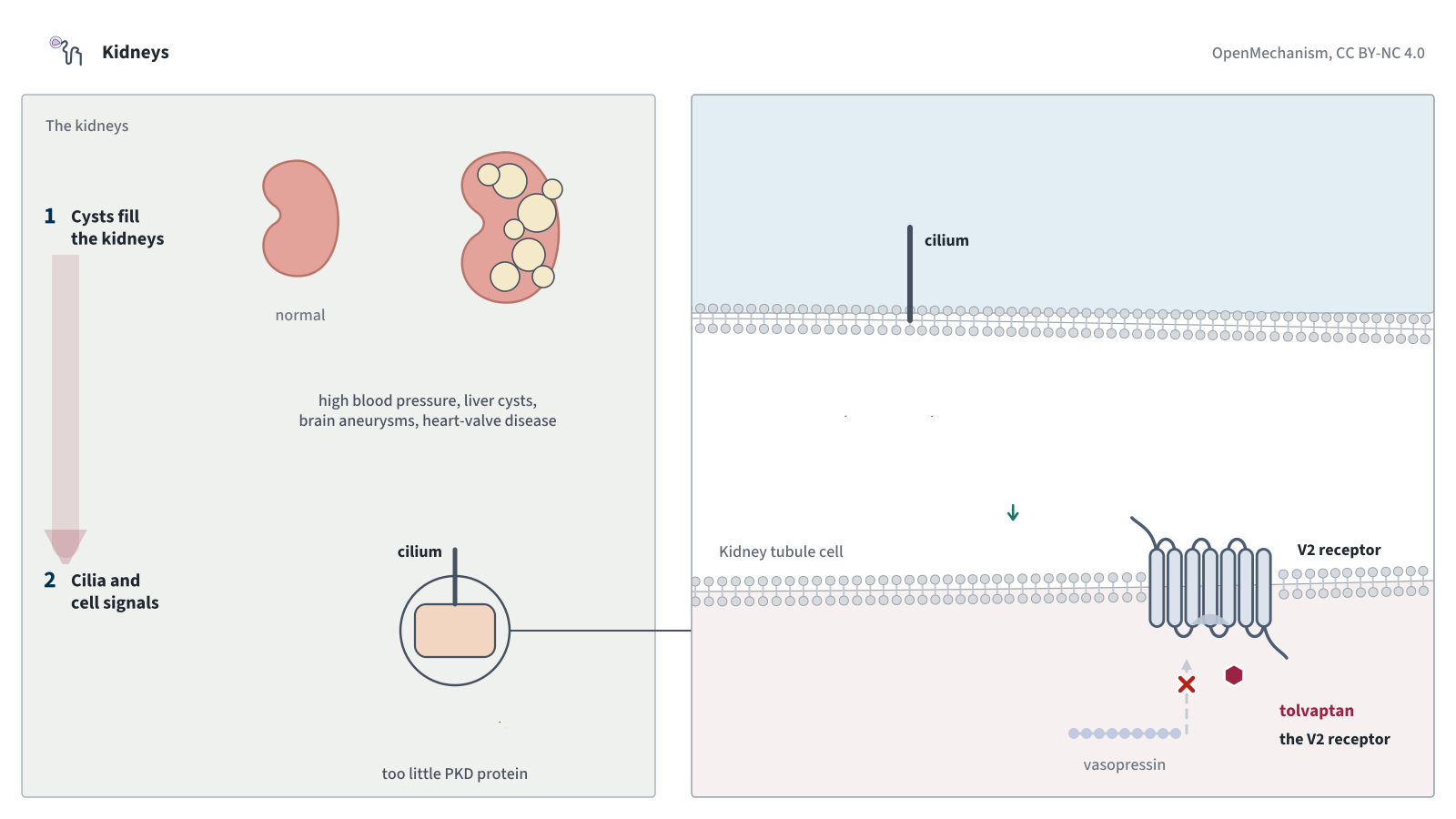
Autosomal dominant polycystic kidney disease (ADPKD) is the most common inherited kidney disease and a common cause of kidney failure: growing cysts enlarge the kidneys, with high blood pressure, liver cysts and brain aneurysms. It is a disorder of cilia, thought to disturb signals such as cAMP. Tolvaptan blocks vasopressin's V2 receptor, lowering cAMP, and slows loss of kidney function.
- Where
- Kidneys
- Body system
- Kidney
- Medicines
- 1 medicine
For teachers: download this drawing.
Key terms in this drawing
- cAMP
- Cyclic adenosine monophosphate (cyclic AMP). A signaling molecule inside cells; a rise in it activates protein kinase A.
- PKD
- Polycystic kidney disease. Polycystic kidney disease; also the name of the proteins its genes make, too little of which is thought to upset the kidney cells' balance.
- V2 receptor
- Vasopressin V2 receptor. The kidney receptor that antidiuretic hormone acts on to save water.
What goes wrong
Cysts fill the kidneys. Growing cysts fill and enlarge the kidneys. It affects the whole body too: high blood pressure, liver cysts, brain aneurysms and heart-valve disease.1
What the source says
“Multiple clinical manifestations, such as enlarged kidneys filled with growing cysts, hypertension, and multiple extrarenal complications, including liver cysts, intracranial aneurysms, and cardiac valvular disease, show that ADPKD is a systemic disorder.”
Source 1Cilia and cell signals. It is a disorder of cilia, the cell's tiny antennae. Too little protein is thought to upset the cell's balance and signals such as .2
What the source says
“are cilia-related disorders and the two main forms of monogenic cystic kidney diseases.”
Source 2“A reduced 'dosage' of PKD proteins is thought to disturb cell homeostasis and converging signalling pathways”
Source 2“cAMP, mechanistic target of rapamycin, WNT, vascular endothelial growth factor and Hippo signalling”
Source 2
Where medicines act
- A
Tolvaptan: vasopressin's V2 receptor blocked
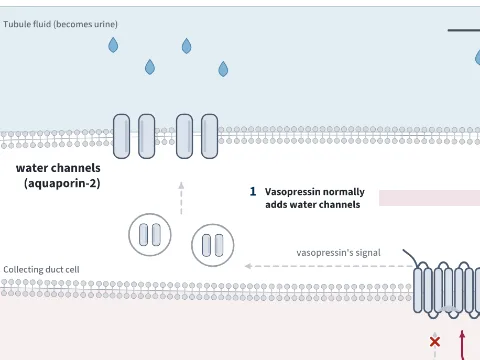
Tolvaptan blocks vasopressin's in the kidney, which lowers cAMP. It slows the loss of kidney function in adults at risk of fast-progressing ADPKD.3
What the source says
“Decreased binding of vasopressin to the V 2 -receptor in the kidney lowers adenylate cyclase activity resulting in a decrease in intracellular adenosine 3′, 5′-cyclic monophosphate (cAMP) concentrations.”
Source 3“Tolvaptan tablets are indicated to slow kidney function decline in adults at risk of rapidly progressing autosomal dominant polycystic kidney disease (ADPKD).”
Source 3
See also
Body system: kidney.
Other conditions: low blood sodium.
Sources
- 1Autosomal dominant polycystic kidney diseaseCornec-Le Gall E et al. Lancet 2019 (abstract). Saved copy
- 2Polycystic kidney diseaseBergmann C et al. Nat Rev Dis Primers 2018 (abstract). Saved copy
- 3Tolvaptan tablets (for ADPKD): FDA label1 Indications and Usage; 12.1 Mechanism of Action. Saved copy
Notes and limits
- Many questions about how the cysts form remain open.2
Notes that apply to every page are on How to read a page.
Spotted a mistake? Report an error (hello@openmechanism.com). Since launch, every published error we fix is listed on the corrections page.
Cite this page
Tran D. Polycystic kidney disease [Internet]. OpenMechanism; 2026 [updated 2026 Oct 16; cited 2026 Oct 16]. Available from: https://openmechanism.com/conditions/polycystic-kidney-disease