Torsemide
Torsemide is almost all bound to protein in the blood, so it reaches the tubule fluid mainly by being secreted in the proximal tubule. From inside the tubule it blocks the in the thick ascending limb of the loop of Henle, so more sodium, chloride and water leave in the urine. In trials it reduced weight and swelling in heart failure, and it lowers blood pressure.
- Acts on
- The Na⁺/K⁺/2Cl⁻ carrier in the thick ascending limb of the loop of Henle
- Where
- Kidney: loop of Henle
- Medicine type
- Small molecule
- Used for
- Heart & circulation
- Drug class
- Diuretics, Loop diuretics
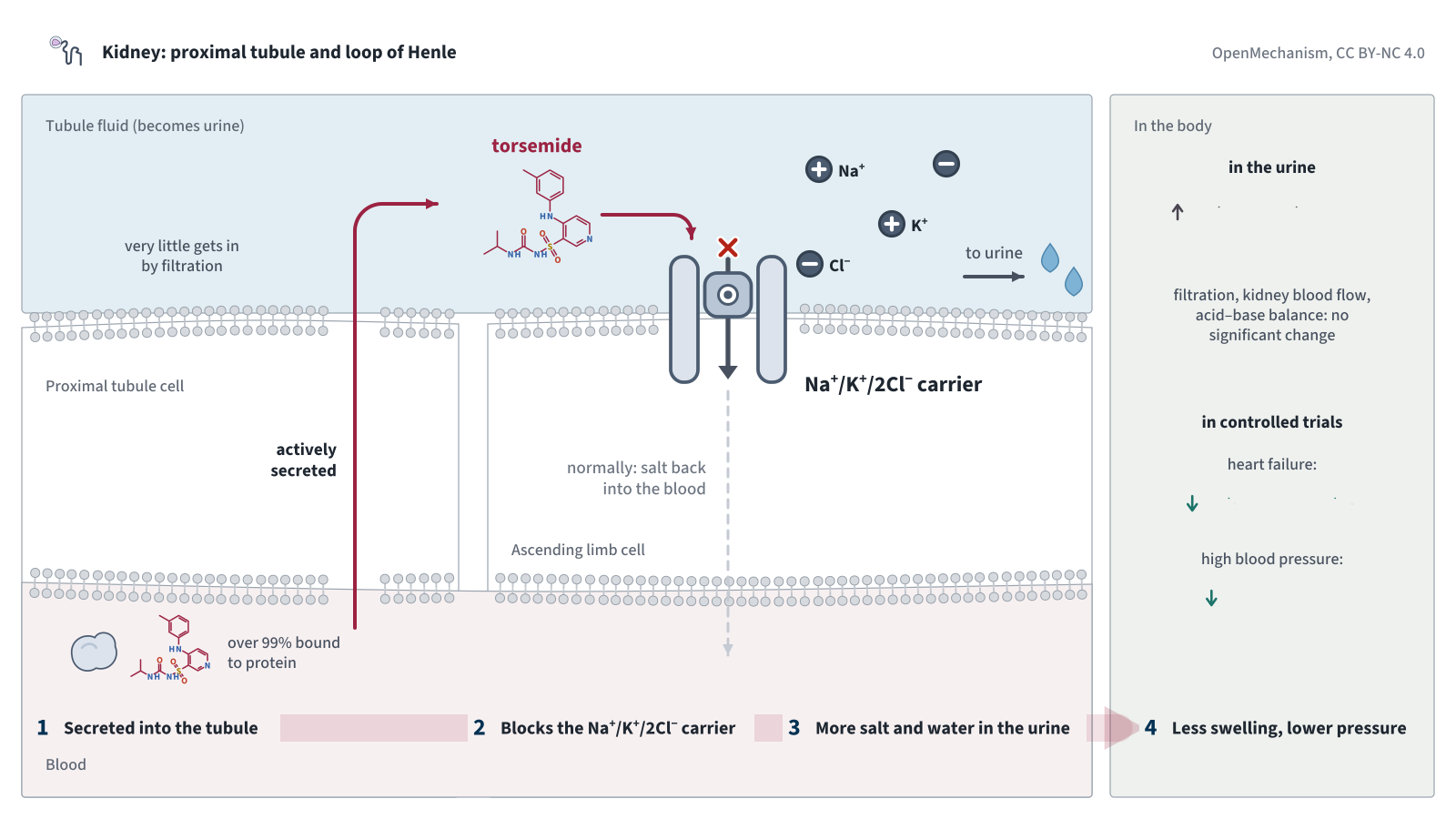
Key terms in this drawing
- NKCC2
- Sodium-potassium-chloride cotransporter 2. A carrier in the loop of Henle, in the kidney, that moves sodium, potassium and chloride together; furosemide blocks it.
How it works
Secreted into the tubule. More than 99% of torsemide in the blood is bound to plasma protein, so very little enters the tubule fluid by filtration. Most of what reaches the urine is actively secreted into it by the proximal tubules.1
Blocks the Na⁺/K⁺/2Cl⁻ carrier. Micropuncture studies in animals showed that torsemide acts from within the lumen of the thick ascending limb of the loop of Henle, where it inhibits the Na⁺/K⁺/2Cl⁻ carrier; clinical pharmacology studies confirmed this site in humans, and effects in other parts of the have not been shown. So its effect follows the rate it is excreted in the urine more closely than its level in the blood.1
More salt and water in the urine. Torsemide increases the excretion of sodium, chloride and water in the urine, without significantly changing the filtration rate, kidney blood flow or acid-base balance. Taken by mouth, diuresis starts within 1 hour, peaks in the first or second hour and lasts about 6 to 8 hours.1
Less swelling, lower pressure. In controlled trials in heart failure, people taking torsemide had greater reductions in weight and edema (swelling) than people taking placebo; in controlled studies in essential hypertension, torsemide lowered blood pressure.1
For teachers: download this drawing.
See also
Condition pages: fluid retention, heart failure and high blood pressure.
Other diuretics: amiloride, chlorthalidone, finerenone, furosemide, hydrochlorothiazide, spironolactone and tolvaptan.
Body systems: kidney; and heart, vessels & cholesterol.
Sources
- 1Torsemide tablets (Aurobindo): FDA label12.1 Mechanism of Action; 12.2 Pharmacodynamics; 12.3 Pharmacokinetics
- 2ChEMBL CHEMBL1148Target and action classification: Sodium-(potassium)-chloride cotransporter 2 inhibitor
Spotted a mistake? Report an error (hello@openmechanism.com). Since launch, every published error we fix is listed on the corrections page.
Notes and limits
- A schematic teaching drawing: not to scale, not exact structures, binding poses or a complete pathway, and not a guide to dosing, treatment or how a person will respond.
All recorded limits are on the evidence page, and notes that apply to every page are on How to read a page. Version 1.0.0, not yet medically reviewed.
Cite this page
Tran D. Torsemide [Internet]. OpenMechanism; 2026 [updated 2026 Oct 11; cited 2026 Oct 11]. Available from: https://openmechanism.com/medicines/torsemide