Atypical hemolytic uremic syndrome (aHUS)
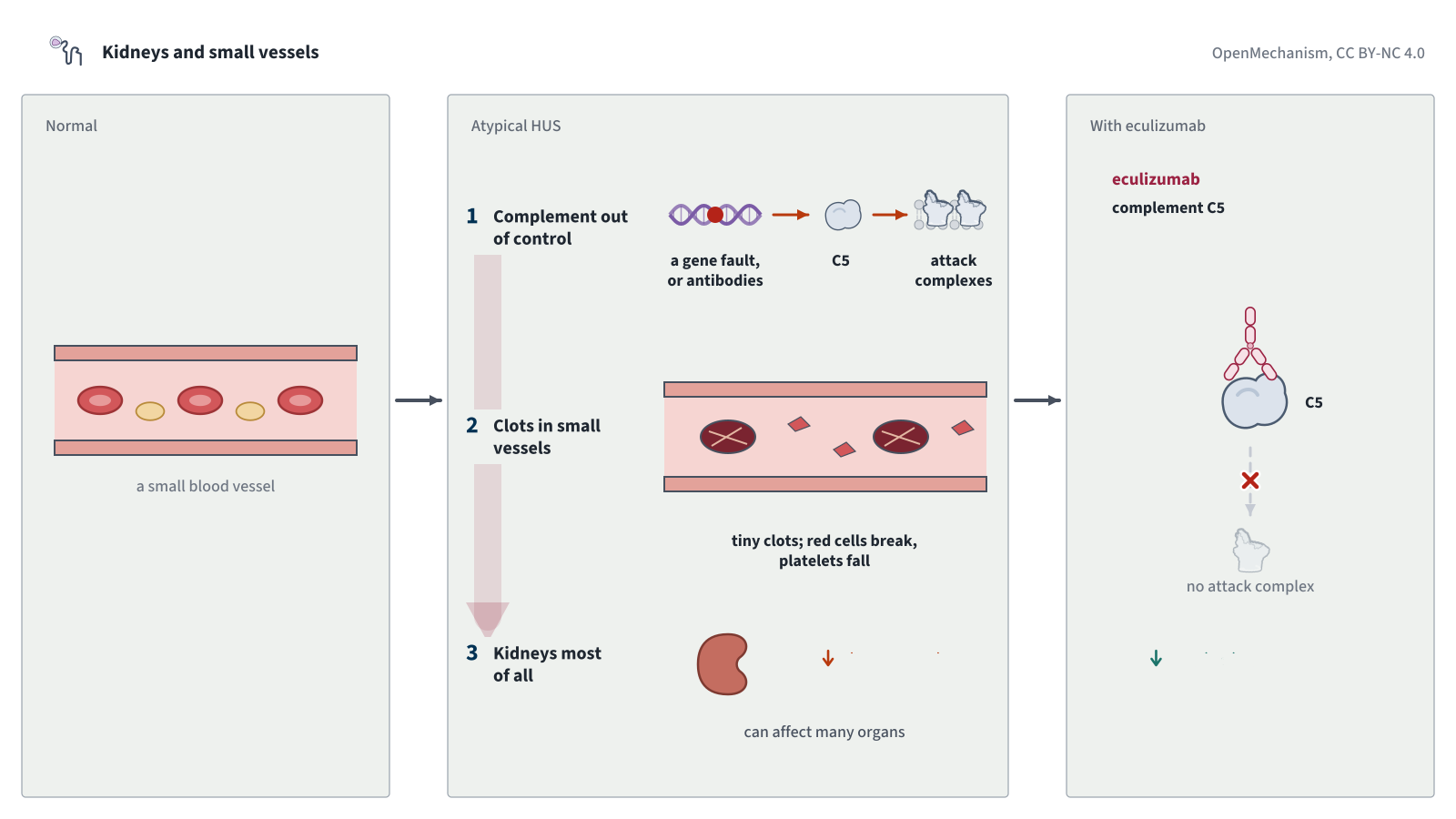
In atypical hemolytic uremic syndrome an inherited fault (or antibodies) in the complement system's alternative pathway lets complement run out of control. Tiny clots form in small vessels, breaking red cells and using up platelets, and the kidneys are harmed most. Eculizumab blocks complement protein C5 and stops the clotting in small vessels.
- Where
- Kidneys and small vessels
- Body systems
- Blood & clotting, Kidney, Immune system
- Medicines
- 1 medicine
For teachers: download this drawing.
Key terms in this drawing
- C5
- Complement component 5. A complement protein; when split, part of it helps build the membrane attack complex.
- complement
- Complement. A set of blood proteins that can kill a cell an antibody has marked.
- HUS
- Hemolytic uremic syndrome. A disease of small blood vessels in which red blood cells break up, platelets fall and the kidneys are injured; atypical HUS (aHUS) is a rare form.
What goes wrong
Complement out of control. A genetic fault in the alternative pathway, or antibodies against complement factors, over-activates complement and forms clots in small vessels.1
What the source says
“This uncommon disorder is caused by a genetic abnormality in the complement alternative pathway resulting in over-activation of the complement system and formation of microvascular thrombi.”
Source 1“Abnormalities of the complement pathway may be in the form of mutations in key complement genes or autoantibodies against specific complement factors.”
Source 1Clots in small vessels. It is a rare form of clotting in small vessels (thrombotic microangiopathy): red cells break, platelets fall and the kidneys fail.1
What the source says
“Atypical hemolytic uremic syndrome (aHUS), a rare variant of thrombotic microangiopathy, is characterized by microangiopathic hemolytic anemia, thrombocytopenia, and renal impairment.”
Source 1Kidneys most of all. It harms the kidneys most but can affect many organs, with a high risk of illness and death.1
Where medicines act
- A
Eculizumab: complement C5 blocked
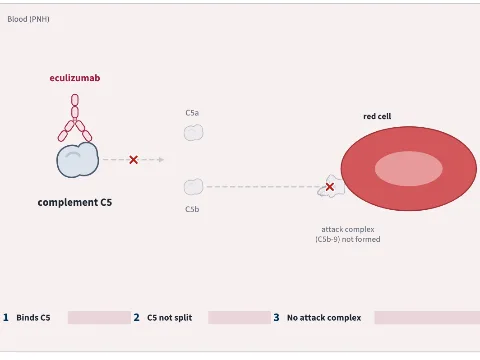
Eculizumab binds complement protein so the cannot form. In it stops complement-driven clotting in small vessels.2
What the source says
“is a monoclonal antibody that specifically binds to the complement protein C5 with high affinity, thereby inhibiting its cleavage to C5a and C5b and preventing the generation of the terminal complement complex C5b-9.”
Source 2“the treatment of patients with atypical hemolytic uremic syndrome (aHUS) to inhibit complement-mediated thrombotic microangiopathy.”
Source 2
See also
Body systems: blood & clotting, kidney and immune system.
Other conditions: paroxysmal nocturnal hemoglobinuria, myasthenia gravis and neuromyelitis optica (NMOSD).
Side effects: why eculizumab raises the risk of meningococcal infections.
Sources
- 1Atypical hemolytic-uremic syndrome: an update on pathophysiology, diagnosis, and treatmentRaina R et al. Ther Apher Dial 2019 (abstract). Saved copy
- 2Soliris (eculizumab): FDA label1 Indications and Usage; 12.1 Mechanism of Action. Saved copy
- 3The complement membrane attack complex (C5b-9) in its open form (cryo-EM)PDB 6H03; Menny, A. et al. Nat Commun 2018;9:5316. The attack complex outline in the drawing is traced from this structure. Saved copy
Notes and limits
- The eculizumab label says it is not for HUS caused by Shiga-toxin E. coli.2
Notes that apply to every page are on How to read a page.
Spotted a mistake? Report an error (hello@openmechanism.com). Since launch, every published error we fix is listed on the corrections page.
Cite this page
Tran D. Atypical hemolytic uremic syndrome (aHUS) [Internet]. OpenMechanism; 2026 [updated 2026 Nov 18; cited 2026 Nov 18]. Available from: https://openmechanism.com/conditions/atypical-hus