Secondary hyperparathyroidism
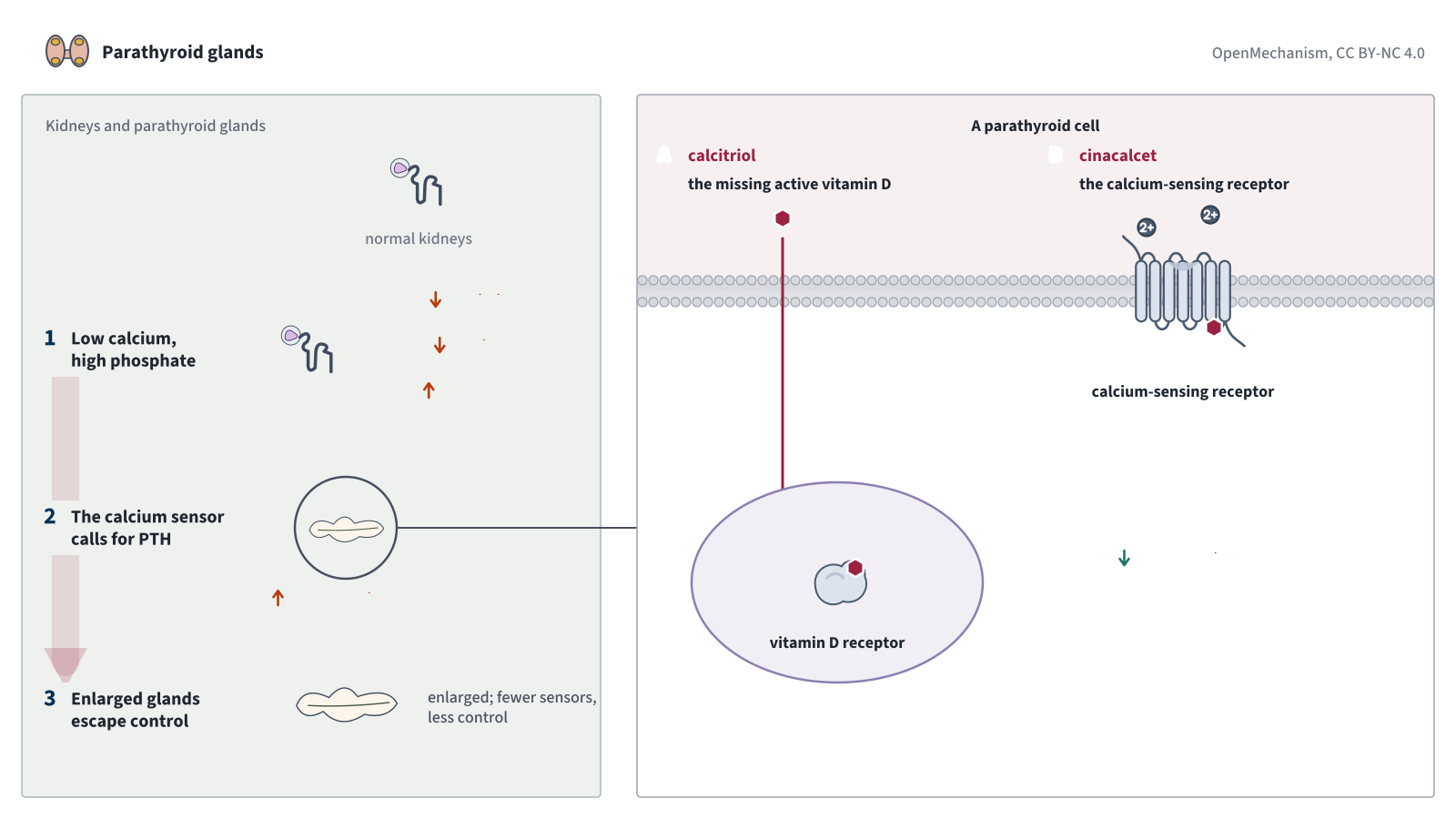
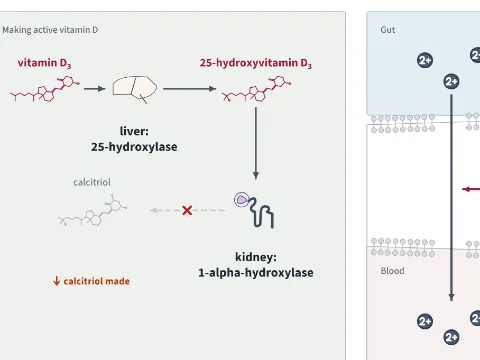
In chronic kidney disease, failing kidneys make too little calcitriol (active vitamin D); calcium falls and phosphate rises, driving the parathyroid glands to release more parathyroid hormone and grow: secondary hyperparathyroidism. Enlarged glands carry fewer calcium-sensing and vitamin D receptors, so calcium and calcitriol may control them less. Calcitriol replaces the missing hormone; cinacalcet makes the calcium sensor more sensitive.
- Where
- Parathyroid glands
- Body systems
- Kidney, Hormones & metabolism
- Medicines
- 2 medicines
For teachers: download this drawing.
What goes wrong
Low calcium, high phosphate. In chronic kidney disease, low calcitriol and failing kidneys bring low calcium and high phosphate, the main drivers of extra parathyroid hormone and of parathyroid cells multiplying.1
What the source says
“Major drivers of PTH hypersecretion and parathyroid cell proliferation are the hypocalcemia and hyperphosphatemia that develop in chronic kidney disease patients with secondary hyperparathyroidism (SHPT) as a result of low calcitriol levels and decreased kidney function.”
Source 1The calcium sensor calls for PTH. The parathyroid's calcium-sensing receptor drives the extra hormone made in answer to low calcium.1
What the source says
“Increased PTH production in response to systemic hypocalcemia is mediated by the calcium-sensing receptor (CaR).”
Source 1Enlarged glands escape control. As the glands enlarge, they carry fewer calcium-sensing and vitamin D receptors, which may leave calcium and calcitriol less able to control the hormone.1
What the source says
“as SHPT progresses, reduced expression of CaRs and vitamin D receptors (VDRs) in hyperplastic parathyroid glands may limit the ability of calcium and calcitriol to regulate PTH secretion.”
Source 1
Where medicines act
- A
Calcitriol: the missing active vitamin D
Calcitriol is used for secondary hyperparathyroidism and its bone disease in moderate to severe chronic kidney failure before dialysis.2
What the source says
“Calcitriol is indicated in the management of secondary hyperparathyroidism and resultant metabolic bone disease in patients with moderate to severe chronic renal failure (Ccr 15 to 55 mL/min) not yet on dialysis.”
Source 2 - B
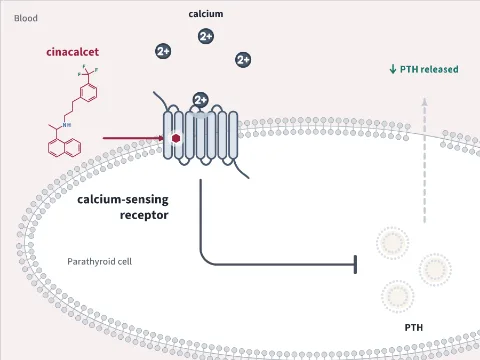
Cinacalcet: the calcium sensor made more sensitive
Cinacalcet makes the calcium-sensing receptor more sensitive to calcium, so less parathyroid hormone is made; it treats secondary hyperparathyroidism in chronic kidney disease on dialysis.3
What the source says
“Cinacalcet, the active ingredient in Sensipar, is a calcimimetic agent that directly lowers PTH levels by increasing the sensitivity of the calcium-sensing receptor to activation by extracellular calcium.”
Source 3“Secondary Hyperparathyroidism (HPT) in adult patients with chronic kidney disease (CKD) on dialysis.”
Source 3
See also
Body systems: kidney and hormones & metabolism.
Zoom in: calcium and the parathyroid glands.
Related medicines: sevelamer.
Other conditions: chronic kidney disease, high calcium from cancer, primary hyperparathyroidism, high phosphate on dialysis, hypoparathyroidism and X-linked hypophosphatemia.
Sources
- 1The calcium-sensing receptor: a key factor in the pathogenesis of secondary hyperparathyroidismRodriguez M et al. Am J Physiol Renal Physiol 2005 (abstract). Saved copy
- 2Calcitriol capsules: FDA labelIndications and Usage. Saved copy
- 3Sensipar (cinacalcet): FDA label1 Indications and Usage; 12.1 Mechanism of Action. Saved copy
Notes and limits
- Vitamin D treatment often works less well as the disease goes on, and it can raise calcium and phosphate, with a risk of calcium deposits in blood vessels.1
Notes that apply to every page are on How to read a page.
Spotted a mistake? Report an error (hello@openmechanism.com). Since launch, every published error we fix is listed on the corrections page.
Cite this page
Tran D. Secondary hyperparathyroidism [Internet]. OpenMechanism; 2026 [updated 2026 Oct 16; cited 2026 Oct 16]. Available from: https://openmechanism.com/conditions/secondary-hyperparathyroidism