Bedwetting (nocturnal enuresis)
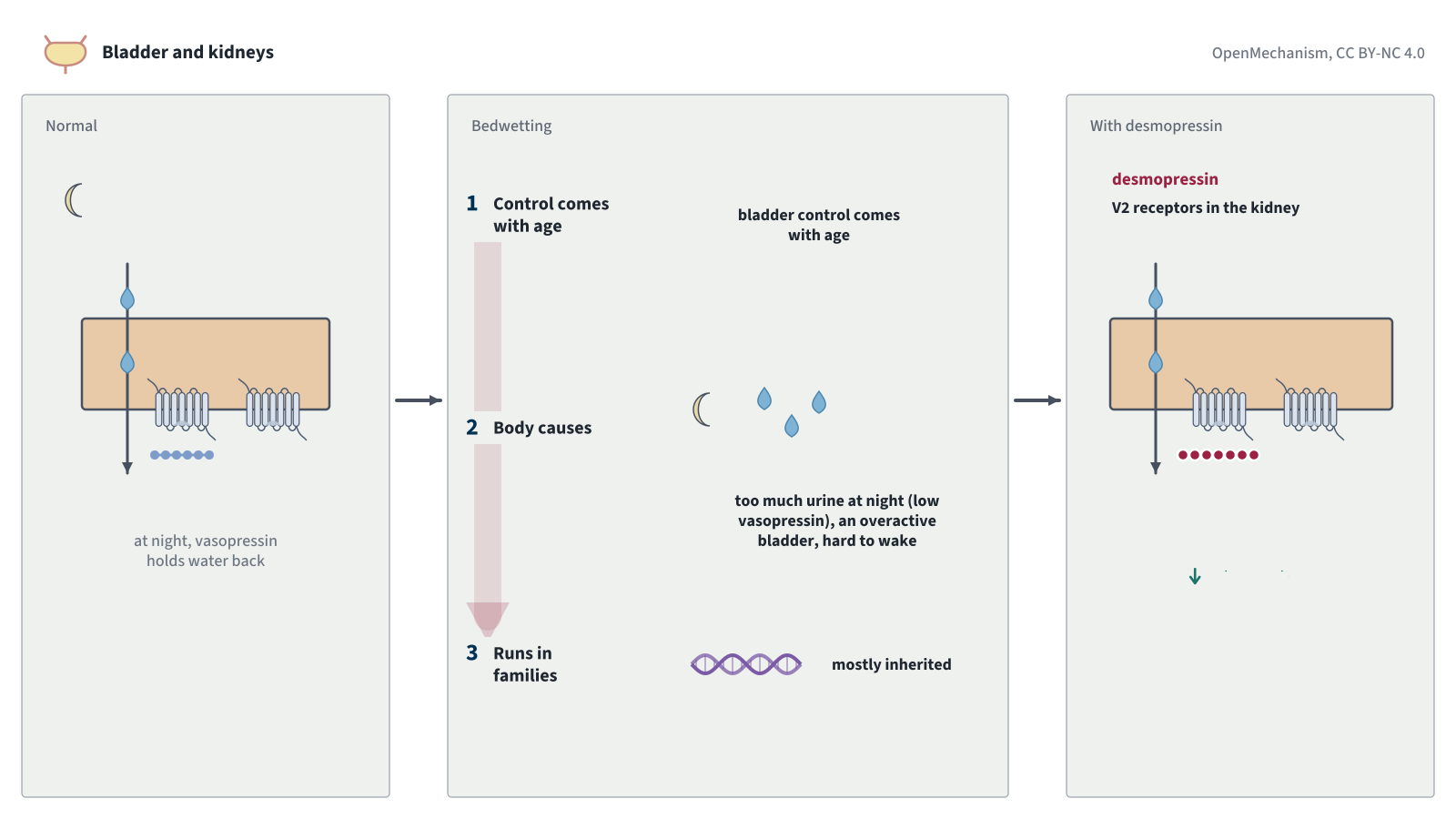
Bedwetting was once seen as a psychiatric problem; body causes are now known to matter most: too much urine at night (often from too little vasopressin), an overactive bladder at night and being hard to wake. It usually runs in families. Desmopressin, a man-made vasopressin, helps the kidney keep water so less urine is made at night.
- Where
- Bladder and kidneys
- Body systems
- Bladder & reproductive organs, Kidney
- Medicines
- 1 medicine
For teachers: download this drawing.
Key terms in this drawing
- V2 receptor
- Vasopressin V2 receptor. The kidney receptor that antidiuretic hormone acts on to save water.
What goes wrong
Control comes with age. Young children empty the bladder without control; voluntary control comes at about age 3 to 5.1
What the source says
“Micturition occurs involuntarily in infants and young children until the age of 3 to 5 years, after which it is regulated voluntarily.”
Source 1Body causes. Bedwetting was once seen as mainly psychiatric. Now too much urine at night (from too little vasopressin), an overactive bladder at night and being hard to wake are known to play a crucial role.2
Runs in families. In most cases it is inherited.2
What the source says
“It has also become clear that enuresis is inherited in the majority of cases”
Source 2
Where medicines act
- A
Desmopressin: less urine at night
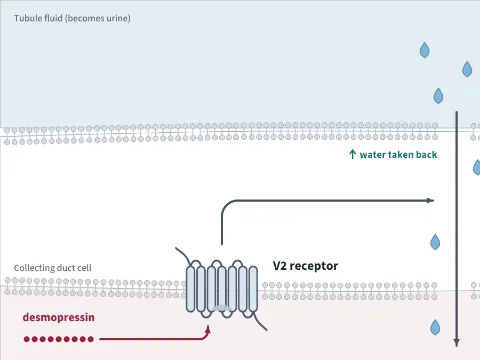
Desmopressin is a man-made version of vasopressin, the body's . It acts on so the kidney takes back more water and makes less urine. Its tablets are used for bedwetting.3,4
What the source says
“a synthetic analogue of the natural pituitary hormone 8-arginine vasopressin (ADH), an antidiuretic hormone affecting renal water conservation.”
Source 3“The antidiuretic effects of desmopressin acetate are mediated by stimulation of vasopressin 2 (V2) receptors, thereby increasing water re-absorption in the kidney, and hence reducing urine production.”
Source 4“Desmopressin Acetate Tablets are indicated for the management of primary nocturnal enuresis.”
Source 3
See also
Body systems: bladder & reproductive organs and kidney.
Other conditions: diabetes insipidus, hemophilia A, von Willebrand disease and urinary tract infections.
Sources
- 1Neural control of the lower urinary tractde Groat WC et al. Compr Physiol 2015 (abstract). Saved copy
- 2Pathogenesis of enuresis: towards a new understandingNevéus T. Int J Urol 2017 (abstract). Saved copy
- 3Desmopressin acetate tablets: FDA labelIndications and Usage; Description. Saved copy
- 4DDAVP (desmopressin) injection: FDA label12.1 Mechanism of Action. Saved copy
Notes and limits
- Too much urine at night is not always due to too little vasopressin.2
Notes that apply to every page are on How to read a page.
Spotted a mistake? Report an error (hello@openmechanism.com). Since launch, every published error we fix is listed on the corrections page.
Cite this page
Tran D. Bedwetting (nocturnal enuresis) [Internet]. OpenMechanism; 2026 [updated 2026 Oct 16; cited 2026 Oct 16]. Available from: https://openmechanism.com/conditions/bedwetting