Low blood sodium
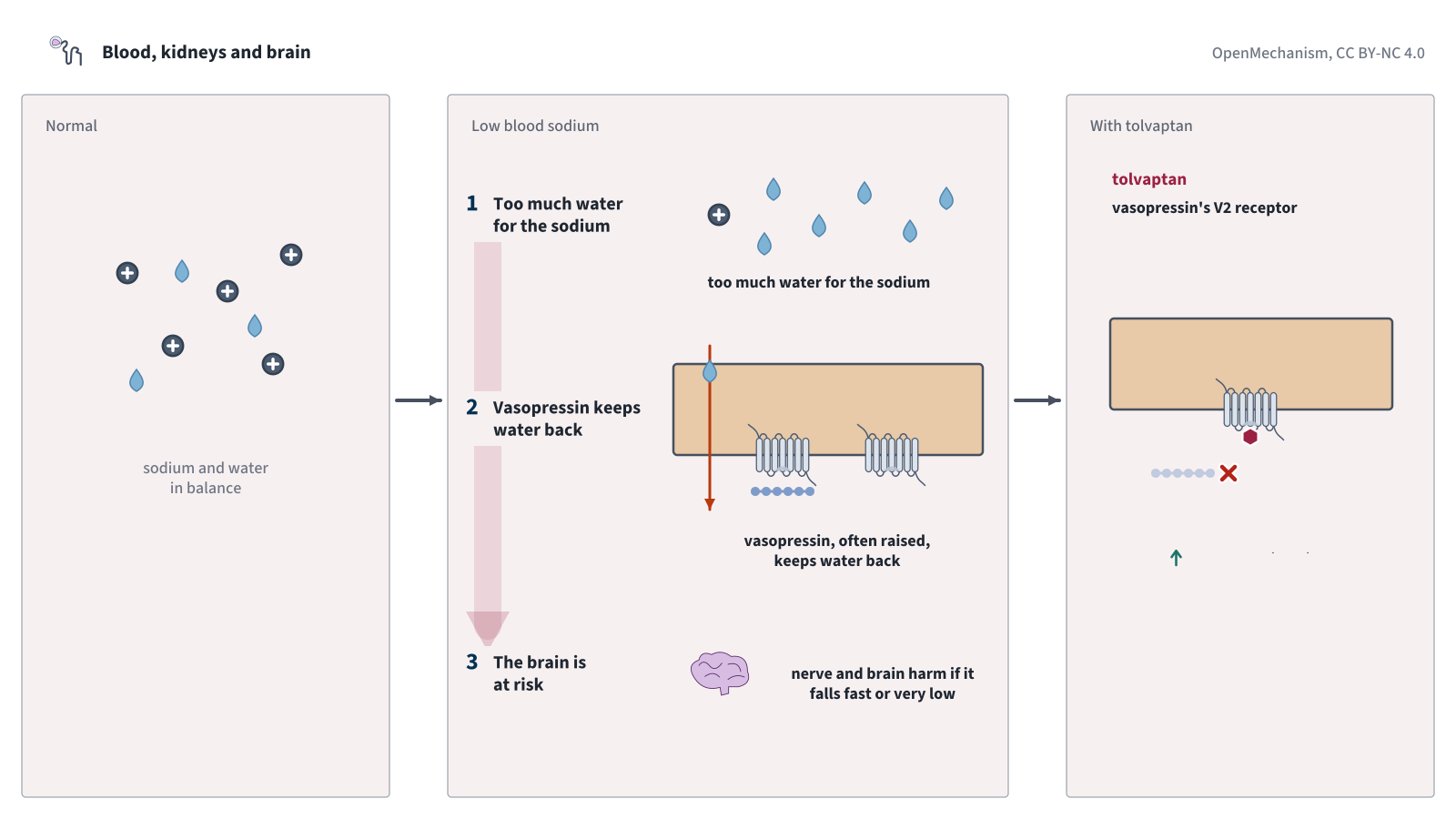
Low blood sodium (hyponatremia) is the most common electrolyte problem in hospital. Most is dilutional: too much water for the sodium, because vasopressin (AVP) is not switched off or because of fluid-holding conditions such as heart failure. Falling fast or very low, it can harm the brain. Tolvaptan blocks vasopressin's V2 receptor so the kidneys excrete more free water.
- Where
- Blood, kidneys and brain
- Body system
- Kidney
- Medicines
- 1 medicine
For teachers: download this drawing.
Key terms in this drawing
- V2 receptor
- Vasopressin V2 receptor. The kidney receptor that antidiuretic hormone acts on to save water.
What goes wrong
Too much water for the sodium. Most low blood sodium is dilutional: too much water for the sodium, either because vasopressin (AVP) is not switched off or because of fluid-holding conditions such as heart failure.1
What the source says
“Hypotonic dilutional hyponatremia is the most common form of this disorder, which may present as euvolemic [e.g., due to failure to suppress secretion of arginine vasopressin (AVP)] or hypervolemic (due to edema-forming conditions such as heart failure).”
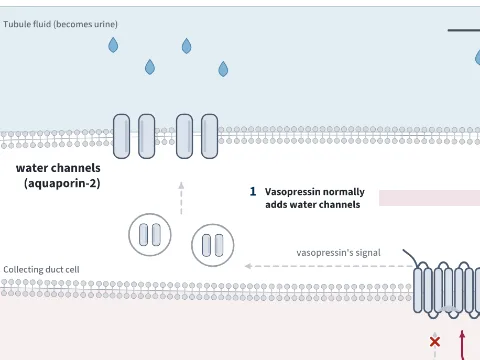
Source 1Vasopressin keeps water back. Vasopressin, which regulates the body's water balance, is often raised in these kinds of low blood sodium.1
What the source says
“Because AVP, which is intimately involved in regulating osmolar homeostasis, is often elevated in patients with hypervolemic and euvolemic hyponatremia”
Source 1The brain is at risk. Low blood sodium is common in hospital and linked to more deaths; serious nerve and brain complications can follow if it develops too fast or falls below 120 mEq/L.1
What the source says
“Hyponatremia is the most common electrolyte abnormality in hospitalized patients and is associated with increased mortality, morbidity, and longer hospital stays.”
Source 1“Serious neurologic complications may ensue when hyponatremia develops too rapidly or the serum sodium concentration ([Na(+)]) falls below 120 mEq/l.”
Source 1
Where medicines act
- A
Tolvaptan: vasopressin's V2 receptor blocked
Tolvaptan blocks the vasopressin , so the kidneys excrete more free water (aquaresis); it treats clinically significant low blood sodium with normal or high body fluid, including heart failure and SIADH.2
What the source says
“Tolvaptan is a selective vasopressin V 2 -receptor antagonist”
Source 2“cause an increase in urine water excretion that results in an increase in free water clearance (aquaresis)”
Source 2“including patients with heart failure and Syndrome of Inappropriate Antidiuretic Hormone (SIADH).”
Source 2
See also
Body system: kidney.
Other conditions: polycystic kidney disease.
Side effects: why SSRIs can lower sodium.
Sources
- 1Mechanisms, risks, and new treatment options for hyponatremiaGhali JK. Cardiology 2008 (abstract). Saved copy
- 2Samsca (tolvaptan): FDA label1 Indications and Usage; 12.1 Mechanism of Action. Saved copy
Notes and limits
- Some low blood sodium comes from losing sodium (hypovolemic); the tolvaptan label lists it for clinically significant low blood sodium of the other kinds, with high or normal body fluid (hypervolemic and euvolemic).1,2
Notes that apply to every page are on How to read a page.
Spotted a mistake? Report an error (hello@openmechanism.com). Since launch, every published error we fix is listed on the corrections page.
Cite this page
Tran D. Low blood sodium [Internet]. OpenMechanism; 2026 [updated 2026 Nov 18; cited 2026 Nov 18]. Available from: https://openmechanism.com/conditions/low-blood-sodium