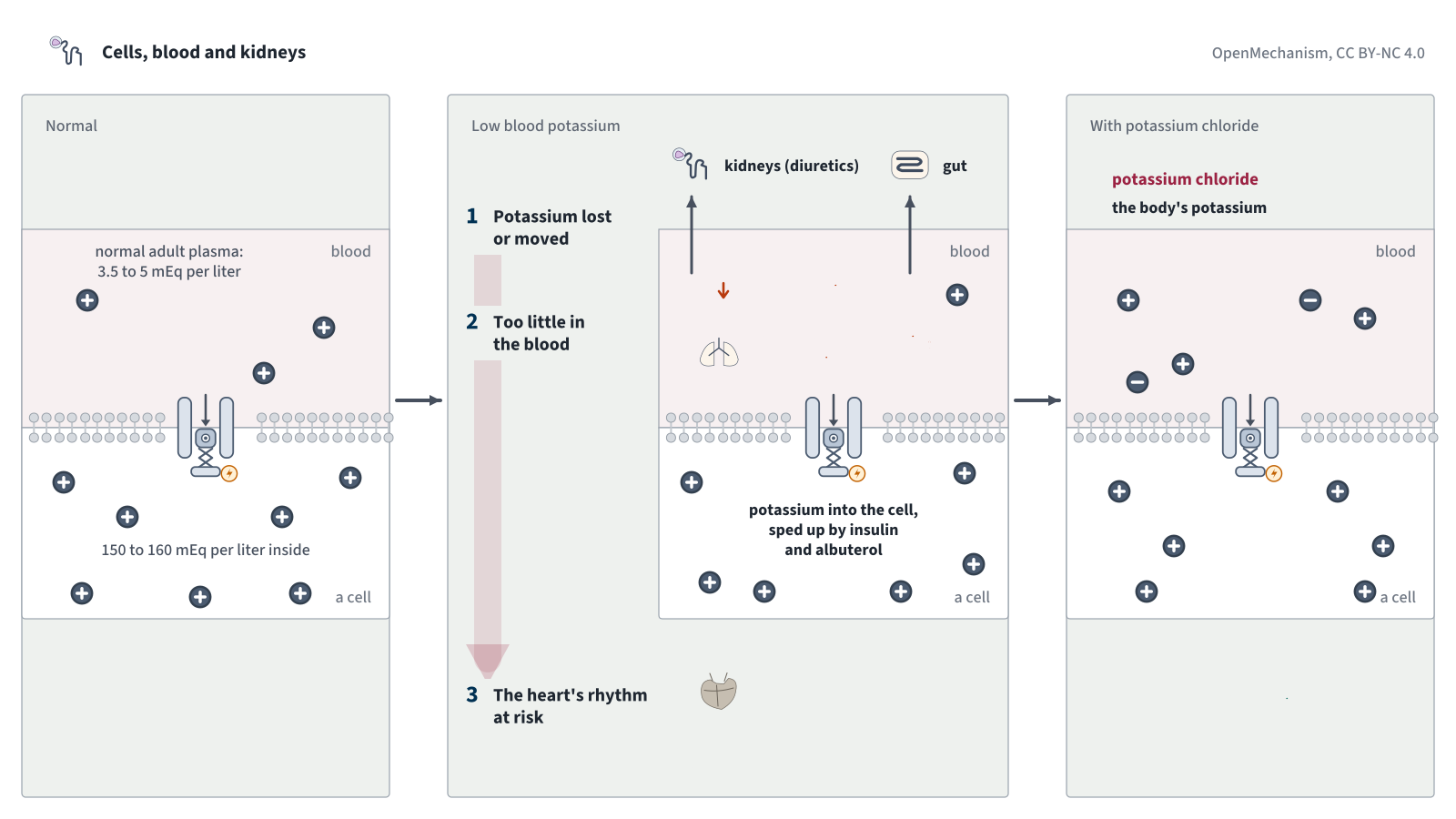
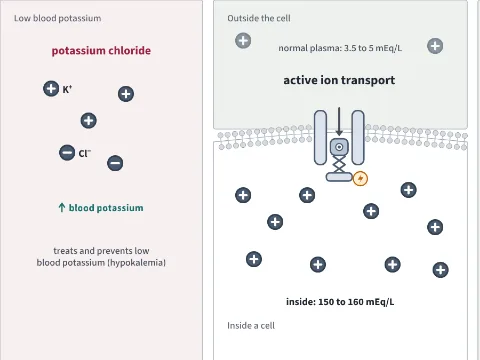
Potassium is the main positive ion in cells, kept there by pumps; an adult's blood plasma normally holds 3.5 to 5 mEq per liter. Low levels often reflect too little in the diet or losses through the kidneys (as with diuretics) or the gut; insulin and albuterol can move it into cells. It can upset the heart's rhythm. Potassium chloride replaces it.
Potassium lost or moved. Low blood potassium often reflects too little potassium in the diet, alkalosis, or losses through the kidneys or the gut; it may develop with diuretics such as furosemide and hydrochlorothiazide. Insulin and beta-2 such as albuterol can also lower it, by stimulating the sodium-potassium pumps in skeletal muscle, which take potassium into the cells.1,2,3,4,5
What the source says
“Hypokalemia often reflects dietary K+ deficiency, alkalosis, renal or gastrointestinal loss of K+.”
“Hypokalemia may develop with LASIX, especially with brisk diuresis, inadequate oral electrolyte intake, when cirrhosis is present, or during concomitant use of corticosteroids, ACTH, licorice in large amounts, or prolonged use of laxatives.”
“Hypokalemia may be induced by the stimulation of the Na+,K+ pumps in skeletal muscles seen postexercise, or by catecholamines, beta2 agonists, pheochromocytoma, theophylline, caffeine or insulin, by sepsis, myocardial infarction, trauma, burns and heart failure.”
Too little in the blood. Potassium is the main positive ion inside most body cells, about 150 to 160 mEq per liter, against a normal 3.5 to 5 in adult blood plasma, a gradient that active transport keeps up. It takes part in carrying nerve impulses and in the contraction of heart, skeletal and smooth muscle; untreated low potassium may paralyze the breathing muscles, upset the heart's rhythm and cause death.4,6
What the source says
“The potassium ion is the principal intracellular cation of most body tissues. Potassium ions participate in a number of essential physiological processes including the maintenance of intracellular tonicity, the transmission of nerve impulses, the contraction of cardiac, skeletal and smooth muscle and the maintenance of normal renal function.”
“The intracellular concentration of potassium is approximately 150 mEq to 160 mEq per liter. The normal adult plasma concentration is 3.5 mEq to 5 mEq per liter. An active ion transport system maintains this gradient across the plasma membrane.”
The heart's rhythm at risk. A 2010 review says low potassium is more likely than high potassium to cause heart rhythm problems. The hydrochlorothiazide label says low potassium may also make the heart more sensitive to the toxic effects of digitalis.1,3
What the source says
“Hypokalemia is more likely to cause arrhythmia than hyperkalemia”
“Hypokalemia may cause cardiac arrhythmia and may also sensitize or exaggerate the response of the heart to the toxic effects of digitalis (e.g., increased ventricular irritability).”
Replaces potassium, absorbed in the small intestine.6
Used forTreatment and prevention of low blood potassium: when potassium-rich foods or a lower diuretic dose are not enough
What the label says
“Klor-Con is indicated for the treatment and prophylaxis of hypokalemia with or without metabolic alkalosis, in patients for whom dietary management with potassium-rich foods or diuretic dose reduction is insufficient.”
Can cause it: furosemide (“Hypokalemia may develop with LASIX, especially with brisk diuresis, inadequate oral electrolyte intake, when cirrhosis is present, or during concomitant use of corticosteroids, ACTH, licorice in large amounts, or prolonged use of laxatives.”2); hydrochlorothiazide (“Hypokalemia may develop, especially with brisk diuresis, when severe cirrhosis is present or after prolonged therapy.”3); insulin glargine (“All insulins, including LANTUS, cause a shift in potassium from the extracellular to intracellular space, possibly leading to hypokalemia.”4); and albuterol (“Beta-adrenergic agonist medicines may produce significant hypokalemia in some patients, possibly through intracellular shunting, which has the potential to produce adverse cardiovascular effects”5).
The hydrochlorothiazide label says low potassium may be avoided or treated with potassium-sparing diuretics or potassium supplements, such as potassium-rich foods.3
The Ventolin HFA (albuterol) label says the fall in potassium is usually brief and does not need supplements.5
Rare causes include hypokalemic periodic paralysis and potassium channels blocked by barium, chloroquine or barbiturates.1
Claude Opus 5.5 (AI source check), 29 October 2026: 27 statements compared with their sources, 6 flagged for the reviewer. An automated check, not a medical review.
Next review due
29 April 2028
Cite this page
Tran D. Low blood potassium (hypokalemia) [Internet]. OpenMechanism; 2026 [updated 2026 Oct 29; cited 2026 Oct 29]. Available from: https://openmechanism.com/conditions/low-blood-potassium