Potassium chloride
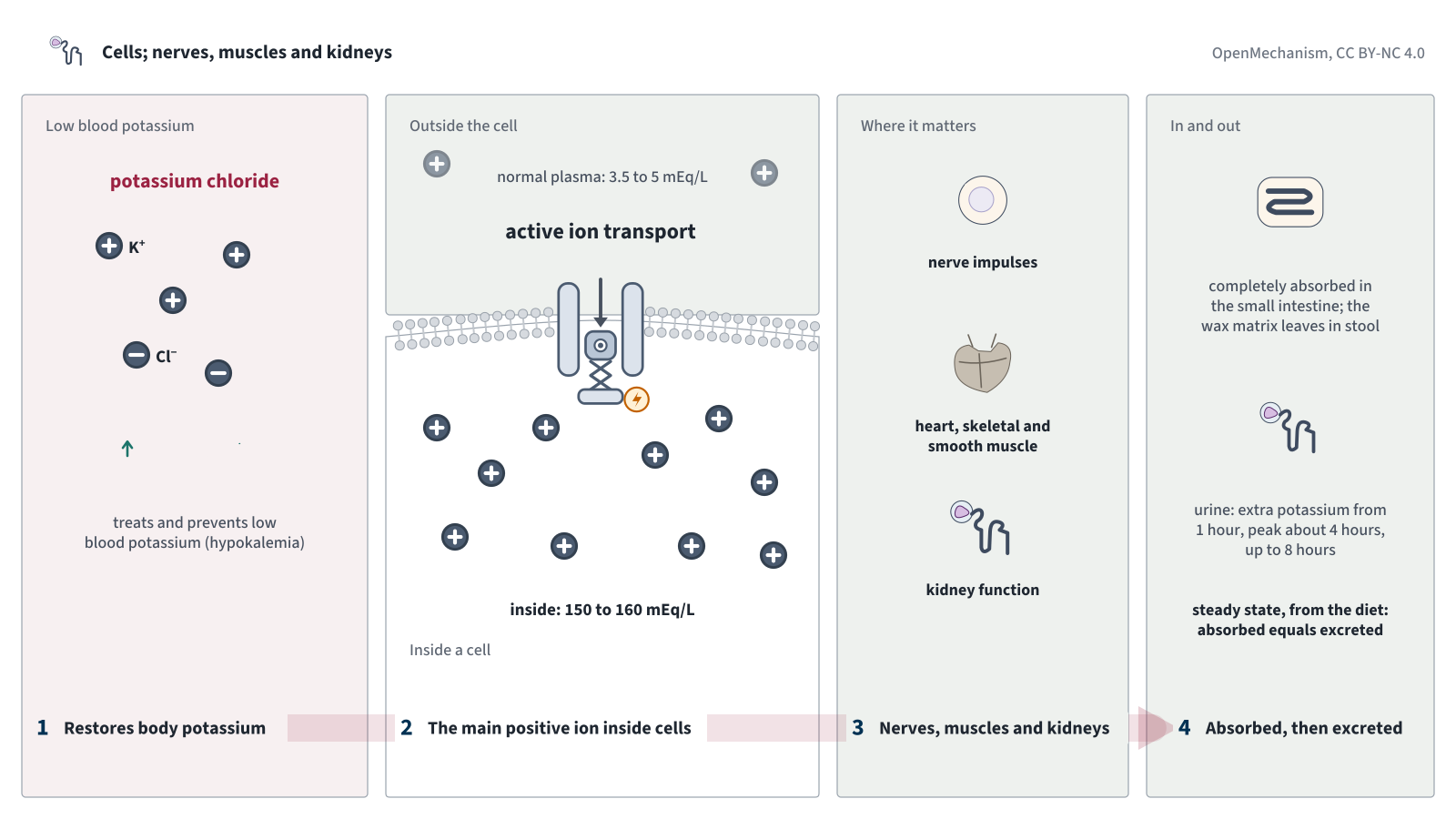
Potassium chloride treats and prevents low blood potassium; its label limits this to people for whom potassium-rich foods or a lower diuretic dose are not enough. Potassium is the main positive ion inside cells, kept far more concentrated inside than in the blood by an active transport system, and it takes part in carrying nerve impulses, contracting heart and other muscle, and keeping kidney function normal. The tablet's potassium is absorbed in the small intestine and leaves in the urine.
- Acts on
- Body potassium (the main positive ion inside cells)
- Where
- Cells; nerves, muscles and kidneys
- Medicine type
- Small molecule
- Used for
- Kidney & electrolytes
Also called Klor-Con (extended-release potassium chloride).
How it works
Restores body potassium. Potassium chloride is a potassium salt. The Klor-Con label says it is for treating and preventing low blood potassium (hypokalemia), with or without metabolic alkalosis, in people for whom potassium-rich foods or a lower diuretic dose are not enough.1
The main positive ion inside cells. Potassium is the main positive ion (cation) inside the cells of most body tissues: about 150 to 160 mEq per liter inside cells, against a normal 3.5 to 5 mEq per liter in adult plasma. An active ion transport system keeps this gradient across the cell membrane.1
Nerves, muscles and kidneys. Potassium ions take part in essential processes, including keeping the tonicity inside cells, carrying nerve impulses, contracting heart, skeletal and smooth muscle, and keeping kidney function normal.1
Absorbed, then excreted. The potassium chloride in the extended-release tablet is completely absorbed before it leaves the small intestine; the wax matrix is not absorbed and leaves in the stool. Potassium is a normal part of the diet, and in steady state the amount absorbed from the gut equals the amount excreted in the urine. With the tablet, the extra urinary potassium starts after 1 hour, peaks at about 4 hours and lasts up to 8 hours.1
For teachers: download this drawing.
See also
Condition pages: low blood potassium (hypokalemia).
Side effects: high blood potassium.
Body system: kidney.
Sources
- 1Klor-Con (potassium chloride) extended-release tablets: FDA label1 Indications and Usage; 12.1 Mechanism of Action; 12.3 Pharmacokinetics
- 2ChEMBL CHEMBL1200731Target and action classification: Supplement
Spotted a mistake? Report an error (hello@openmechanism.com). Since launch, every published error we fix is listed on the corrections page.
Notes and limits
- A schematic teaching drawing: not to scale, not exact structures, binding poses or a complete pathway, and not a guide to dosing, treatment or how a person will respond.
All recorded limits are on the evidence page, and notes that apply to every page are on How to read a page. Version 1.0.1, medically reviewed by Daniel Tran, PharmD, on 29 October 2026.
Cite this page
Tran D. Potassium chloride [Internet]. OpenMechanism; 2026 [updated 2026 Oct 29; cited 2026 Oct 29]. Available from: https://openmechanism.com/medicines/potassium-chloride