Finerenone
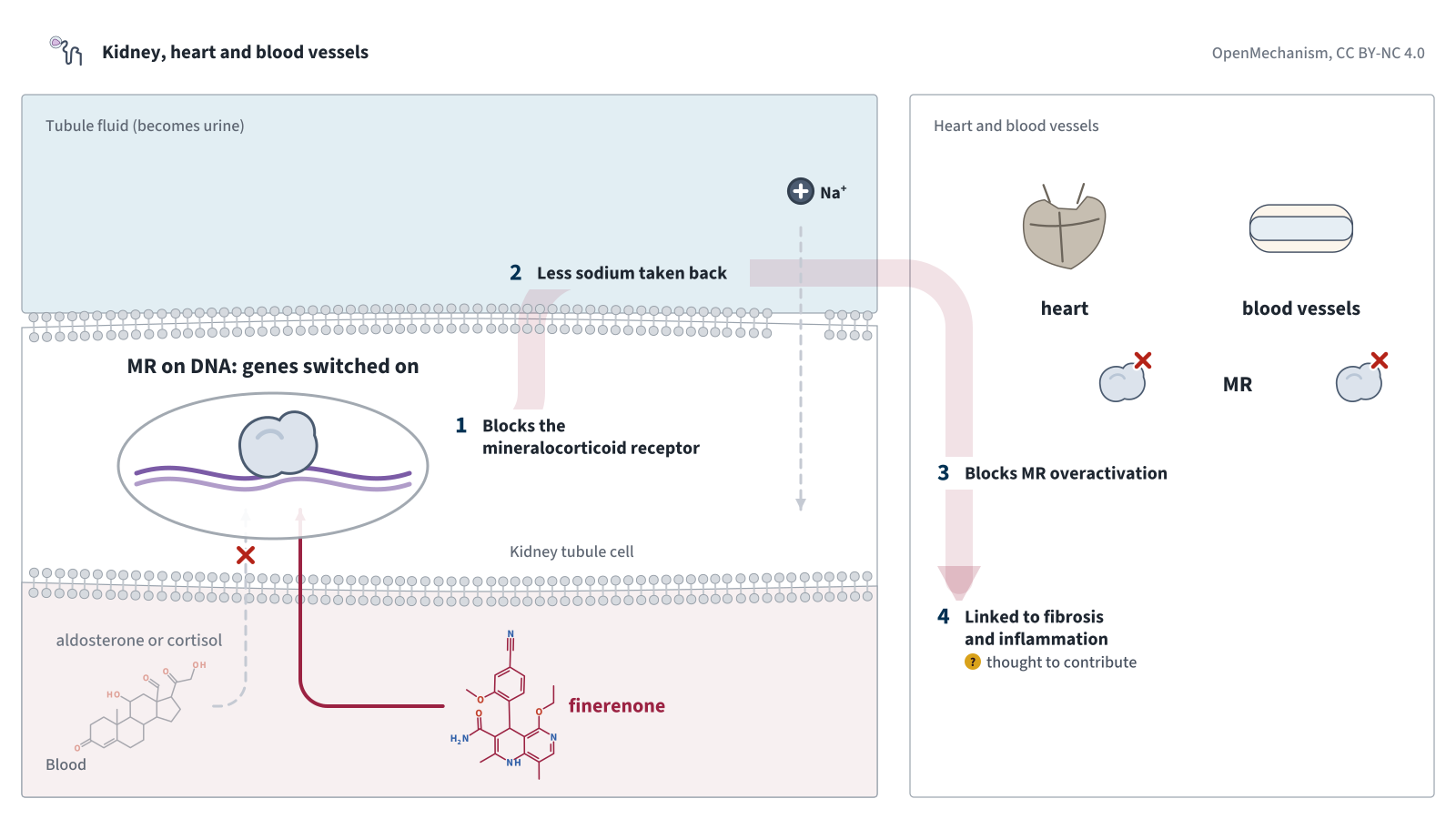
Finerenone is a nonsteroidal blocker of the (MR), which and cortisol switch on. It blocks MR-driven sodium uptake and MR overactivation in the kidney, heart and blood vessels; the label says MR overactivation is thought to contribute to and inflammation.
- Acts on
- Mineralocorticoid receptor (MR)
- Where
- Kidney, heart and blood vessels
- Medicine type
- Small molecule
- Used for
- Heart & circulation
- Drug class
- Diuretics
Also called Kerendia.
Step 4: thought to contribute
The Kerendia (finerenone) label says: MR overactivation is thought to contribute to fibrosis and inflammation.
Source 1: Kerendia (finerenone) tablets: FDA label, 12.1 Mechanism of Action
Clinical study: A double-blind trial in 5734 people with chronic kidney disease and type 2 diabetes measured kidney and heart outcomes, not fibrosis or inflammation, over a median of 2.6 years: In patients with CKD and type 2 diabetes, treatment with finerenone resulted in lower risks of CKD progression and cardiovascular events than placebo.
Bakris GL et al., N Engl J Med 2020 (PMID 33264825)
This study was picked with a literature search and is not yet checked by our reviewer.
Key terms in this drawing
- aldosterone
- Aldosterone. Released by the adrenal glands, it helps the body keep sodium and fluid; angiotensin II stimulates its release.
- DNA
- Deoxyribonucleic acid. The molecule that stores genes.
- MR
- Mineralocorticoid receptor. A receptor that aldosterone and cortisol switch on; it controls which genes are read, and in the kidney it drives sodium reabsorption.
How it works
Blocks the mineralocorticoid receptor. Finerenone is a nonsteroidal, selective of the mineralocorticoid receptor (MR), which aldosterone and cortisol activate and which regulates gene transcription. It has no relevant for androgen, progesterone, estrogen and glucocorticoid receptors.1
Less sodium taken back. It blocks MR-mediated sodium reabsorption.1
Blocks MR overactivation. It blocks MR overactivation in both epithelial (for example kidney) and non-epithelial (for example heart and blood vessel) tissues.1
Linked to fibrosis and inflammation. MR overactivation is thought to contribute to fibrosis and inflammation.1
For teachers: download this drawing.
See also
Condition pages: chronic kidney disease and heart failure.
Side effects: high blood potassium.
Other diuretics: amiloride, chlorthalidone, furosemide, hydrochlorothiazide, spironolactone, tolvaptan and torsemide.
Body systems: kidney; and heart, vessels & cholesterol.
Sources
- 1Kerendia (finerenone) tablets: FDA label12.1 Mechanism of Action
- 2ChEMBL CHEMBL2181927Target and action classification: Mineralocorticoid receptor antagonist
- 3Effect of Finerenone on Chronic Kidney Disease Outcomes in Type 2 DiabetesBakris GL et al. N Engl J Med 2020 (abstract)
Spotted a mistake? Report an error (hello@openmechanism.com). Since launch, every published error we fix is listed on the corrections page.
Notes and limits
- A schematic teaching drawing: not to scale, not exact structures, binding poses or a complete pathway, and not a guide to dosing, treatment or how a person will respond.
- The label says MR overactivation is thought to contribute to fibrosis and inflammation.
All recorded limits are on the evidence page, and notes that apply to every page are on How to read a page. Version 1.0.0, not yet medically reviewed.
Cite this page
Tran D. Finerenone [Internet]. OpenMechanism; 2026 [updated 2026 Oct 10; cited 2026 Oct 10]. Available from: https://openmechanism.com/medicines/finerenone