Focal segmental glomerulosclerosis (FSGS)
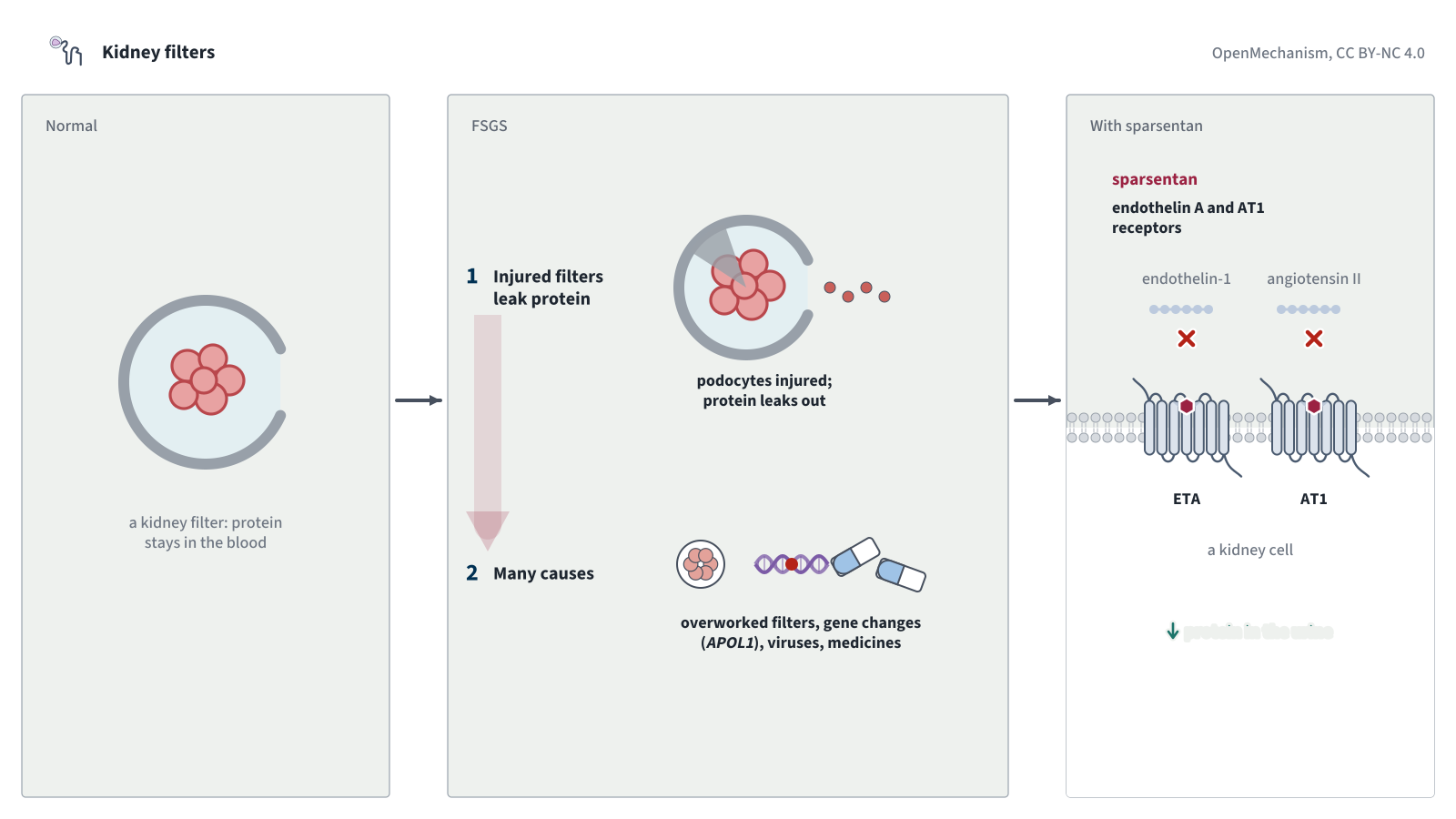
FSGS is a pattern of injury in the kidney's filters (glomeruli): heavy protein in the urine and damaged podocytes, the cells that wrap them. A leading cause of kidney disease worldwide, it is considered the most common filter disease leading to kidney failure. Causes include overworked filters, gene changes, viruses and medicines. Sparsentan blocks endothelin A and receptors.
- Where
- Kidney filters
- Body system
- Kidney
- Medicines
- 1 medicine
For teachers: download this drawing.
Key terms in this drawing (6)
- angiotensin II
- Angiotensin II. A hormone that strongly tightens blood vessels; ACE makes it from angiotensin I.
- APOL1
- APOL1 gene. A gene whose risk variants are linked to FSGS in people with sub-Saharan African ancestry.
- AT1 receptor
- Angiotensin II type 1 receptor. The receptor angiotensin II acts on to tighten blood vessels and stimulate aldosterone release.
- ET-1
- Endothelin-1. A potent signaling peptide made in the body; it acts on blood-vessel muscle and lining through two receptors, ETA and ETB.
- ETA receptor
- Endothelin receptor type A. The endothelin-1 receptor whose main actions are tightening blood vessels and making their cells multiply.
- FSGS
- Focal segmental glomerulosclerosis. A pattern of injury to the kidney's filters (glomeruli) seen under the microscope, rather than a single disease.
What goes wrong
Injured filters leak protein. is a pattern of injury in the kidney's filters (), not a single disease. It shows heavy protein in the urine and damage to podocytes, the cells that wrap the filters.1,2
Many causes. Causes include overworked filters (a large body size or too few ), changes in one of nearly 40 genes, viruses, medicines, and risk genes in people of sub-Saharan African ancestry.3
What the source says
“adaptive FSGS is associated with excessive nephron workload due to increased body size, reduced nephron capacity, or single glomerular hyperfiltration associated with certain diseases.”
Source 3“high-penetrance genetic FSGS due to mutations in one of nearly 40 genes, virus-associated FSGS, and medication-associated FSGS.”
Source 3“APOL1 risk allele-associated FSGS in individuals with sub-Saharan ancestry.”
Source 3
Where medicines act
- A
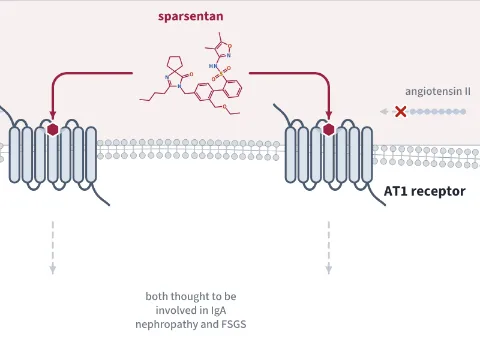
Sparsentan: two receptors blocked
Sparsentan blocks both the endothelin A receptor and the . It lowers protein in the urine in people aged 8 and over with FSGS without nephrotic syndrome.4
What the source says
“Sparsentan is a single molecule with antagonism of the endothelin type A receptor (ET A R) and the angiotensin II type 1 receptor (AT 1 R).”
Source 4“To reduce proteinuria in adult and pediatric patients aged 8 years and older with focal segmental glomerulosclerosis (FSGS) without nephrotic syndrome”
Source 4
See also
Body system: kidney.
Other conditions: chronic kidney disease and IgA nephropathy.
Sources
- 1Focal segmental glomerulosclerosis: state-of-the-art and clinical perspectiveShabaka A et al. Nephron 2020 (abstract). Saved copy
- 2Causes and pathogenesis of focal segmental glomerulosclerosisFogo AB. Nat Rev Nephrol 2015 (abstract). Saved copy
- 3Focal segmental glomerulosclerosisRosenberg AZ, Kopp JB. Clin J Am Soc Nephrol 2017 (abstract). Saved copy
- 4Filspari (sparsentan): FDA label1 Indications and Usage; 12.1 Mechanism of Action. Saved copy
Notes and limits
- FSGS is a leading cause of kidney disease worldwide, and is considered the most common filter disease that leads to kidney failure.1,3
- The circulating factor thought to cause primary FSGS has not been identified.3
- The circulating factors behind FSGS that comes back after a transplant are incompletely understood.2
Notes that apply to every page are on How to read a page.
Spotted a mistake? Report an error (hello@openmechanism.com). Since launch, every published error we fix is listed on the corrections page.
Cite this page
Tran D. Focal segmental glomerulosclerosis (FSGS) [Internet]. OpenMechanism; 2026 [updated 2026 Oct 16; cited 2026 Oct 16]. Available from: https://openmechanism.com/conditions/fsgs