Methotrexate toxicity
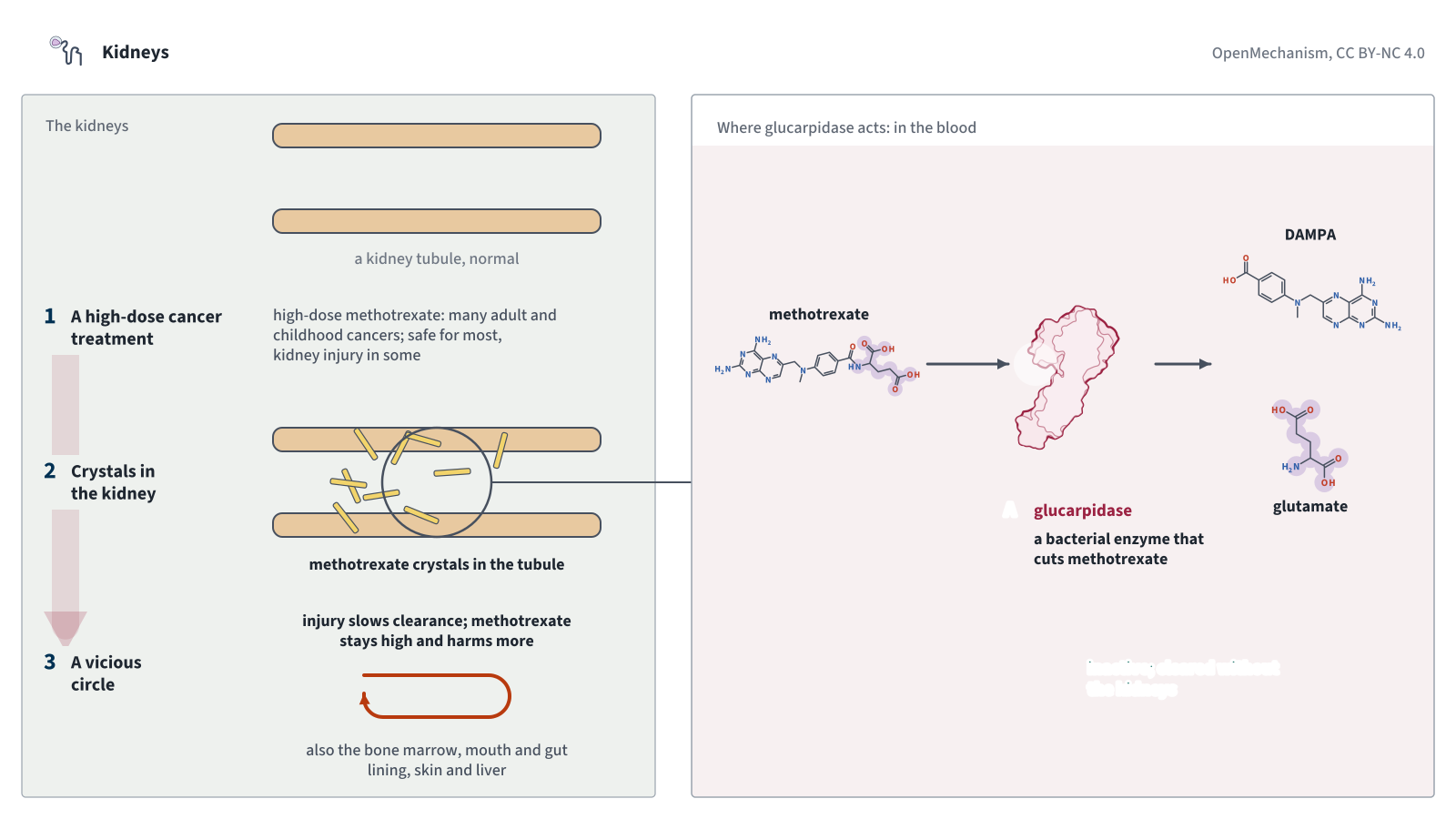
High-dose methotrexate treats many adult and childhood cancers and is given safely to most patients, but it can injure the kidneys (in 2-12%) by crystallizing in the tubules. Kidney injury slows its clearance; longer exposure harms the kidneys further and the bone marrow, mouth and gut lining, skin and liver. Glucarpidase, a bacterial enzyme, breaks methotrexate down outside the kidneys.
- Where
- Kidneys
- Body system
- Kidney
- Medicines
- 1 medicine
For teachers: download this drawing.
Key terms in this drawing
- DAMPA
- 4-Deoxy-4-amino-N10-methylpteroic acid. An inactive piece of methotrexate made by glucarpidase.
What goes wrong
A high-dose cancer treatment. High-dose methotrexate treats a range of adult and childhood cancers and is given safely to most patients, but it can cause serious toxicity, including kidney injury in 2-12%.1
Crystals in the kidney. Methotrexate can crystallize inside the kidney tubules and injure them.1
What the source says
“Nephrotoxicity results from crystallization of methotrexate in the renal tubular lumen, leading to tubular toxicity.”
Source 1A vicious circle. Kidney injury slows methotrexate clearance; longer exposure to toxic levels harms the kidneys further and the bone marrow, the lining of the mouth and gut, the skin and the liver.1
What the source says
“Renal toxicity leads to impaired methotrexate clearance and prolonged exposure to toxic concentrations, which further worsen renal function and exacerbate nonrenal adverse events, including myelosuppression, mucositis, dermatologic toxicity, and hepatotoxicity.”
Source 1
Where medicines act
- A
Glucarpidase: methotrexate cut up outside the kidneys
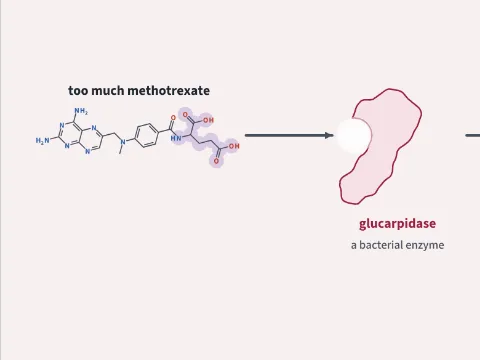
Glucarpidase, a bacterial enzyme, turns methotrexate into inactive pieces, giving it a way out that does not depend on the kidneys. It is used when poor kidney function delays methotrexate clearance.2
What the source says
“Glucarpidase converts methotrexate to its inactive metabolites”
Source 2“VORAXAZE provides an alternate non-renal pathway for methotrexate elimination in patients with renal dysfunction during high-dose methotrexate treatment.”
Source 2“in adult and pediatric patients with delayed methotrexate clearance”
Source 2
See also
Body system: kidney.
Also used for it: leucovorin (for the toxicity of impaired methotrexate elimination: “Leucovorin calcium is also indicated to diminish the toxicity and counteract the effects of impaired methotrexate elimination and of inadvertent overdosages of folic acid antagonists.”3).
Can raise or cause it: methotrexate (“Nephrotoxicity results from crystallization of methotrexate in the renal tubular lumen, leading to tubular toxicity.”1).
Other conditions: acute lymphoblastic leukemia, B-cell lymphomas, colorectal cancer, cutaneous T-cell lymphoma, juvenile idiopathic arthritis and osteosarcoma.
Interactions: methotrexate with NSAIDs or trimethoprim-sulfamethoxazole.
Sources
- 1Preventing and managing toxicities of high-dose methotrexateHoward SC et al. Oncologist 2016 (abstract). Saved copy
- 2Voraxaze (glucarpidase): FDA label1 Indications and Usage; 12.1 Mechanism of Action. Saved copy
- 3Leucovorin calcium injection (Fresenius Kabi): FDA labelIndications and Usage. Saved copy
- 4Pseudomonas carboxypeptidase G2 with its active-site zincPDB 1CG2; Rowsell, S. et al. Structure 1997;5:337-347. The glucarpidase outline in the drawing is traced from this structure. Saved copy
Notes and limits
- It is only for delayed clearance: lowering methotrexate in people who clear it normally could leave too little to treat the cancer.2
Notes that apply to every page are on How to read a page.
Spotted a mistake? Report an error (hello@openmechanism.com). Since launch, every published error we fix is listed on the corrections page.
Cite this page
Tran D. Methotrexate toxicity [Internet]. OpenMechanism; 2026 [updated 2026 Oct 20; cited 2026 Oct 20]. Available from: https://openmechanism.com/conditions/methotrexate-toxicity