Diabetes insipidus
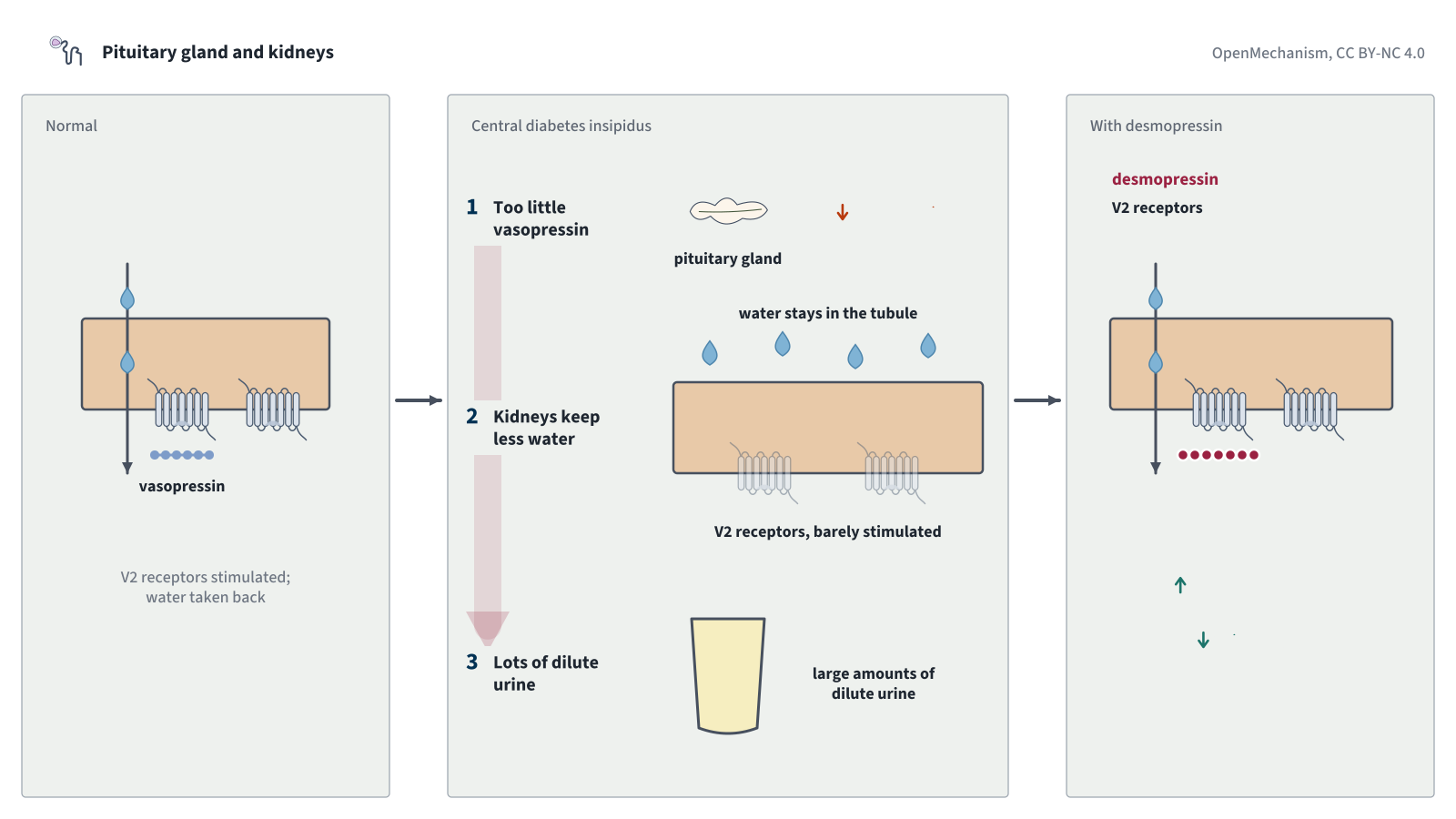
Diabetes insipidus means passing large amounts of dilute urine. In the central form, the pituitary gland or hypothalamus makes too little of the hormone vasopressin (antidiuretic hormone), which normally acts on V2 receptors to hold water back. Desmopressin is a long-acting replacement that acts on V2 receptors, so the kidneys take back more water and make less urine.
- Where
- Pituitary gland and kidneys
- Body systems
- Hormones & metabolism, Kidney
- Medicines
- 1 medicine
For teachers: download this drawing.
Key terms in this drawing
- V2 receptor
- Vasopressin V2 receptor. The kidney receptor that antidiuretic hormone acts on to save water.
What goes wrong
Too little vasopressin. In central diabetes insipidus, the pituitary gland or hypothalamus makes too little of the hormone arginine vasopressin.1
What the source says
“central diabetes insipidus resulting from a deficiency of the hormone arginine vasopressin (AVP) in the pituitary gland or the hypothalamus”
Source 1Kidneys keep less water. Vasopressin normally holds water back (antidiuresis) by stimulating .2
What the source says
“vasopressin stimulates antidiuresis via stimulation of V 2 receptors which are coupled to adenyl cyclase.”
Source 2Lots of dilute urine. The result is a large amount of dilute urine.1
What the source says
“Diabetes insipidus is a disorder characterized by excretion of large amounts of hypotonic urine.”
Source 1
Where medicines act
- A
Desmopressin: the missing hormone replaced
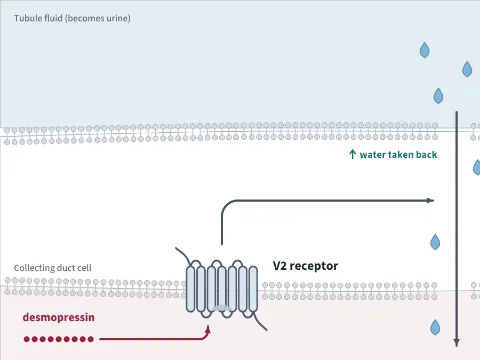
Desmopressin replaces in central diabetes insipidus; it stimulates V2 receptors, so the kidneys take back more water and make less urine.3
What the source says
“Desmopressin acetate is a replacement hormone for antidiuretic hormone in the treatment of central diabetes insipidus.”
Source 3“The antidiuretic effects of desmopressin acetate are mediated by stimulation of vasopressin 2 (V2) receptors, thereby increasing water re-absorption in the kidney, and hence reducing urine production.”
Source 3“DDAVP Injection is indicated as antidiuretic replacement therapy in the management of central (cranial) diabetes insipidus”
Source 3
See also
Body systems: hormones & metabolism and kidney.
Zoom in: saving water in the kidney.
Other conditions: growth hormone deficiency, acromegaly, bedwetting (nocturnal enuresis), hemophilia A, von Willebrand disease and cystinosis.
Side effects: why lithium can cause diabetes insipidus.
Sources
- 1Diagnosis and management of diabetes insipidus for the internist: an updateChrist-Crain M et al. J Intern Med 2021 (abstract). Saved copy
- 2Vasostrict (vasopressin): FDA label12.1 Mechanism of Action. Saved copy
- 3DDAVP injection (desmopressin acetate): FDA label1 Indications and Usage; 12.1 Mechanism of Action. Saved copy
Notes and limits
- This page shows the central form. In the nephrogenic form the kidneys resist vasopressin, and desmopressin does not work.1,3
- Central diabetes insipidus can be the first sign of another illness, so a cause is looked for.1
Notes that apply to every page are on How to read a page.
Spotted a mistake? Report an error (hello@openmechanism.com). Since launch, every published error we fix is listed on the corrections page.
Cite this page
Tran D. Diabetes insipidus [Internet]. OpenMechanism; 2026 [updated 2026 Oct 20; cited 2026 Oct 20]. Available from: https://openmechanism.com/conditions/diabetes-insipidus