Ethylene glycol and methanol poisoning
Ethylene glycol, in most antifreezes, and methanol, in windshield washer fluid, do their harm through what the liver makes of them. Its alcohol dehydrogenase starts their breakdown into toxic acids, which cause metabolic acidosis, kidney damage and loss of vision. Fomepizole blocks the enzyme.
- Where
- Liver cells
- Body systems
- Kidney; Stomach, gut & liver
- Medicines
- 1 medicine
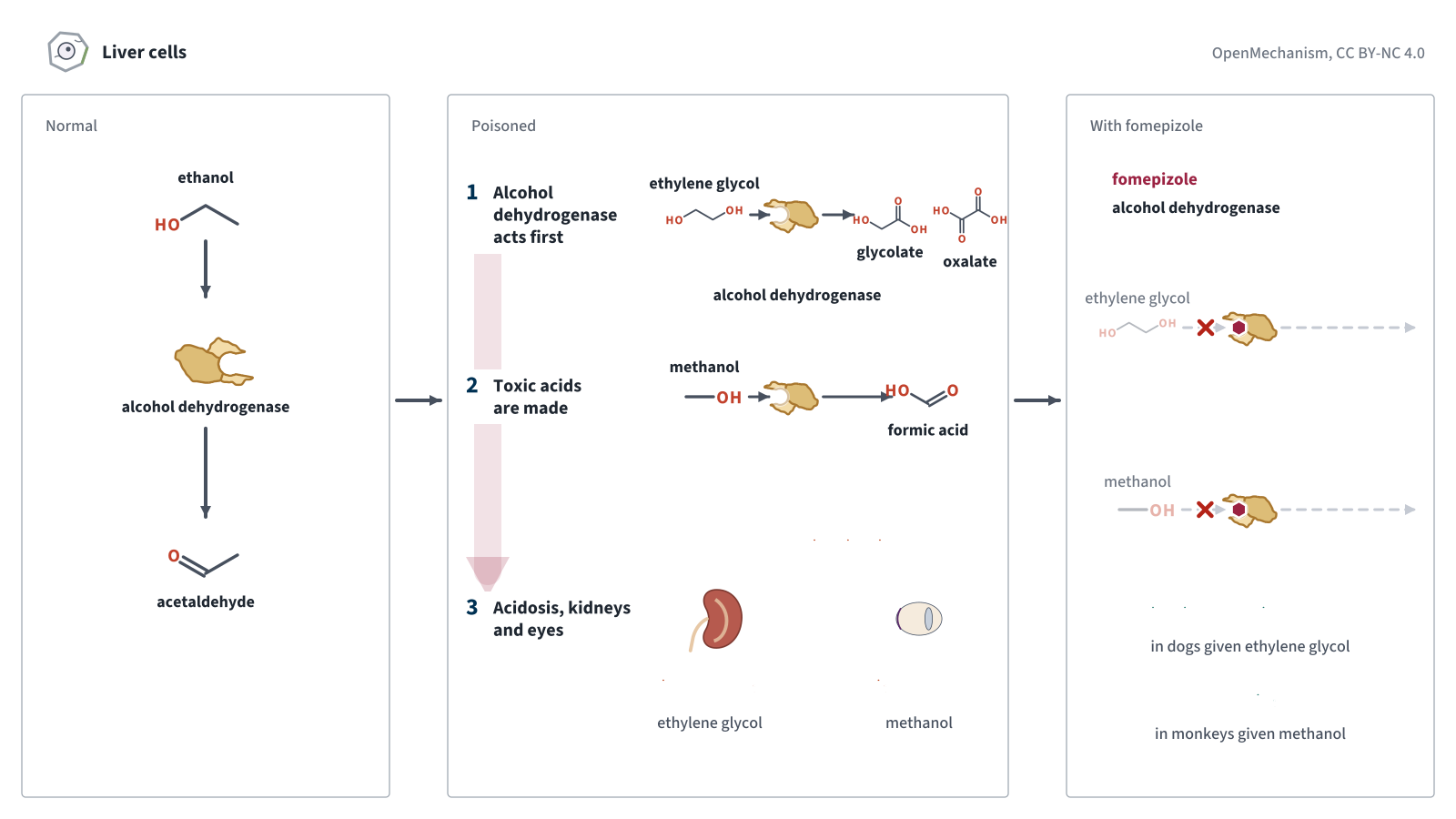
For teachers: download this drawing.
What goes wrong
Alcohol dehydrogenase acts first. Alcohol dehydrogenase, which turns ethanol into acetaldehyde, also carries out the first steps in breaking down ethylene glycol (the main part of most antifreezes and coolants) and methanol (the main part of windshield washer fluid) into toxic products. Their harm comes from what they are turned into.1,2
What the source says
“Alcohol dehydrogenase catalyzes the oxidation of ethanol to acetaldehyde.”
Source 1“Alcohol dehydrogenase also catalyzes the initial steps in the metabolism of ethylene glycol and methanol to their toxic metabolites.”
Source 1“Ethylene glycol, the main component of most antifreezes and coolants”
Source 1“Methanol, the main component of windshield wiper fluid”
Source 1“The effects of these substances, except for isopropanol and possibly alcoholic ketoacidosis, are due to their metabolites, which can cause metabolic acidosis and cellular dysfunction.”
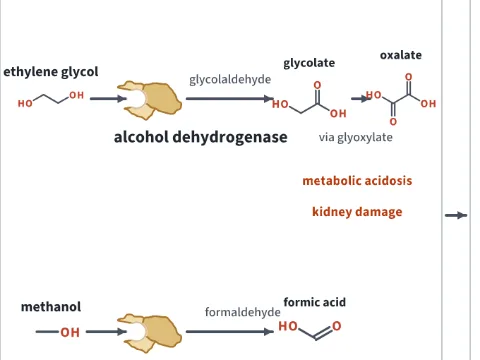
Source 2Toxic acids are made. Ethylene glycol becomes glycoaldehyde, then glycolate, glyoxylate and oxalate. Methanol is slowly turned into formaldehyde, then formic acid.1
What the source says
“Ethylene glycol, the main component of most antifreezes and coolants, is metabolized to glycoaldehyde, which undergoes subsequent sequential oxidations to yield glycolate, glyoxylate, and oxalate.”
Source 1“Methanol, the main component of windshield wiper fluid, is slowly metabolized via alcohol dehydrogenase to formaldehyde with subsequent oxidation via formaldehyde dehydrogenase to yield formic acid.”
Source 1Acidosis, kidneys and eyes. Glycolate and oxalate cause most of the metabolic acidosis and kidney damage of ethylene glycol poisoning. Formic acid causes most of the metabolic acidosis and the visual disturbances of methanol poisoning, from poorer sight to possible blindness.1
What the source says
“Glycolate and oxalate are the metabolic byproducts primarily responsible for the metabolic acidosis and renal damage seen in ethylene glycol toxicosis.”
Source 1“Formic acid is primarily responsible for the metabolic acidosis and visual disturbances (e.g., decreased visual acuity and potential blindness) associated with methanol poisoning.”
Source 1
Where medicines act
In liver cells
- A
Fomepizole targets Alcohol dehydrogenase
Competitively blocks alcohol dehydrogenase, the enzyme that starts making the toxic acids.1,2
Used forEthylene glycol or methanol poisoning: known or suspected, alone or with hemodialysis
What the label says
“Fomepizole injection is indicated as an antidote for ethylene glycol (such as antifreeze) or methanol poisoning, or for use in suspected ethylene glycol or methanol ingestion, either alone or in combination with hemodialysis”
Source 1“Fomepizole is a competitive inhibitor of alcohol dehydrogenase.”
Source 1“Fomepizole has been shown in vitro to block alcohol dehydrogenase enzyme activity in dog, monkey, and human liver.”
Source 1“In a study of dogs given a lethal dose of ethylene glycol, three animals each were administered fomepizole, ethanol, or left untreated (control group).”
Source 1“Fomepizole or ethanol, given 3 hours after ethylene glycol ingestion, attenuated the metabolic acidosis and prevented the renal tubular damage associated with ethylene glycol intoxication.”
Source 1“Several studies have demonstrated that fomepizole plasma concentrations of approximately 10 µmol/L (0.82 mg/L) in monkeys are sufficient to inhibit methanol metabolism to formate, which is also mediated by alcohol dehydrogenase.”
Source 1“Administration of fomepizole or ethanol to inhibit alcohol dehydrogenase, a critical enzyme in metabolism of the alcohols, is beneficial in treatment of ethylene glycol and methanol intoxication and possibly diethylene glycol and propylene glycol intoxication.”
Source 2
See also
Body systems: kidney; and stomach, gut & liver.
Other conditions: acetaminophen overdose, cyanide poisoning, methemoglobinemia and heavy metal poisoning.
Sources
- 1Fomepizole injection: FDA labelIndications and Usage; Clinical Pharmacology. Saved copy
- 2Toxic alcohol ingestions: clinical features, diagnosis, and managementKraut JA, Kurtz I. Clin J Am Soc Nephrol 2008 (abstract). Saved copy
- 3Human beta-1 alcohol dehydrogenase (ADH1B, the dimer) with NAD+ and 4-iodopyrazolePDB 1DEH; Davis, G.J. et al. J.Biol.Chem. 1996;271:17057-17061. The alcohol dehydrogenase outline in the drawing is traced from this structure. Saved copy
Notes and limits
- Dialysis, which removes the unchanged alcohol and possibly the acid, can help in several of these poisonings.2
- Some of these poisonings can also bring acute kidney failure and disease of the brain and nerves.2
Notes that apply to every page are on How to read a page.
Spotted a mistake? Report an error (hello@openmechanism.com). Since launch, every published error we fix is listed on the corrections page.
Cite this page
Tran D. Ethylene glycol and methanol poisoning [Internet]. OpenMechanism; 2026 [updated 2026 Nov 18; cited 2026 Nov 18]. Available from: https://openmechanism.com/conditions/ethylene-glycol-and-methanol-poisoning