Transplant rejection
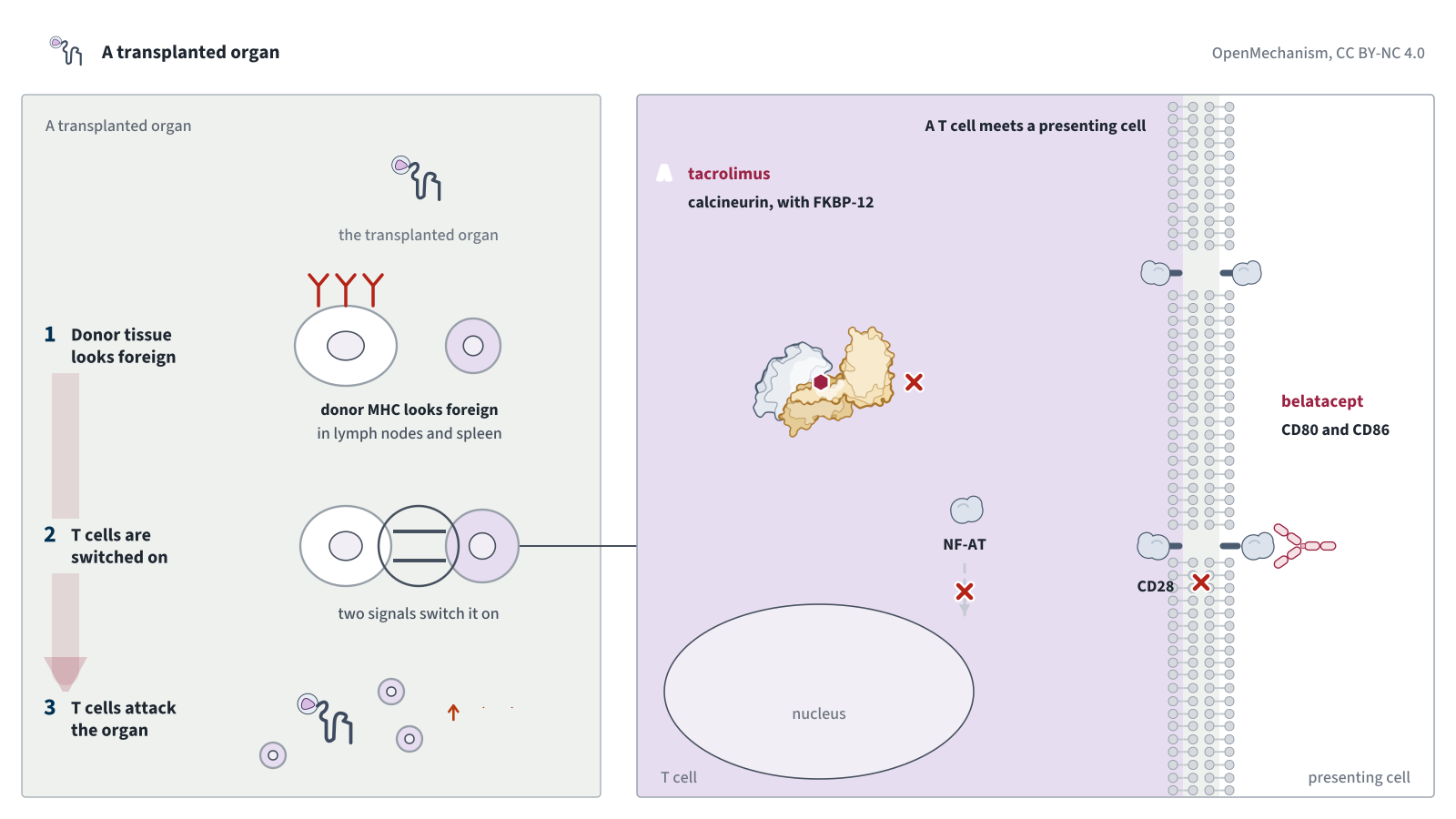
After a transplant, the recipient's T cells recognize the donor's tissue molecules (MHC) as foreign, directly on donor cells or as pieces shown by the recipient's own cells. Activated T cells then lead the attack on the transplanted organ. Tacrolimus blocks calcineurin inside T cells; belatacept blocks the second signal T cells need to switch on.
- Where
- A transplanted organ
- Body systems
- Immune system, Kidney
- Medicines
- 2 medicines
For teachers: download this drawing.
Key terms in this drawing (6)
- CD28
- CD28 protein. A T-cell protein that gives the 'second signal' needed for activation.
- CD80/CD86
- CD80 and CD86 proteins. Proteins on antigen-presenting cells that bind CD28 on T cells.
- FKBP12
- FK506-binding protein 12. A protein inside cells that tacrolimus binds.
- MHC
- Major histocompatibility complex. Molecules on cells that T cells read; a donor's MHC molecules can switch on the recipient's T cells against a transplant.
- NFAT
- Nuclear factor of activated T cells. A protein that switches on immune-signal genes in T cells.
- T cell
- T lymphocyte. A white blood cell of the immune system.
What goes wrong
Donor tissue looks foreign. The recipient's recognize donor molecules in the lymph nodes and spleen, starting the immune response that rejects the transplant.1
What the source says
“Recognition of donor antigens by recipient T cells in secondary lymphoid organs initiates the adaptive inflammatory immune response leading to the rejection of allogeneic transplants.”
Source 1T cells are switched on. T cells are activated by donor molecules on donor cells, or by donor pieces shown on the recipient's own antigen-presenting cells.1
What the source says
“Allospecific T cells become activated through interaction of their T cell receptors with intact allogeneic major histocompatibility complex (MHC) molecules on donor cells (direct pathway) and/or donor peptides presented by self-MHC molecules on recipient antigen-presenting cells (APCs) (indirect pathway).”
Source 1T cells attack the organ. Activated T cells are the main drivers of rejection.2
What the source says
“Activated T lymphocytes are the predominant mediators of immunologic rejection.”
Source 2
Where medicines act
- A
Tacrolimus: calcineurin blocked
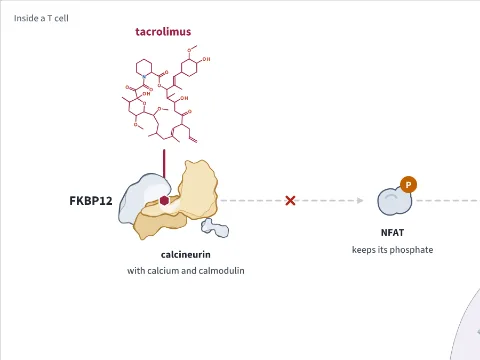
Tacrolimus binds inside the cell and blocks calcineurin, so and NF-kappa-B cannot move into the nucleus. It prevents rejection of liver, kidney, heart and lung transplants, with other immunosuppressants.3
What the source says
“Tacrolimus binds to an intracellular protein, FKBP-12.”
Source 3“after which the phosphatase activity of calcineurin is inhibited.”
Source 3“Such inhibition prevents the dephosphorylation and translocation of various factors such as the nuclear factor of activated T-cells (NF-AT)”
Source 3“indicated for the prophylaxis of organ rejection in adult and pediatric patients receiving allogeneic liver, kidney, heart, or lung transplants, in combination with other immunosuppressants.”
Source 3 - B
Belatacept: the second signal blocked
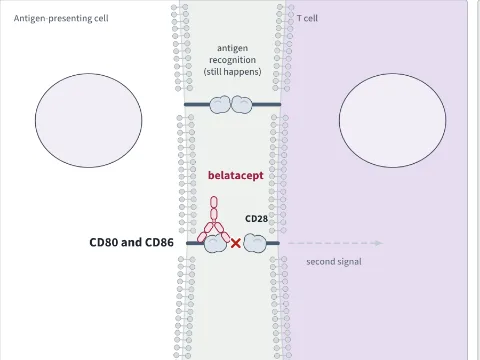
Belatacept binds and CD86 on antigen-presenting cells, blocking the signal that T cells need to switch on. It prevents rejection of a kidney transplant.2
What the source says
“Belatacept, a selective T cell (lymphocyte) costimulation blocker, binds to CD80 and CD86 on antigen-presenting cells thereby blocking CD28 mediated costimulation of T lymphocytes.”
Source 2“indicated for prophylaxis of organ rejection in adult patients receiving a kidney transplant.”
Source 2
See also
Body systems: immune system and kidney.
Zoom in: t cells and a transplanted kidney.
Also used for it: mycophenolate mofetil (for preventing rejection of kidney, heart or liver transplants, with other immunosuppressants: “CELLCEPT is an antimetabolite immunosuppressant indicated for the prophylaxis of organ rejection in adult and pediatric recipients 3 months of age and older of allogeneic kidney, heart or liver transplants, in combination with other immunosuppressants.”4); and sirolimus (for preventing rejection of kidney transplants: “Sirolimus is indicated for the prophylaxis of organ rejection in patients aged 13 years or older receiving renal transplants.”5).
Related medicines: cyclosporine.
Other conditions: lupus nephritis, psoriasis, rheumatoid arthritis, ANCA vasculitis and atypical hemolytic uremic syndrome (aHUS).
The medicine in the body: tacrolimus and the CYP3A5 gene.
Sources
- 1Allorecognition by T lymphocytes and allograft rejectionMarino J et al. Front Immunol 2016 (abstract). Saved copy
- 2Nulojix (belatacept): FDA label1 Indications and Usage; 12.1 Mechanism of Action. Saved copy
- 3Prograf (tacrolimus): FDA label1 Indications and Usage; 12.1 Mechanism of Action. Saved copy
- 4CellCept (mycophenolate mofetil): FDA label1 Indications and Usage. Saved copy
- 5Sirolimus tablets (Mylan): FDA label1 Indications and Usage. Saved copy
- 6Bovine calcineurin A and B with FKBP12 and tacrolimusPDB 1TCO; Griffith, J.P. et al. Cell(Cambridge,Mass.) 1995;82:507-522. The FKBP12 and calcineurin outlines in the drawing are traced from this structure. Saved copy
Notes and limits
- How regulatory T cells recognize donor tissue and bring tolerance is still unclear.1
Notes that apply to every page are on How to read a page.
Spotted a mistake? Report an error (hello@openmechanism.com). Since launch, every published error we fix is listed on the corrections page.
Cite this page
Tran D. Transplant rejection [Internet]. OpenMechanism; 2026 [updated 2026 Oct 20; cited 2026 Oct 20]. Available from: https://openmechanism.com/conditions/transplant-rejection