Empagliflozin
Empagliflozin blocks , the main transporter that takes glucose back from the kidney's filtrate into the blood. Less glucose is reabsorbed and more leaves the body in urine. The label lists four uses: in adults with heart failure, to lower the risk of cardiovascular death and hospital stays for heart failure; in adults with chronic kidney disease at risk of getting worse, to lower the risk of sustained loss of kidney function, end-stage kidney disease, cardiovascular death and hospital stays; in adults with type 2 diabetes and established cardiovascular disease, to lower the risk of cardiovascular death; and, with diet and exercise, to improve blood glucose control in adults and children 10 years and older with type 2 diabetes.
- Acts on
- SGLT2
- Where
- The kidney's proximal tubule
- Medicine type
- Small molecule
- Used for
- Hormones & metabolism
- Drug class
- SGLT2 inhibitors
Also called Jardiance.
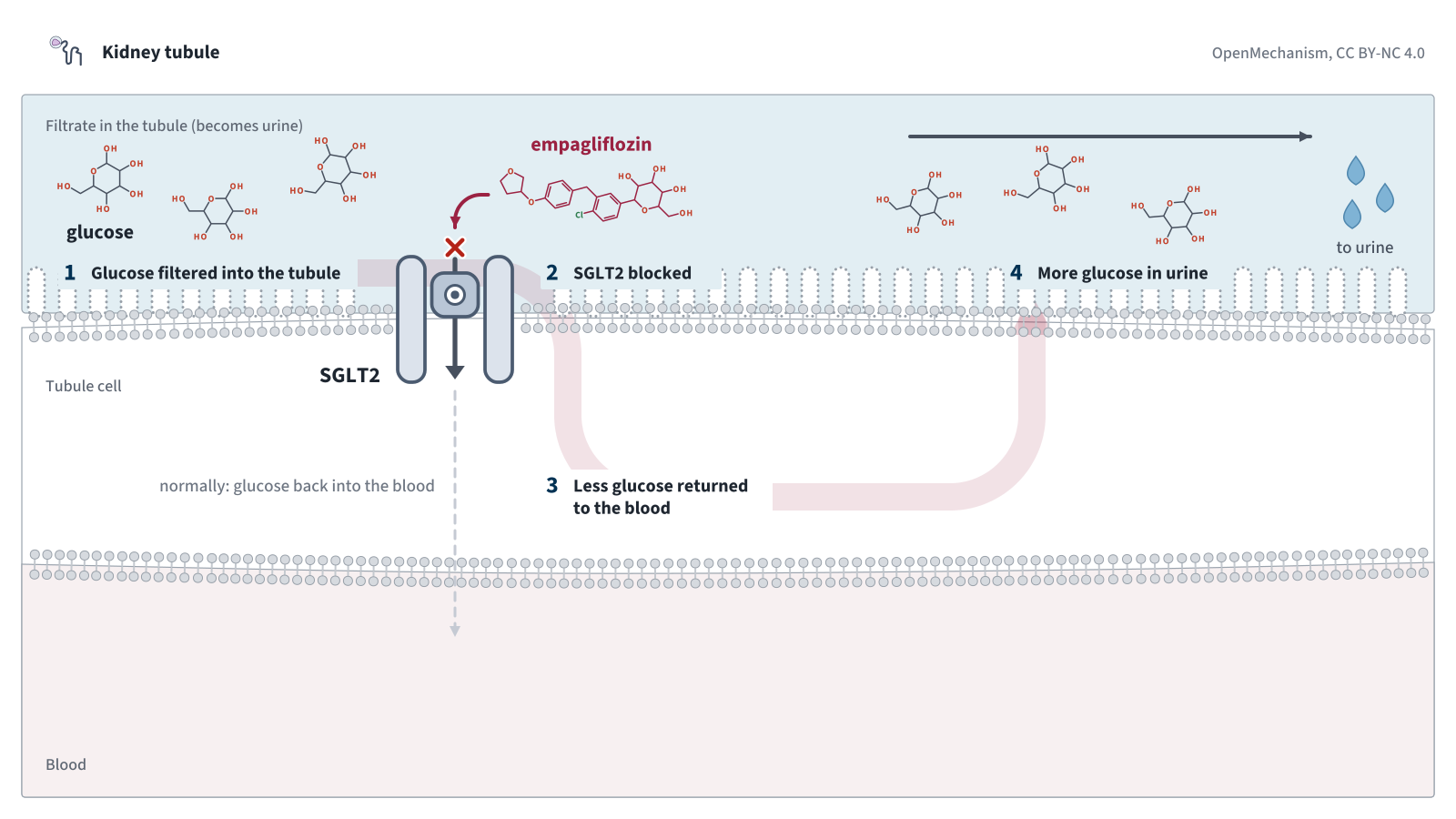
Key terms in this drawing
- SGLT2
- Sodium-glucose cotransporter 2. The kidney's main transporter for taking glucose back from the filtrate into the blood.
How it works
Glucose filtered into the tubule. SGLT2 normally reabsorbs glucose from glomerular filtrate into the circulation.1
SGLT2 blocked. Empagliflozin inhibits the predominant renal glucose-reabsorption transporter.1
Less glucose returned to the blood. Less filtered glucose returns to the circulation and the renal glucose threshold falls.1
More glucose in urine. More glucose is excreted in urine.1
For teachers: download this drawing or build a slide deck.
More detail
Glucose out in the urine, and lower blood glucose
Taken by mouth and absorbed. Oral empagliflozin is absorbed into systemic circulation.2
Blocks SGLT2 in the kidney. Empagliflozin inhibits SGLT2, the predominant transporter of filtered-glucose reabsorption.2
Less glucose taken back; more in the urine. SGLT2 inhibition reduces glucose reabsorption and increases urinary glucose excretion.2
Lower blood glucose in type 2 diabetes. Urinary glucose excretion accompanies glucose lowering in studied type 2 diabetes populations; the label does not recommend it for glucose control in type 1 diabetes or when eGFR is below 30 mL/min/1.73 m².2
What the source says
“Empagliflozin is an inhibitor of SGLT2, the predominant transporter responsible for reabsorption of glucose from the glomerular filtrate back into the circulation.”
Source 2
“By inhibiting SGLT2, empagliflozin reduces renal reabsorption of filtered glucose and lowers the renal threshold for glucose, and thereby increases urinary glucose excretion.”
Source 2
“After oral administration, peak plasma concentrations of empagliflozin were reached at 1.5 hours post-dose.”
Source 2
“In patients with type 2 diabetes mellitus, urinary glucose excretion increased immediately following a dose of empagliflozin and was maintained at the end of a 4-week treatment period”
Source 2
“JARDIANCE is not recommended for use to improve glycemic control in patients with type 1 diabetes mellitus.”
Source 2
“JARDIANCE is not recommended for use to improve glycemic control in patients with type 2 diabetes mellitus with an eGFR less than 30 mL/min/1.73 m 2 .”
Source 2
Sodium, and possible effects on the kidney and heart
Less sodium taken back. Empagliflozin reduces sodium reabsorption and increases distal sodium delivery.2
Possible kidney and heart effects (proposed). The label says this may influence several functions, including increasing tubuloglomerular feedback, reducing intraglomerular pressure, lowering both pre- and afterload of the heart and downregulating sympathetic activity.2
What the source says
“Empagliflozin also reduces sodium reabsorption and increases the delivery of sodium to the distal tubule.”
Source 2
“This may influence several physiological functions including, but not restricted to, increasing tubuloglomerular feedback and reducing intraglomerular pressure, lowering both pre- and afterload of the heart and downregulating sympathetic activity.”
Source 2
How the body clears it
Leaves in urine and stool, much of it unchanged. After a radiolabeled dose by mouth in healthy people, 54.4% of the radioactivity was recovered in urine and 41.2% in stool; most of that in stool, and about half of that in urine, was unchanged empagliflozin. In vitro studies suggest glucuronidation is its main route of breakdown.2
What the source says
“In vitro studies suggested that the primary route of metabolism of empagliflozin in humans is glucuronidation by the uridine 5'-diphospho-glucuronosyltransferases UGT2B7, UGT1A3, UGT1A8, and UGT1A9.”
Source 2
“Following administration of an oral [ 14 C]-empagliflozin solution to healthy subjects, approximately 95.6% of the drug-related radioactivity was eliminated in feces (41.2%) or urine (54.4%). The majority of drug-related radioactivity recovered in feces was unchanged parent drug and approximately half of drug-related radioactivity excreted in urine was unchanged parent drug.”
Source 2
Weaker glucose lowering when the kidneys work less well
Less glucose lowering as kidney function falls. In a trial in adults with type 2 diabetes and mild or moderate kidney impairment, the glucose-lowering benefit of empagliflozin 25 mg fell as kidney function worsened; urinary glucose excretion also fell as kidney filtration (eGFR) fell.2
What the source says
“The efficacy and safety of JARDIANCE for glycemic control were evaluated in a trial of adult patients with type 2 diabetes mellitus with mild and moderate renal impairment (eGFR 30 to less than 90 mL/min/1.73 m 2 )”
Source 2
“The glucose lowering benefit of JARDIANCE 25 mg decreased in adult patients with worsening renal function.”
Source 2
“However, the fraction of empagliflozin that was excreted unchanged in urine, and urinary glucose excretion, declined with decrease in eGFR.”
Source 2
Fluid loss, ketoacidosis and infections
Fluid loss and low blood pressure. Empagliflozin can cause intravascular volume depletion (less fluid in the blood vessels), which may sometimes show as low blood pressure with symptoms or as short-lived changes in creatinine; acute kidney injury, some needing hospital care and dialysis, has been reported in people with type 2 diabetes taking SGLT2 inhibitors, including empagliflozin.2
Ketoacidosis, even without very high glucose. The label says empagliflozin significantly increases the risk of diabetic ketoacidosis, a life-threatening event, in type 1 diabetes, and reports fatal ketoacidosis in people with type 2 diabetes taking SGLT2 inhibitors, including empagliflozin. Blood glucose at presentation may be lower than usual for diabetic ketoacidosis (for example, under 250 mg/dL). Triggers the label lists include missed or reduced insulin doses, an illness with fever, eating less, a ketogenic diet, surgery, fluid loss and alcohol abuse.2
More genital and urinary infections. The label says empagliflozin raises the risk of urinary tract and genital fungal (mycotic) infections in women and men; serious ones, including urosepsis, pyelonephritis and Fournier's gangrene, a rare life-threatening infection, have occurred with SGLT2 inhibitors, including empagliflozin, some needing hospital care.2
What the source says
“JARDIANCE can cause intravascular volume depletion which may sometimes manifest as symptomatic hypotension or acute transient changes in creatinine”
Source 2
“There have been post-marketing reports of acute kidney injury, some requiring hospitalization and dialysis, in patients with type 2 diabetes mellitus receiving SGLT2 inhibitors, including JARDIANCE.”
Source 2
“In patients with type 1 diabetes mellitus, JARDIANCE significantly increases the risk of diabetic ketoacidosis, a life-threatening event, beyond the background rate.”
Source 2
“There have been postmarketing reports of fatal events of ketoacidosis in patients with type 2 diabetes mellitus using SGLT2 inhibitors, including JARDIANCE. Precipitating conditions for diabetic ketoacidosis or other ketoacidosis include under-insulinization due to insulin dose reduction or missed insulin doses, acute febrile illness, reduced caloric intake, ketogenic diet, surgery, volume depletion, and alcohol abuse.”
Source 2
“Blood glucose levels at presentation may be below those typically expected for diabetic ketoacidosis (e.g., less than 250 mg/dL).”
Source 2
“increases the risk of genitourinary infections including urinary tract infections and genital mycotic infections in both male and female patients”
Source 2
“Serious genitourinary infections, including urosepsis, pyelonephritis, and necrotizing fasciitis of the perineum (Fournier's gangrene, a rare life-threatening infection requiring urgent surgical intervention), have occurred in patients with and without diabetes mellitus receiving SGLT2 inhibitors, including JARDIANCE”
Source 2
“Cases have required hospitalization.”
Source 2
See also
Condition pages: chronic kidney disease, heart failure and type 2 diabetes.
Other SGLT2 inhibitors: dapagliflozin.
Explained: why SGLT2 inhibitors can cause genital yeast infections.
Animations: glucose in the kidney.
Body systems: kidney and hormones & metabolism.
Inside the body: inside the kidney.
Sources
- 1Jardiance (empagliflozin): FDA label12.1 Mechanism of Action
- 2Jardiance (empagliflozin): FDA label1 Indications and Usage; 12.1 Mechanism of Action; 12.2 Pharmacodynamics; 12.3 Pharmacokinetics; 8.6 Renal Impairment; 5.1 Ketoacidosis; 5.2 Volume Depletion; 5.3 Genitourinary Infections
- 3ChEMBL CHEMBL2107830Target and action classification: Sodium/glucose cotransporter 2 inhibitor
Also used on this page
This label section supports where the page places SGLT2, in the proximal renal tubules; the steps above come from the sources listed above.
- 4Farxiga (dapagliflozin): FDA label12.1 Mechanism of Action
Spotted a mistake? Report an error (hello@openmechanism.com). Since launch, every published error we fix is listed on the corrections page.
Notes and limits
- A schematic teaching drawing: not to scale, not exact structures, binding poses or a complete pathway, and not a guide to dosing, treatment or how a person will respond.
- These steps show how empagliflozin puts more glucose in the urine; this page does not claim that this one chain explains its heart and kidney benefits.
- Weaker glucose lowering when the kidneys work less well is not taken to mean that the heart and kidney effects are lost; the label's trials did not enroll adults with eGFR below 20 mL/min/1.73 m² or on dialysis.
- The label does not recommend empagliflozin for chronic kidney disease in polycystic kidney disease, or in people who need, or recently needed, immune-suppressing treatment into a vein or more than 45 mg of prednisone or an equivalent for their kidney disease, where it is not expected to work.
All recorded limits are on the evidence page, and notes that apply to every page are on How to read a page. Version 1.1.1, medically reviewed by Daniel Tran, PharmD, on 29 October 2026.
Cite this page
Tran D. Empagliflozin [Internet]. OpenMechanism; 2026 [updated 2026 Oct 29; cited 2026 Oct 29]. Available from: https://openmechanism.com/medicines/empagliflozin