Chronic kidney disease means kidney function below a set level, or signs of kidney damage, for at least 3 months; diabetes and high blood pressure are its main causes. The kidney scars, and anemia and bone disease follow. Medicines slow the loss of kidney function or treat the complications; losartan (in type 2 diabetes with a history of high blood pressure) and captopril (in type 1 diabetes with eye damage) treat some kidney disease caused by diabetes.
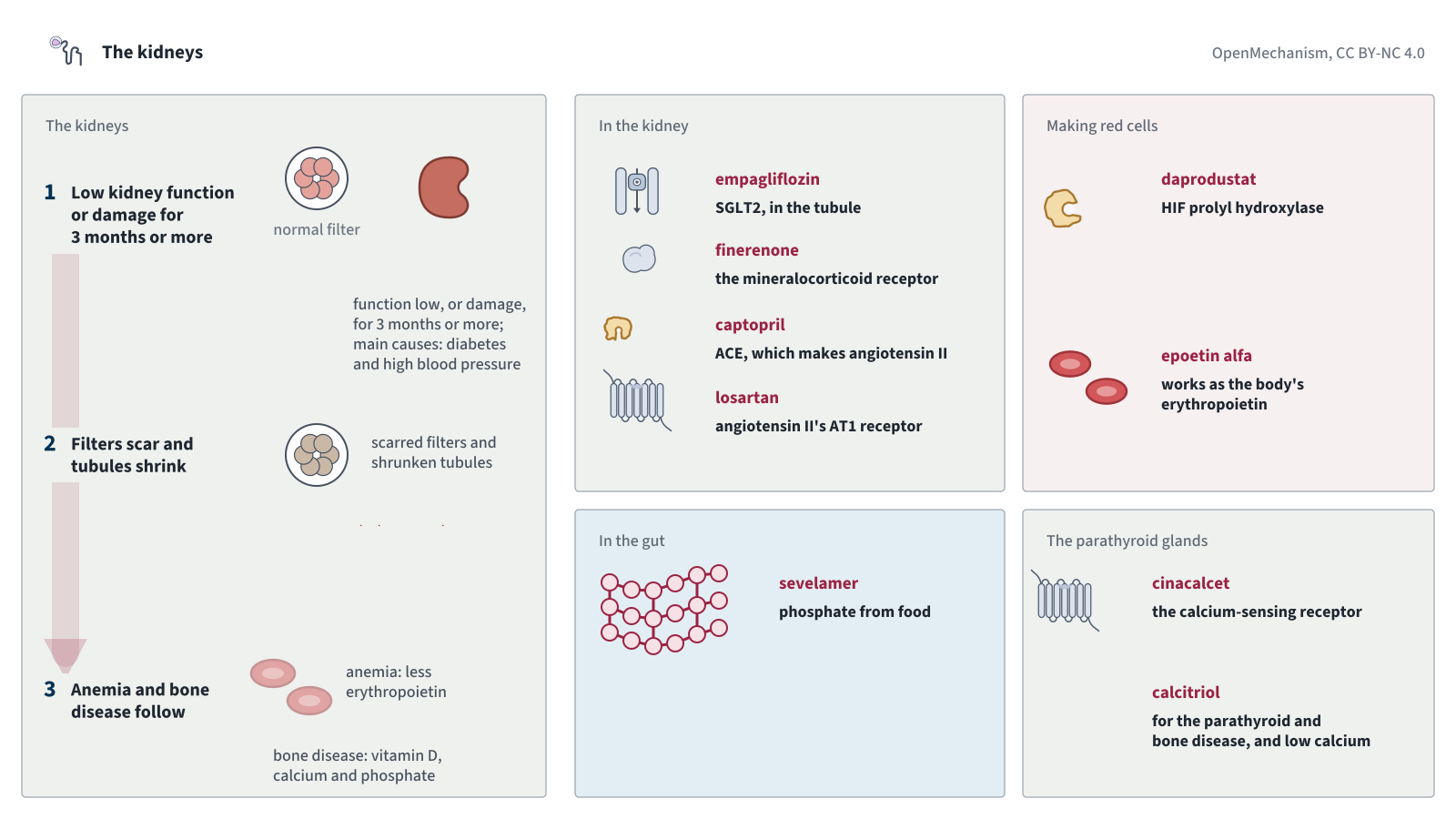
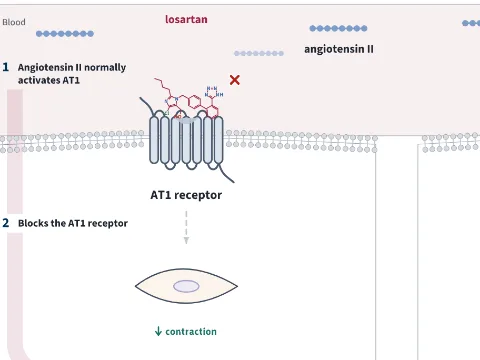
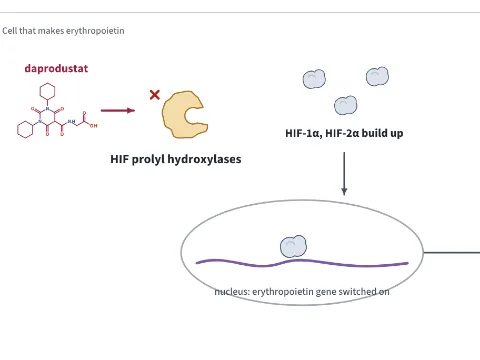
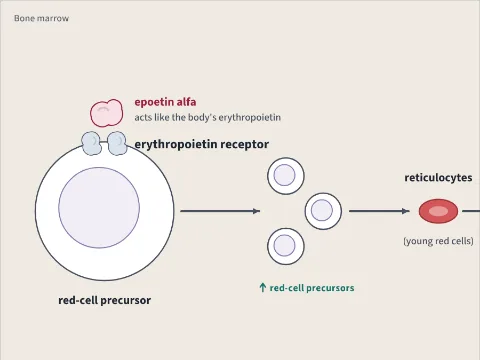
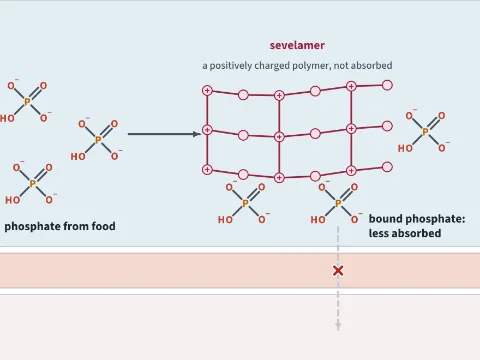
What goes wrong in chronic kidney disease, and where medicines act. Schematic, not to scale. ACE outline from the structure with lisinopril. HIF prolyl hydroxylase outline from the structure with 2-oxoglutarate. License CC BY-NC 4.0.
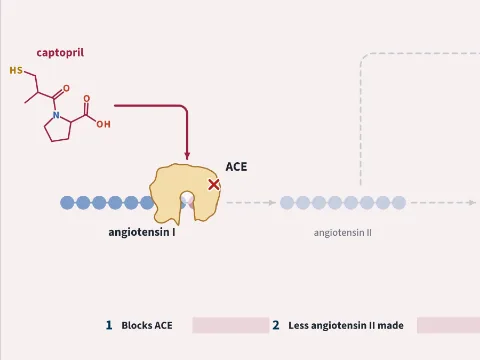
Angiotensin-converting enzyme. The enzyme that makes angiotensin II from angiotensin I.
angiotensin II
Angiotensin II. A hormone that strongly tightens blood vessels; ACE makes it from angiotensin I.
AT1 receptor
Angiotensin II type 1 receptor. The receptor angiotensin II acts on to tighten blood vessels and stimulate aldosterone release.
EPO
Erythropoietin. Made by the body, it drives the making of red blood cells (erythropoiesis).
HIF
Hypoxia-inducible factor. Transcription factors (HIF-1α and HIF-2α) that switch on genes such as the one for erythropoietin; daprodustat stabilizes them.
HIF prolyl hydroxylase
Hypoxia-inducible factor prolyl hydroxylase (HIF-PH1, PH2 and PH3). The enzymes HIF-PH1, PH2 and PH3; when daprodustat blocks them, HIF-1α and HIF-2α are stabilized and switch on genes such as the one for erythropoietin.
MR
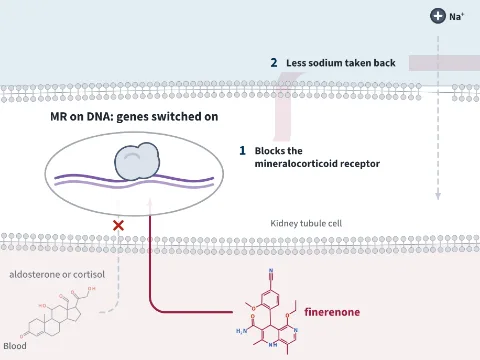
Mineralocorticoid receptor. A receptor that aldosterone and cortisol switch on; it controls which genes are read, and in the kidney it drives sodium reabsorption.
SGLT2
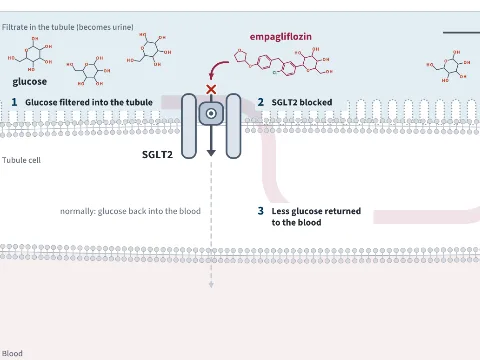
Sodium-glucose cotransporter 2. The kidney's main transporter for taking glucose back from the filtrate into the blood.
What goes wrong
Low kidney function or damage for 3 months or more. Chronic kidney disease is kidney function below a glomerular filtration rate of 60 mL/min per 1.73 m², or signs of kidney damage, or both, for at least 3 months; diabetes and high blood pressure are its main causes in all high- and middle-income countries and many low-income ones.1
What the source says
“current international guidelines define this condition as decreased kidney function shown by glomerular filtration rate (GFR) of less than 60 mL/min per 1·73 m”
Filters scar and tubules shrink. Biopsies can show scarred , shrunken tubules and ; protein in the urine signals a higher risk of the disease getting worse.1
What the source says
“Kidney biopsy samples can show definitive evidence of CKD, through common changes such as glomerular sclerosis, tubular atrophy, and interstitial fibrosis.”
Anemia and bone disease follow. Complications include anemia, because the kidney makes less ; shorter red blood cell survival and iron deficiency; and bone disease from disturbed vitamin D, calcium and phosphate.1
What the source says
“Complications include anaemia due to reduced production of erythropoietin by the kidney; reduced red blood cell survival and iron deficiency; and mineral bone disease caused by disturbed vitamin D, calcium, and phosphate metabolism.”
Empagliflozin blocks in the kidney and also reduces sodium reabsorption there, which may lower the pressure inside the kidney's filters; it reduces the risk of sustained loss of kidney function and of end-stage kidney disease in adults with chronic kidney disease at risk of progression.2
What the source says
“to reduce the risk of sustained decline in eGFR, end-stage kidney disease, cardiovascular death, and hospitalization in adults with chronic kidney disease at risk of progression.”
“Empagliflozin also reduces sodium reabsorption and increases the delivery of sodium to the distal tubule. This may influence several physiological functions including, but not restricted to, increasing tubuloglomerular feedback and reducing intraglomerular pressure, lowering both pre- and afterload of the heart and downregulating sympathetic activity.”
Finerenone blocks the ; in adults with chronic kidney disease associated with type 2 diabetes it reduces the risk of sustained loss of kidney function and of end-stage kidney disease; in adults with chronic kidney disease associated with type 1 diabetes it lowers albumin in the urine, which is expected to reduce those risks.3
What the source says
“Finerenone is a nonsteroidal, selective antagonist of the mineralocorticoid receptor (MR)”
“reduce the risk of sustained estimated glomerular filtration rate (eGFR) decline, end-stage kidney disease, cardiovascular death, non-fatal myocardial infarction, and hospitalization for heart failure in adults with chronic kidney disease (CKD) associated with Type 2 diabetes mellitus (T2DM)”
“reduce urinary albumin-to-creatinine ratio (UACR), which is expected to reduce the risk of sustained eGFR decline and end-stage kidney disease in adults with CKD associated with Type 1 diabetes mellitus (T1DM)”
Captopril blocks , the enzyme that makes . It treats diabetic kidney disease with more than 500 mg of protein a day in the urine in people with type 1 diabetes and eye damage (retinopathy).4
What the source says
“specific competitive inhibitor of angiotensin I-converting enzyme (ACE), the enzyme responsible for the conversion of angiotensin I to angiotensin II.”
“Diabetic Nephropathy Captopril tablets are indicated for the treatment of diabetic nephropathy (proteinuria > 500 mg/day) in patients with type I insulin-dependent diabetes mellitus and retinopathy.”
Losartan blocks angiotensin II from binding its . In type 2 diabetes with a history of high blood pressure, and kidney damage with a raised serum creatinine and protein in the urine, a urine albumin-to-creatinine ratio of 300 mg/g or more (diabetic nephropathy), it slows the kidney disease toward dialysis or transplant.5
What the source says
“Losartan and its principal active metabolite block the vasoconstrictor and aldosterone-secreting effects of angiotensin II by selectively blocking the binding of angiotensin II to the AT 1 receptor”
“COZAAR is indicated for the treatment of diabetic nephropathy with an elevated serum creatinine and proteinuria (urinary albumin to creatinine ratio ≥300 mg/g) in patients with type 2 diabetes and a history of hypertension. In this population, COZAAR reduces the rate of progression of nephropathy as measured by the occurrence of doubling of serum creatinine or end stage renal disease (need for dialysis or renal transplantation)”
Daprodustat blocks , so builds up and switches on genes including erythropoietin; it treats the anemia of chronic kidney disease in adults who have been on dialysis for at least four months.6
What the source says
“Daprodustat is a reversible inhibitor of HIF-PH1, PH2 and PH3 (IC 50 in the low nM range). This activity results in the stabilization and nuclear accumulation of HIF-1α and HIF-2α transcription factors, leading to increased transcription of the HIF-responsive genes, including erythropoietin.”
“JESDUVROQ is indicated for the treatment of anemia due to chronic kidney disease (CKD) in adults who have been receiving dialysis for at least four months.”
Epoetin alfa stimulates red blood cell production in the same way as the body's erythropoietin; it treats the anemia of chronic kidney disease, on dialysis or not, to reduce the need for red blood cell transfusions.7
What the source says
“Epogen stimulates erythropoiesis by the same mechanism as endogenous erythropoietin.”
“Epogen is indicated for the treatment of anemia due to chronic kidney disease (CKD), including patients on dialysis and not on dialysis to decrease the need for red blood cell (RBC) transfusion.”
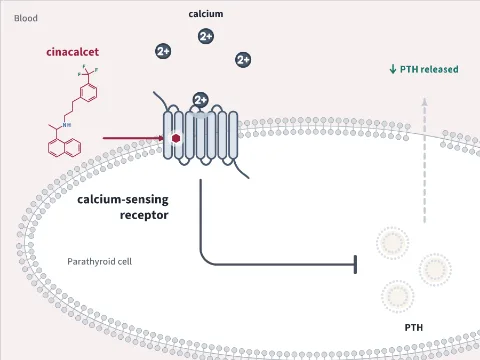
Cinacalcet makes the parathyroid's calcium-sensing receptor more sensitive to calcium, so less parathyroid hormone is made; it treats secondary hyperparathyroidism in adults with chronic kidney disease on dialysis.9
What the source says
“Cinacalcet, the active ingredient in Sensipar, is a calcimimetic agent that directly lowers PTH levels by increasing the sensitivity of the calcium-sensing receptor to activation by extracellular calcium.”
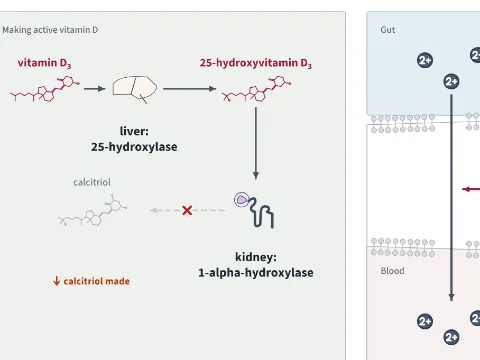
Calcitriol is the active form of vitamin D. In kidney failure (uremia) the kidneys cannot make enough of it, and the low calcium and secondary hyperparathyroidism that follow are a major cause of its bone disease. It is used for secondary hyperparathyroidism and its bone disease in moderate to severe chronic kidney failure before dialysis, and for low calcium and its bone disease in dialysis.10
“The kidneys of uremic patients cannot adequately synthesize calcitriol, the active hormone formed from precursor vitamin D. Resultant hypocalcemia and secondary hyperparathyroidism are a major cause of the metabolic bone disease of renal failure.”
“Calcitriol is indicated in the management of secondary hyperparathyroidism and resultant metabolic bone disease in patients with moderate to severe chronic renal failure (Ccr 15 to 55 mL/min) not yet on dialysis.”
Chronic kidney disease has no cure; people with it are five to ten times more likely to die early than to reach end-stage kidney disease.1,11
The empagliflozin label does not recommend it for chronic kidney disease in polycystic kidney disease, or in people who need, or recently needed, immune-suppressing treatment into a vein or more than 45 mg of prednisone or an equivalent for their kidney disease, where it is not expected to work.2
Claude Opus 5.5 (AI source check), 29 October 2026: 51 statements compared with their sources, 13 flagged for the reviewer. An automated check, not a medical review.
Key terms
Definitions reworded since this review: SGLT2. Definitions are shared across pages, so a later rewording does not take the review line off (what a review covers).
Next review due
29 April 2028
Cite this page
Tran D. Chronic kidney disease [Internet]. OpenMechanism; 2026 [updated 2026 Oct 29; cited 2026 Oct 29]. Available from: https://openmechanism.com/conditions/chronic-kidney-disease