Amiloride
Amiloride blocks sodium uptake in the last parts of the kidney tubule, where the epithelial sodium channel () takes sodium back. The tubule fluid becomes less negative, so less potassium and hydrogen are secreted and potassium is kept. Its own diuretic effect is weak.
- Acts on
- Sodium reabsorption through the amiloride-sensitive epithelial sodium channel (ENaC)
- Where
- Kidney: distal tubule and collecting duct
- Medicine type
- Small molecule
- Used for
- Heart & circulation
- Drug class
- Diuretics
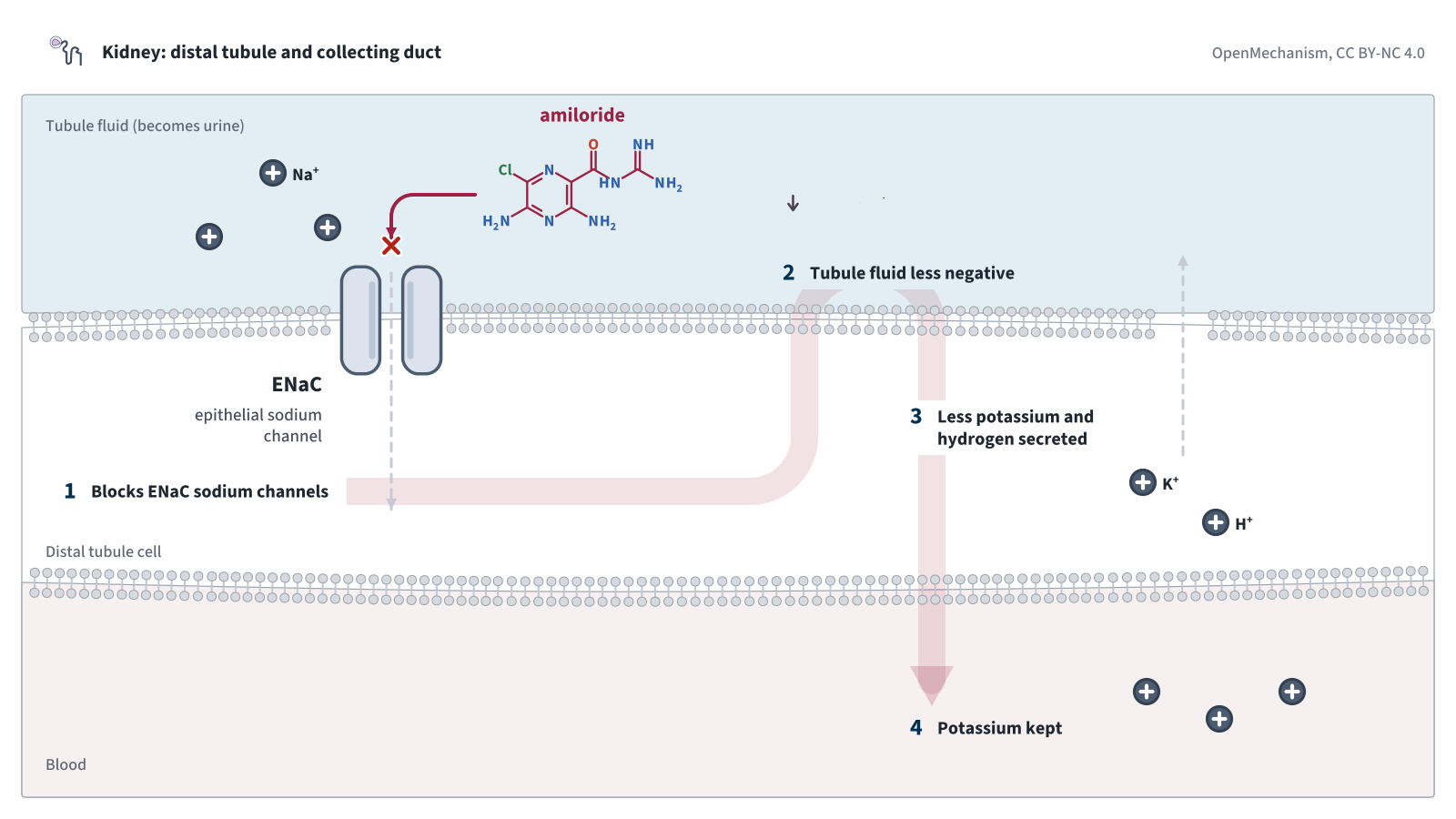
Key terms in this drawing
- ENaC
- Epithelial sodium channel. A sodium channel in the cells lining the last part of the kidney tubule; it sets the pace of sodium uptake there, and amiloride blocks it.
How it works
Blocks ENaC sodium channels. Amiloride inhibits sodium reabsorption at the distal convoluted tubule, cortical collecting tubule and collecting duct. In the cells lining the distal part of the renal tubule, the amiloride-sensitive epithelial sodium channel (ENaC) is the rate-limiting step for sodium reabsorption.1,2
Tubule fluid less negative. This decreases the net negative potential (charge) of the tubular lumen.1
Less potassium and hydrogen secreted. Potassium and hydrogen secretion, and so their excretion, are reduced; this accounts in large part for amiloride's potassium-sparing action.1
Potassium kept. Amiloride conserves potassium; its own natriuretic, diuretic and antihypertensive activity is weak compared with thiazide diuretics. It is not an : its effects are seen even without aldosterone.1
For teachers: download this drawing.
See also
Condition pages: fluid retention.
Other diuretics: chlorthalidone, finerenone, furosemide, hydrochlorothiazide, spironolactone, tolvaptan and torsemide.
Explained: why lithium can cause diabetes insipidus and why trimethoprim can raise potassium.
Body systems: kidney; and heart, vessels & cholesterol.
Sources
- 1Amiloride hydrochloride tablets: FDA labelClinical Pharmacology
- 2Amiloride-sensitive epithelial Na+ channel is made of three homologous subunitsCanessa CM et al., Nature 1994 (abstract)
- 3ChEMBL CHEMBL945Target and action classification: Amiloride-sensitive sodium channel, ENaC blocker
Spotted a mistake? Report an error (hello@openmechanism.com). Since launch, every published error we fix is listed on the corrections page.
Notes and limits
- A schematic teaching drawing: not to scale, not exact structures, binding poses or a complete pathway, and not a guide to dosing, treatment or how a person will respond.
All recorded limits are on the evidence page, and notes that apply to every page are on How to read a page. Version 1.0.0, not yet medically reviewed.
Cite this page
Tran D. Amiloride [Internet]. OpenMechanism; 2026 [updated 2026 Oct 13; cited 2026 Oct 13]. Available from: https://openmechanism.com/medicines/amiloride