Furosemide
Furosemide blocks , the carrier in the loop of Henle that takes sodium, potassium and chloride back from the fluid that becomes urine. Less salt is taken back, so more salt and water leave in the urine. It is used to reduce extra body fluid in heart failure, liver cirrhosis and kidney disease.
- Acts on
- Na⁺-K⁺-2Cl⁻ cotransporter 2 (NKCC2) in the loop of Henle
- Where
- Kidney: loop of Henle
- Medicine type
- Small molecule
- Used for
- Heart & circulation
- Drug class
- Diuretics, Loop diuretics
Also called Lasix.
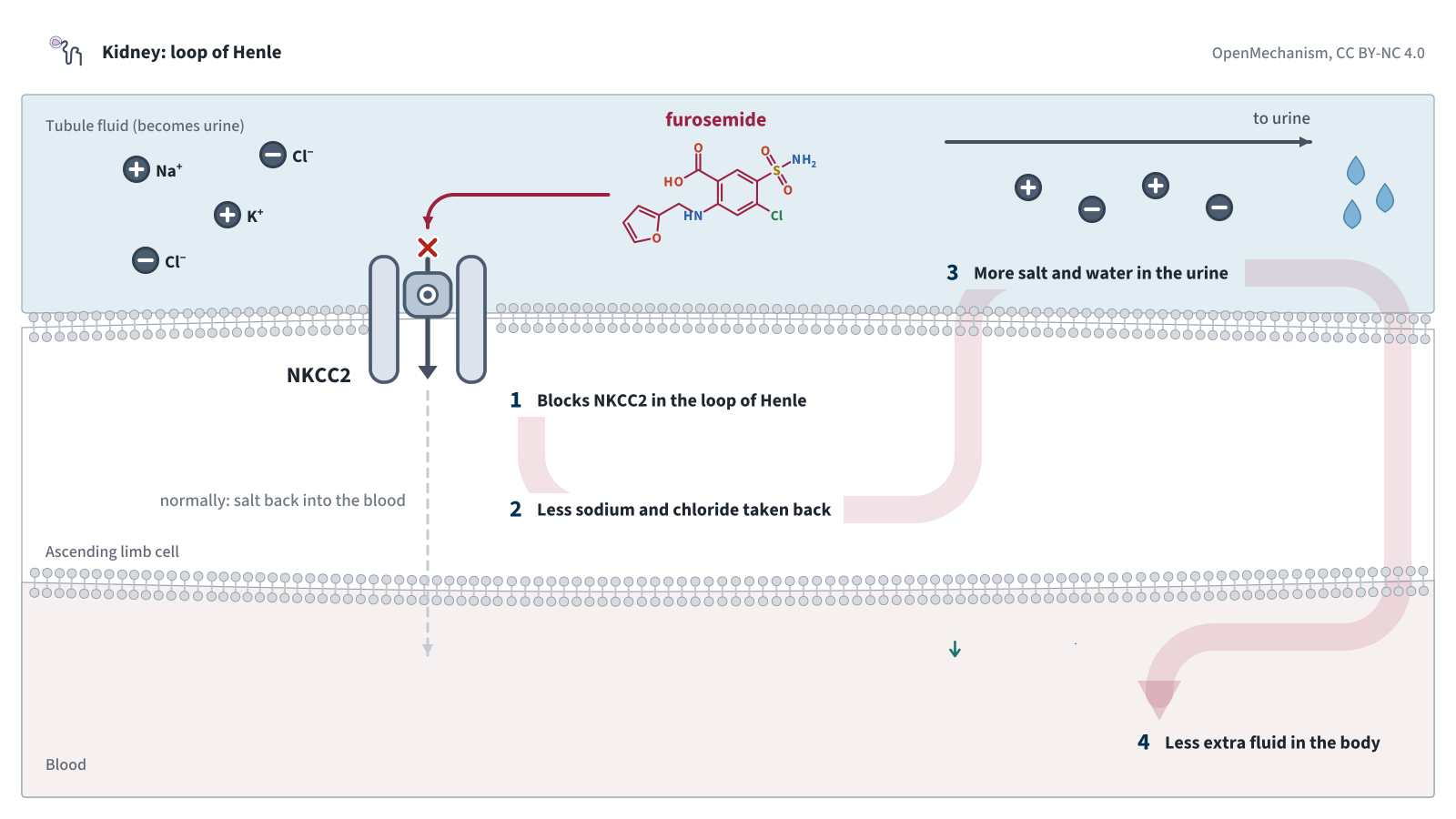
Key terms in this drawing
- NKCC2
- Sodium-potassium-chloride cotransporter 2. A carrier in the loop of Henle, in the kidney, that moves sodium, potassium and chloride together; furosemide blocks it.
How it works
Blocks NKCC2 in the loop of Henle. Furosemide inhibits the Na⁺-K⁺-2Cl⁻ cotransporter 2 (NKCC2) in the ascending limb of the loop of Henle.1
Less sodium and chloride taken back. The label says it inhibits mainly the absorption of sodium and chloride, not only in the proximal and distal tubules but also in the loop of Henle, and that its high efficacy is largely due to this site of action.2
More salt and water in the urine. Furosemide is a potent natriuretic (sodium-excreting) medicine; after a dose by mouth, diuresis begins within 1 hour, peaks in the first or second hour and lasts 6 to 8 hours.1,2
Less extra fluid in the body. It is used to reduce extracellular fluid volume expansion (extra fluid outside the cells) in heart failure, liver cirrhosis and kidney disease.1,2
For teachers: download this drawing.
See also
Condition pages: fluid retention, heart failure and high blood pressure.
Side effects: low blood potassium (hypokalemia).
Other diuretics: amiloride, chlorthalidone, finerenone, hydrochlorothiazide, spironolactone, tolvaptan and torsemide.
Explained: digoxin and diuretics; why diuretics can lower potassium; lithium and NSAIDs, diuretics or ACE inhibitors; and why NSAIDs can harm the kidneys.
Body systems: kidney; and heart, vessels & cholesterol.
Sources
- 1Everything we always wanted to know about furosemide but were afraid to askHuang X et al., Am J Physiol Renal Physiol 2016 (abstract)
- 2Lasix (furosemide) tablets: FDA labelIndications and Usage; Clinical Pharmacology; Warning
- 3ChEMBL CHEMBL35Target and action classification: Sodium-(potassium)-chloride cotransporter 2 inhibitor
Spotted a mistake? Report an error (hello@openmechanism.com). Since launch, every published error we fix is listed on the corrections page.
Notes and limits
- A schematic teaching drawing: not to scale, not exact structures, binding poses or a complete pathway, and not a guide to dosing, treatment or how a person will respond.
- A 2016 review notes undesirable consequences of furosemide, such as worsening of kidney function and unpredictable effects on sodium balance, and gaps in what is known about its renal and systemic effects.
- The label warns that furosemide is a potent diuretic and that, in excessive amounts, it can cause a large loss of water and salts (electrolytes).
- The label's account comes from micropuncture studies in rats, stop-flow experiments in dogs and clearance studies in people and animals.
All recorded limits are on the evidence page, and notes that apply to every page are on How to read a page. Version 1.0.1, medically reviewed by Daniel Tran, PharmD, on 29 October 2026.
Cite this page
Tran D. Furosemide [Internet]. OpenMechanism; 2026 [updated 2026 Oct 29; cited 2026 Oct 29]. Available from: https://openmechanism.com/medicines/furosemide