X-linked hypophosphatemia
X-linked hypophosphatemia is an inherited disease of phosphate: variants that switch off the PHEX gene lead to high levels of FGF23. FGF23 stops the kidney tubules taking back phosphate and lowers the kidney's production of active vitamin D, and low phosphate causes rickets, soft bones (osteomalacia), poor growth and bone pain. Burosumab blocks FGF23.
- Where
- Kidneys and bones
- Body systems
- Kidney; Muscles, bones & joints
- Medicines
- 1 medicine
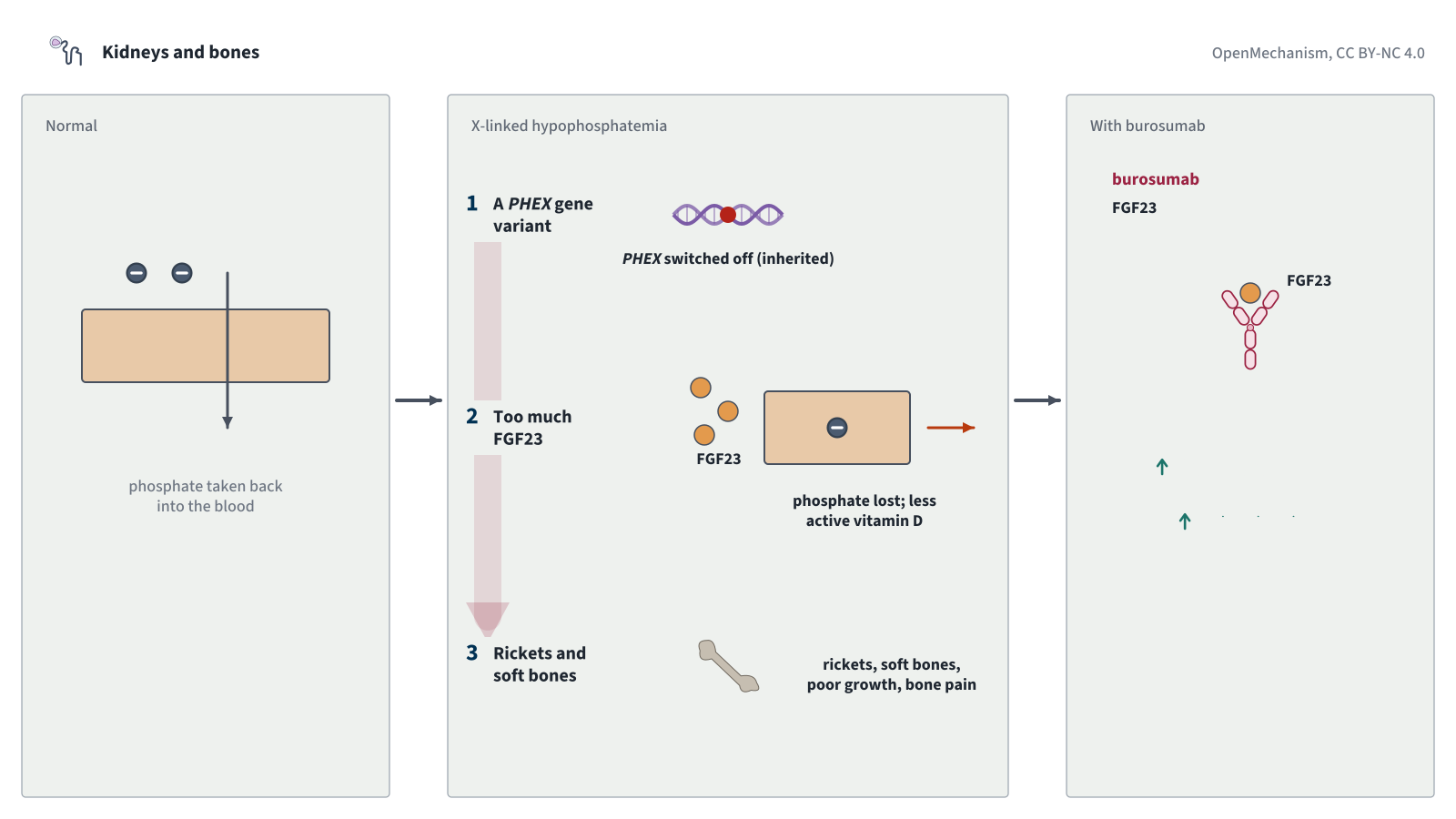
For teachers: download this drawing.
Key terms in this drawing
- FGF23
- Fibroblast growth factor 23. A growth factor that is high in X-linked hypophosphatemia and is thought to cause many of the disease's effects.
- PHEX
- PHEX gene. A gene on the X chromosome; mutations that switch it off cause X-linked hypophosphatemia.
What goes wrong
A PHEX gene variant. Variants that switch off the gene cause this inherited disease of phosphate.1
What the source says
“X-linked hypophosphatemia (XLH) is an inherited disease of phosphate metabolism in which inactivating mutations of the Phosphate Regulating Endopeptidase Homolog, X-Linked (PHEX) gene lead to local and systemic effects”
Source 1Too much FGF23. is raised; it stops the kidney tubules taking back phosphate and lowers the kidney's production of active vitamin D (1,25-dihydroxyvitamin D).1,2
What the source says
“Patients with XLH present with elevated levels of fibroblast growth factor 23 (FGF23), which is thought to mediate many of the aforementioned manifestations of the disease.”
Source 1“X-linked hypophosphatemia is caused by excess fibroblast growth factor 23 (FGF23) which suppresses renal tubular phosphate reabsorption and the renal production of 1,25 dihydroxy vitamin D.”
Source 2Rickets and soft bones. Low phosphate leads to poor growth, rickets, soft bones (osteomalacia), bone pain and other problems.1
Where medicines act
- A
Burosumab: FGF23 blocked
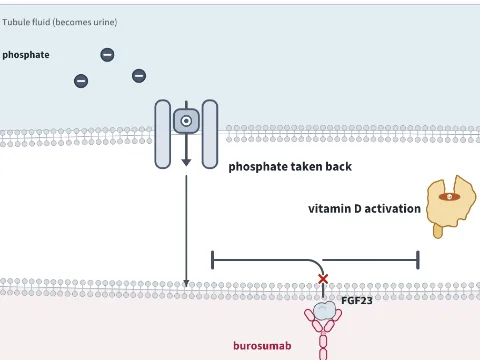
Burosumab, an antibody, binds FGF23 and blocks it, so the kidneys take back phosphate again and active vitamin D rises.2
What the source says
“Burosumab-twza binds to and inhibits the biological activity of FGF23 restoring renal phosphate reabsorption and increasing the serum concentration of 1,25 dihydroxy vitamin D.”
Source 2“The treatment of X-linked hypophosphatemia (XLH) in adult and pediatric patients 6 months of age and older.”
Source 2
See also
Body systems: kidney; and muscles, bones & joints.
Related medicines: calcitriol and ergocalciferol (vitamin D2).
Other conditions: hypoparathyroidism, chronic kidney disease, secondary hyperparathyroidism and primary hyperparathyroidism.
Sources
- 1FGF23 and its role in X-linked hypophosphatemia-related morbidityBeck-Nielsen SS et al. Orphanet J Rare Dis 2019 (abstract). Saved copy
- 2Crysvita (burosumab-twza): FDA label1 Indications and Usage; 12.1 Mechanism of Action. Saved copy
Notes and limits
- How FGF23 causes each part of the disease is not fully understood.1
Notes that apply to every page are on How to read a page.
Spotted a mistake? Report an error (hello@openmechanism.com). Since launch, every published error we fix is listed on the corrections page.
Cite this page
Tran D. X-linked hypophosphatemia [Internet]. OpenMechanism; 2026 [updated 2026 Oct 16; cited 2026 Oct 16]. Available from: https://openmechanism.com/conditions/x-linked-hypophosphatemia