Chlorthalidone
Chlorthalidone appears to work like the thiazide diuretics, at the distal convoluted tubule, so more sodium, chloride and water are lost in the urine for up to 72 hours. It is long-lived ( 40 to 60 hours). Losing sodium and water appears to underlie its blood-pressure lowering, though the mechanism is not wholly clear.
- Acts on
- The distal convoluted tubule (apparently), like the thiazides
- Where
- Kidney tubules
- Medicine type
- Small molecule
- Used for
- Heart & circulation
- Drug class
- Diuretics, Thiazide diuretics
Also called Thalitone.
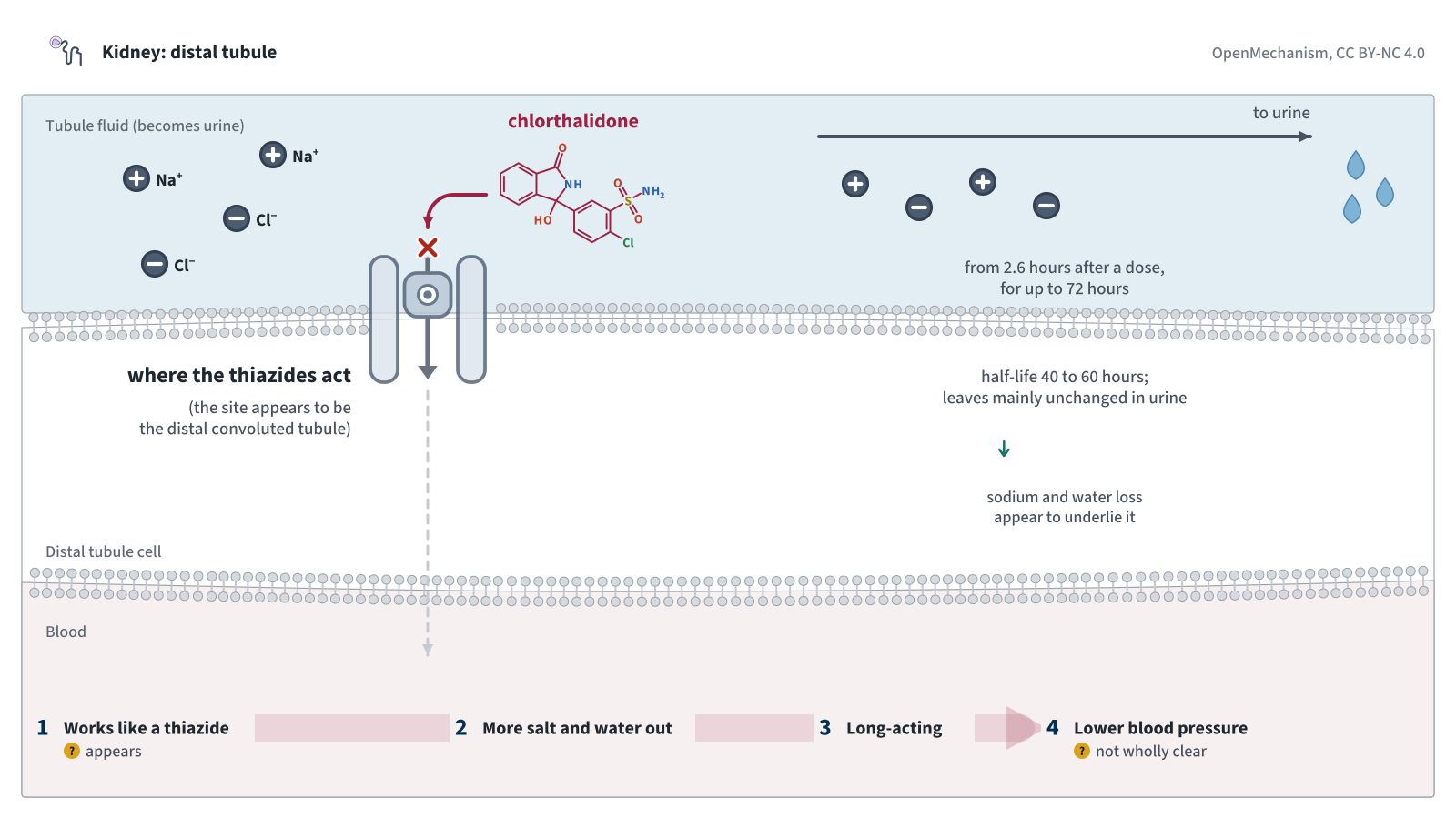
Step 1: appears
The Thalitone label says: The diuretic effects of chlorthalidone and the benzothiadiazine (thiazide) diuretics appear to arise from similar mechanisms and the maximal effect of chlorthalidone and the thiazides appear to be similar. The site of the action appears to be the distal convoluted tubule of the nephron.
Clinical study: In SHEP, a randomized, double-blind, placebo-controlled trial in 4736 people aged 60 or over with isolated systolic hypertension, with low-dose chlorthalidone as the first step; the trial measured stroke and blood pressure, not where chlorthalidone acts: The 5-year average systolic blood pressure was 155 mm Hg for the placebo group and 143 mm Hg for the active treatment group
SHEP Cooperative Research Group, JAMA 1991 (PMID 2046107)
This study was picked with a literature search and is not yet checked by our reviewer.
Step 4: not wholly clear
The Thalitone label says: Although the mechanism of action of chlorthalidone and related drugs is not wholly clear, sodium and water depletion appear to provide a basis for its antihypertensive effect.
Clinical study: In the same trial (SHEP), which measured stroke, not how chlorthalidone lowers blood pressure: antihypertensive stepped-care drug treatment with low-dose chlorthalidone as step 1 medication reduced the incidence of total stroke by 36%
SHEP Cooperative Research Group, JAMA 1991 (PMID 2046107)
This study was picked with a literature search and is not yet checked by our reviewer.
Key terms in this drawing
- half-life
- Half-life. The time it takes for the amount in the blood to fall by half.
How it works
Works like a thiazide. Chlorthalidone's diuretic effect appears to arise from mechanisms similar to the thiazide diuretics', with a similar maximal effect; its site of action appears to be the distal convoluted tubule.1
More salt and water out. Its diuretic action starts about 2.6 hours after a dose and lasts up to 72 hours, with more sodium and chloride excreted.1
Long-acting. Its plasma half-life is about 40 to 60 hours; it is eliminated mainly unchanged in the urine.1
Lower blood pressure. Although the mechanism is not wholly clear, sodium and water depletion appear to provide a basis for its antihypertensive effect.1
For teachers: download this drawing.
See also
Condition pages: fluid retention and high blood pressure.
Other diuretics: amiloride, finerenone, furosemide, hydrochlorothiazide, spironolactone, tolvaptan and torsemide.
Body systems: kidney; and heart, vessels & cholesterol.
Sources
- 1Thalitone (chlorthalidone): FDA label12.1 Mechanism of Action; 12.2 Pharmacodynamics; 12.3 Pharmacokinetics
- 2ChEMBL CHEMBL1055Target and action classification: Thiazide-sensitive sodium-chloride cotransporter inhibitor
- 3Prevention of stroke by antihypertensive drug treatment in older persons with isolated systolic hypertension. Final results of the Systolic Hypertension in the Elderly Program (SHEP)SHEP Cooperative Research Group. JAMA 1991 (abstract)
Spotted a mistake? Report an error (hello@openmechanism.com). Since launch, every published error we fix is listed on the corrections page.
Notes and limits
- A schematic teaching drawing: not to scale, not exact structures, binding poses or a complete pathway, and not a guide to dosing, treatment or how a person will respond.
- The label says the mechanism appears to be similar to the thiazides' and the site of action appears to be the distal convoluted tubule.
- The label says the mechanism of action of chlorthalidone and related medicines is not wholly clear.
All recorded limits are on the evidence page, and notes that apply to every page are on How to read a page. Version 1.0.0, not yet medically reviewed.
Cite this page
Tran D. Chlorthalidone [Internet]. OpenMechanism; 2026 [updated 2026 Oct 14; cited 2026 Oct 14]. Available from: https://openmechanism.com/medicines/chlorthalidone