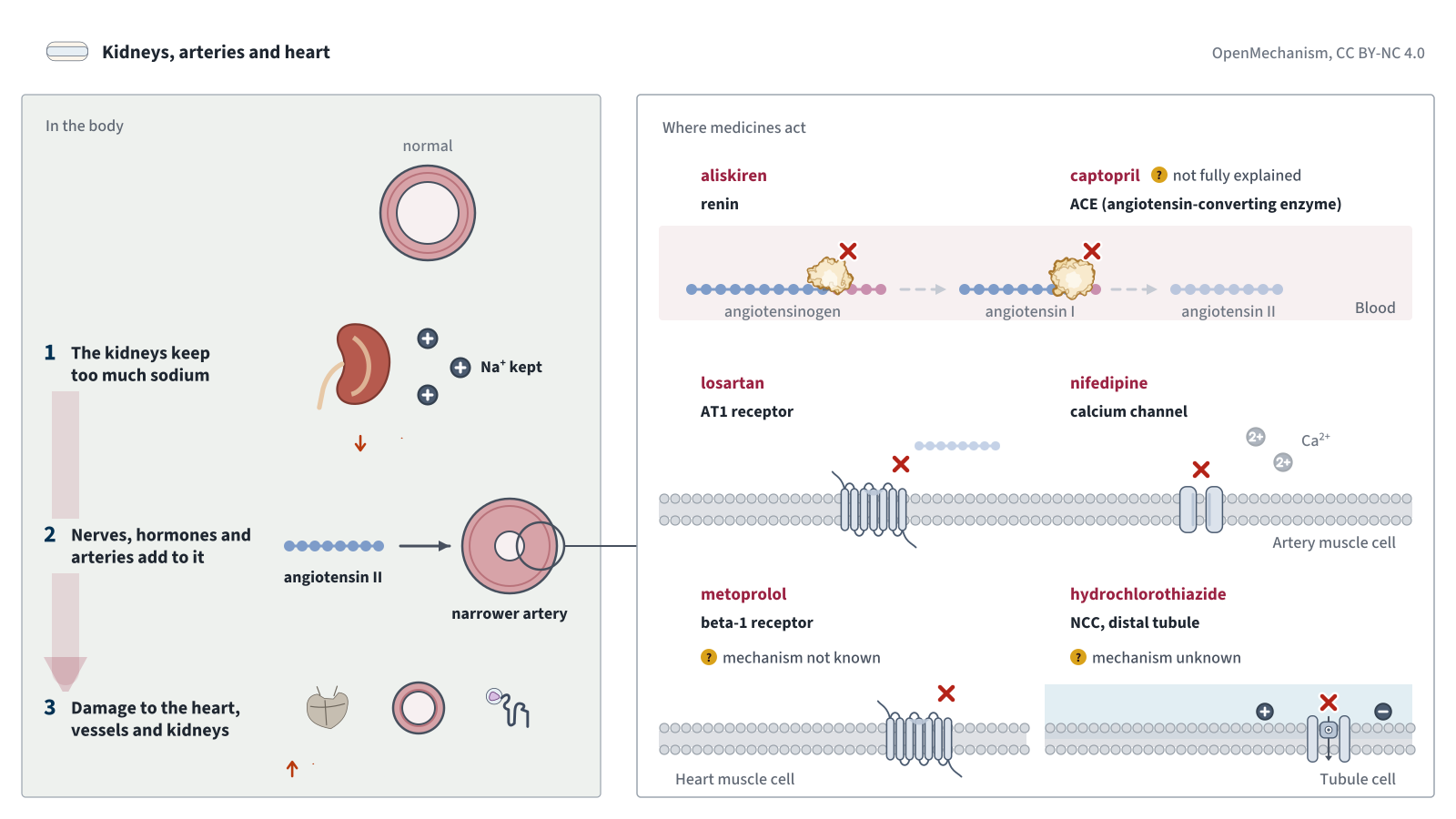
Essential high blood pressure depends on a primary or secondary inability of the kidneys to get rid of sodium at a normal blood pressure, and nerves, hormones such as angiotensin II and the arteries add to it. It often damages the heart, vessels and kidneys. Medicines act on the angiotensin chain in the blood, on the artery muscle, on the heart and in the kidney.
What goes wrong in high blood pressure, and where medicines act. Schematic, not to scale. ACE outline from the structure with lisinopril. License CC BY-NC 4.0.
?Not fully explained
The captopril label says: The mechanism of action of captopril tablets have not yet been fully elucidated. … Increased concentrations of bradykinin or prostaglandin E may also have a role in the therapeutic effect of captopril tablets.
Clinical study: In a 1998 randomized, single-blind study of 27 people (20 with normal and 7 with high blood pressure), studied while salt-depleted (10 mmol of sodium a day) and given the drugs on four separate study days, a bradykinin-receptor blocker weakened captopril's effect on blood pressure: These data confirm that bradykinin contributes to the short-term effects of ACE inhibition on blood pressure in normotensive and hypertensive personsGainer JV et al., N Engl J Med 1998 (PMID 9791144)
?Mechanism not known
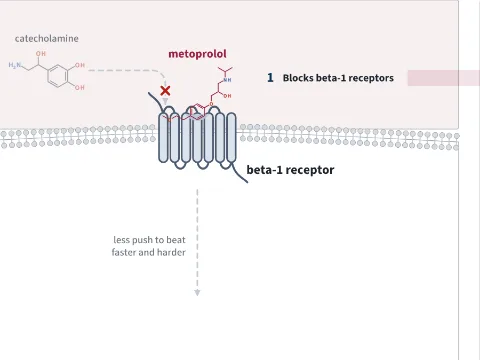
The Toprol-XL (metoprolol) label says: Hypertension: The mechanism of the antihypertensive effects of beta-blocking agents has not been elucidated. However, several possible mechanisms have been proposed: (1) competitive antagonism of catecholamines at peripheral (especially cardiac) adrenergic neuron sites, leading to decreased cardiac output; (2) a central effect leading to reduced sympathetic outflow to the periphery; and (3) suppression of renin activity.
Clinical study: In a study in people with essential high blood pressure, recordings from a leg nerve made before and during long-term metoprolol treatment showed less sympathetic activity during treatment than before it: Metoprolol treatment lowered blood pressure and heart rate in all subjects. … It is suggested that the reduction of sympathetic vasoconstrictor outflow to muscles contributed to the blood pressure reduction.Wallin BG et al., Hypertension 1984 (PMID 6378790)
?Mechanism unknown
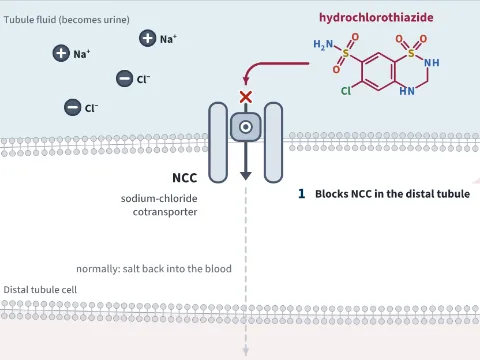
The hydrochlorothiazide label says: The mechanism of the antihypertensive effect of thiazides is unknown.
Clinical study: In 13 people with high blood pressure given hydrochlorothiazide 100 mg daily (measured to 12 weeks, and 9 of them also at 24 and 36 weeks), blood pressure fell, but resistance in the blood vessels fell only in those who responded well: Hydrochlorothiazide lowered mean arterial pressure (p less than 0.01). … Consequently, total peripheral resistance was lowered only in responders.van Brummelen P et al., Clin Pharmacol Ther 1980 (PMID 6987024)
Angiotensin-converting enzyme. The enzyme that makes angiotensin II from angiotensin I.
angiotensin II
Angiotensin II. A hormone that strongly tightens blood vessels; ACE makes it from angiotensin I.
AT1 receptor
Angiotensin II type 1 receptor. The receptor angiotensin II acts on to tighten blood vessels and stimulate aldosterone release.
beta-1 receptor
Beta-1 adrenergic receptor. A receptor, mainly in the heart, through which catecholamines make the heart beat faster and harder.
NCC
Sodium-chloride cotransporter. A salt carrier in the kidney tubule; it helps set blood pressure and is the target of thiazide diuretics.
renin
Renin. An enzyme that cuts angiotensinogen to make angiotensin I.
What goes wrong
The kidneys keep too much sodium. Essential high blood pressure depends on a primary or secondary inability of the kidneys to get rid of sodium at a normal blood pressure.1
What the source says
“The pathophysiology of essential hypertension depends on the primary or secondary inability of the kidney to excrete sodium at a normal blood pressure.”
Nerves, hormones and arteries add to it. The nervous system, hormones and the arteries also play a part; , for example, narrows the vessels and is an important part of high blood pressure.1,2
What the source says
“The central nervous system, endocrine factors, the large arteries, and the microcirculation also have roles in the disorder.”
“is a potent vasoconstrictor, the primary vasoactive hormone of the renin-angiotensin system, and an important component in the pathophysiology of hypertension.”
Damage to the heart, vessels and kidneys. High blood pressure is common and long-lasting and often damages the heart, blood vessels and kidneys; lowering it reduces the risk of strokes and heart attacks.1,3
What the source says
“Hypertension is a frequent, chronic, age-related disorder, which often entails debilitating cardiovascular and renal complications.”
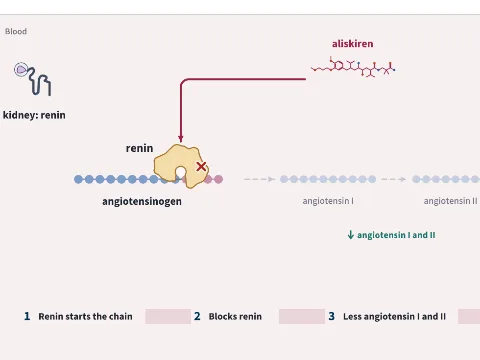
“Tekturna is a renin inhibitor (RI) indicated for the treatment of hypertension in adults and in pediatric patients weighing 50 kg or greater who are at least 6 years of age, to lower blood pressure.”
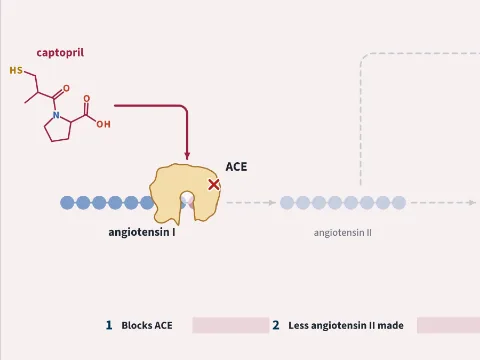
Blocks , so less angiotensin II is made; how it lowers blood pressure is not fully worked out.5
Used forHigh blood pressure: from the start with normal kidney function; with impaired kidney function, only after other medicines caused unacceptable side effects or drug combinations did not work
What the label says
“specific competitive inhibitor of angiotensin I-converting enzyme (ACE), the enzyme responsible for the conversion of angiotensin I to angiotensin II.”
“In patients with impaired renal function, particularly those with collagen vascular disease, captopril should be reserved for hypertensives who have either developed unacceptable side effects on other drugs, or have failed to respond satisfactorily to drug combinations.”
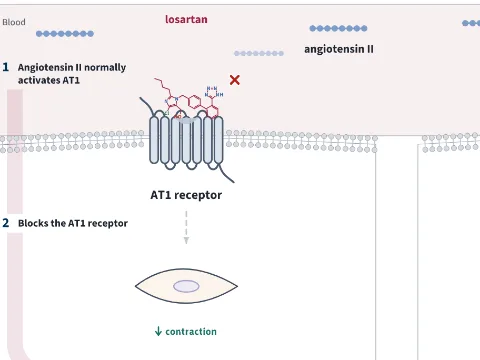
Blocks angiotensin II from binding the on artery muscle and elsewhere, so angiotensin II narrows vessels and releases less.2
Used forHigh blood pressure: adults and children 6 and older
What the label says
“Losartan and its principal active metabolite block the vasoconstrictor and aldosterone-secreting effects of angiotensin II by selectively blocking the binding of angiotensin II to the AT 1 receptor found in many tissues, (e.g., vascular smooth muscle, adrenal gland).”
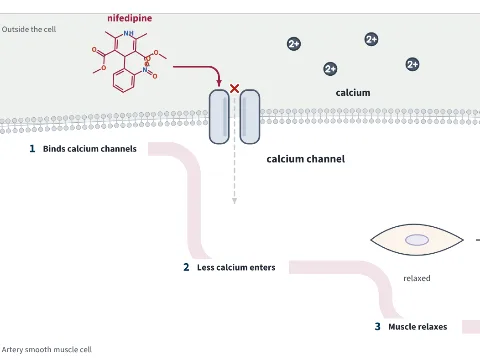
“The mechanism by which nifedipine reduces arterial blood pressure involves peripheral arterial vasodilatation and, consequently, a reduction in peripheral vascular resistance.”
“The binding of nifedipine to voltage-dependent and possibly receptor-operated channels in vascular smooth muscle results in an inhibition of calcium influx through these channels.”
“However, several possible mechanisms have been proposed: (1) competitive antagonism of catecholamines at peripheral (especially cardiac) adrenergic neuron sites, leading to decreased cardiac output;”
Acts on salt reabsorption in the distal tubule, where thiazides target , so more sodium and chloride leave in the urine; how thiazides lower blood pressure is unknown.7,8
Used forHigh blood pressure: alone, or with other medicines in its more severe forms
What the label says
“Hydrochlorothiazide USP is a diuretic and antihypertensive.”
Also used for it: labetalol (“control of blood pressure in severe hypertension”9); nicardipine (in adults: “short-term treatment of hypertension when oral therapy is not feasible or not desirable”10); esmolol (“short-term treatment of tachycardia and hypertension that occur during induction and tracheal intubation, during surgery, on emergence from anesthesia and in the postoperative period”11); and minoxidil (because of the potential for serious adverse effects, only for high blood pressure with symptoms or organ damage that full doses of a diuretic and two other medicines do not control: “minoxidil tablets are indicated only in the treatment of hypertension that is symptomatic or associated with target organ damage and is not manageable with maximum therapeutic doses of a diuretic plus two other antihypertensive drugs.”12).
Human renin with aliskirenPDB 2V0Z; Rahuel, J. et al. Chem.Biol. 2000;7:493-504. The renin outline in the drawing is traced from this structure. Saved copy
High blood pressure mostly comes from many genes acting with the environment; the review calls the idea that a few major genes explain essential high blood pressure an oversimplification.1
text ae4f701c647f…; drawings 2b6e0d4d8f21…; notes ca1066da4b2d…
AI source check
Claude Opus 5.5 (AI source check), 28 October 2026: 95 statements compared with their sources, 6 flagged for the reviewer. An automated check, not a medical review.
Conflict of interest
Spironolactone: Pfizer, the reviewer's former employer, makes or markets this medicine. Labetalol: Pfizer, the reviewer's former employer, makes or markets this medicine. Details
Key terms
Definitions reworded since this review: AT1 receptor and beta-1 receptor. Definitions are shared across pages, so a later rewording does not take the review line off (what a review covers).
Next review due
28 April 2028
Cite this page
Tran D. High blood pressure [Internet]. OpenMechanism; 2026 [updated 2026 Oct 28; cited 2026 Oct 28]. Available from: https://openmechanism.com/conditions/high-blood-pressure