Primary hyperoxaluria type 1
Primary hyperoxaluria type 1 is a rare, severe inherited disease: a variant in the AGXT gene leaves the liver without the enzyme alanine-glyoxylate aminotransferase (AGT). Glyoxylate that AGT should handle is available to make oxalate, which forms kidney stones and can lead to kidney failure. Lumasiran lowers the enzyme upstream (glycolate oxidase), so less glyoxylate is made.
- Where
- Liver and kidneys
- Body systems
- Kidney, Hormones & metabolism
- Medicines
- 1 medicine
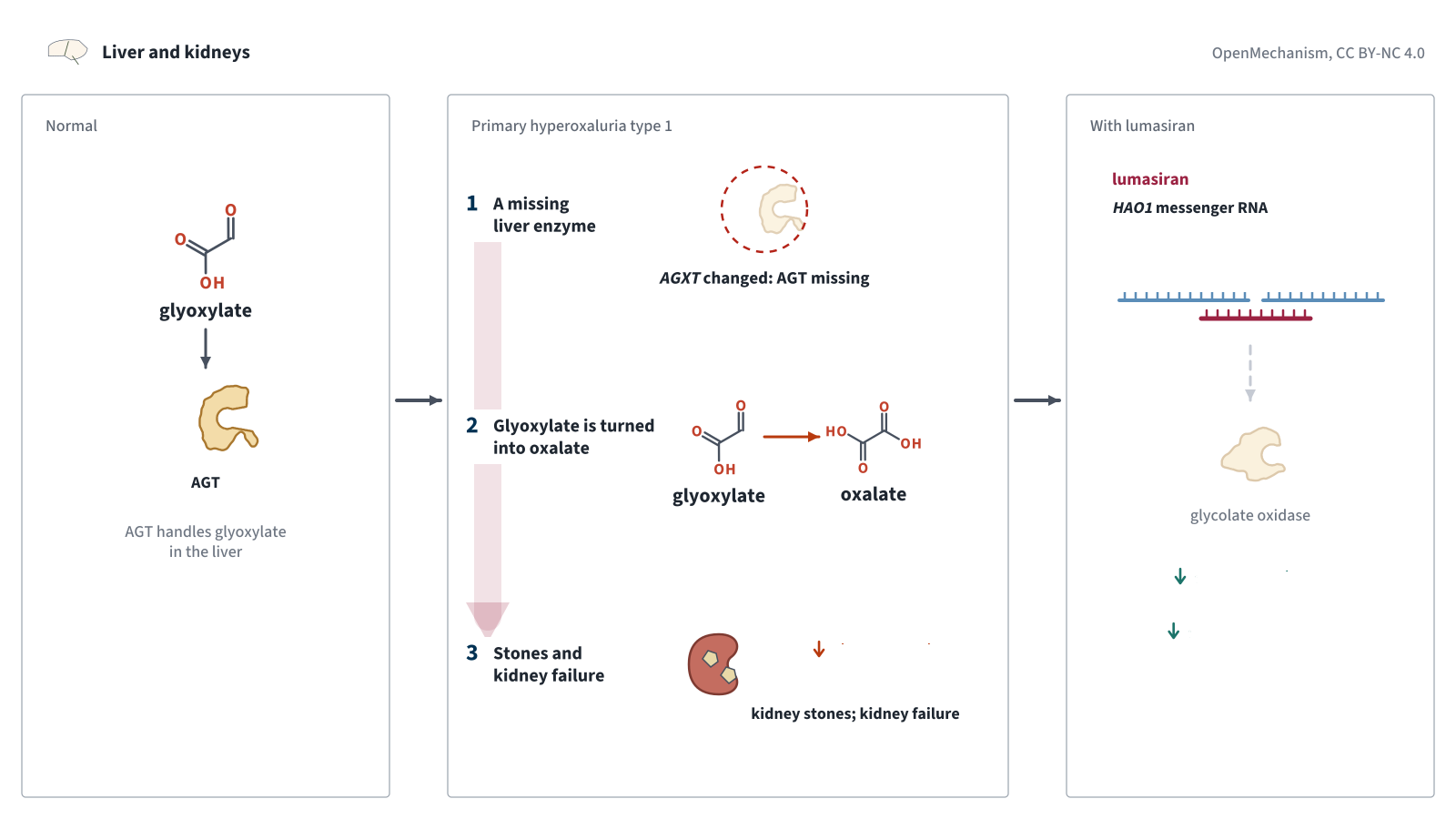
For teachers: download this drawing.
Key terms in this drawing (5)
- AGT
- Alanine-glyoxylate aminotransferase. A liver enzyme of oxalate metabolism; a mutation in its gene, AGXT, causes primary hyperoxaluria type 1.
- AGXT
- AGXT gene. The gene for the liver enzyme AGT; a mutation in it causes primary hyperoxaluria type 1.
- HAO1
- HAO1 gene (hydroxyacid oxidase 1). The gene whose messenger RNA codes for glycolate oxidase; lumasiran targets that message in liver cells.
- mRNA
- Messenger RNA. A copy of a gene that a cell reads to make a protein.
- RNA
- Ribonucleic acid. A molecule copied from DNA; messenger RNA carries a gene's instructions.
What goes wrong
A missing liver enzyme. A variant in the gene leaves the liver without alanine-glyoxylate aminotransferase (), an enzyme in its peroxisomes.1
What the source says
“is a rare and severe autosomal recessive disease of oxalate metabolism, resulting from a mutation in the AGXT gene that encodes the hepatic peroxisomal enzyme alanine-glyoxylate aminotransferase (AGT).”
Source 1Glyoxylate is turned into oxalate. Glyoxylate, upstream of the deficient AGT, is a substrate for oxalate production.2
Stones and kidney failure. Kidney stones are frequent, and people with can progress to kidney failure, once treated with kidney and liver transplants.1
Where medicines act
- A
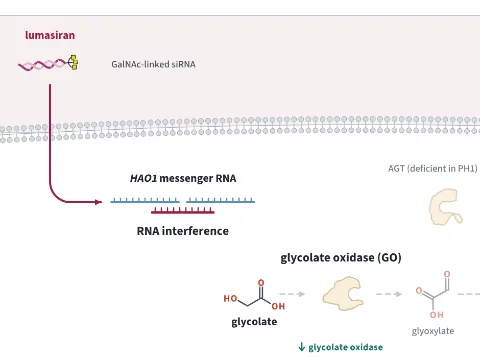
Lumasiran: less glycolate oxidase made
Lumasiran, an , targets the in liver cells, lowering glycolate oxidase, so less glyoxylate is available; it lowers urine and blood oxalate in PH1.2
What the source says
“Lumasiran reduces levels of glycolate oxidase (GO) enzyme by targeting the hydroxyacid oxidase 1 ( HAO1 ) messenger ribonucleic acid (mRNA) in hepatocytes through RNA interference.”
Source 2“OXLUMO is indicated for the treatment of primary hyperoxaluria type 1 (PH1) to lower urinary and plasma oxalate levels in pediatric and adult patients”
Source 2
See also
Body systems: kidney and hormones & metabolism.
Other conditions: cystinosis, diabetes insipidus, Fabry disease, high calcium from cancer, primary aldosteronism and primary hyperparathyroidism.
Sources
- 1Primary hyperoxaluria type 1: novel therapies at a glanceBacchetta J, Lieske JC. Clin Kidney J 2022 (abstract). Saved copy
- 2Oxlumo (lumasiran): FDA label1 Indications and Usage; 12.1 Mechanism of Action. Saved copy
- 3Human alanine:glyoxylate aminotransferase (AGT) with its cofactorPDB 1H0C; Zhang, X. et al. J.Mol.Biol. 2003;331:643. The AGT outline in the drawing is traced from this structure. Saved copy
- 4Human glycolate oxidase with an inhibitorPDB 2RDT; Murray, M.S. et al. Biochemistry 2008;47:2439-2449. The glycolate oxidase outline in the drawing is traced from this structure. Saved copy
Notes and limits
- Long-term data on whether these medicines preserve kidney function and reduce stones are still to come.1
Notes that apply to every page are on How to read a page.
Spotted a mistake? Report an error (hello@openmechanism.com). Since launch, every published error we fix is listed on the corrections page.
Cite this page
Tran D. Primary hyperoxaluria type 1 [Internet]. OpenMechanism; 2026 [updated 2026 Oct 16; cited 2026 Oct 16]. Available from: https://openmechanism.com/conditions/primary-hyperoxaluria-type-1