Chronic hives (urticaria)
Hives (urticaria), an inflammatory skin disorder that up to 20% of people have at some point, brings wheals, deeper swelling or both as skin mast cells release histamine. Chronic spontaneous urticaria affects about 1% of people and usually lasts over a year; in over half, autoantibodies activate the mast cells. Omalizumab lowers free IgE, though how this helps is unknown.
- Where
- Skin
- Body systems
- Skin, hair & nails; Immune system
- Medicines
- 1 medicine
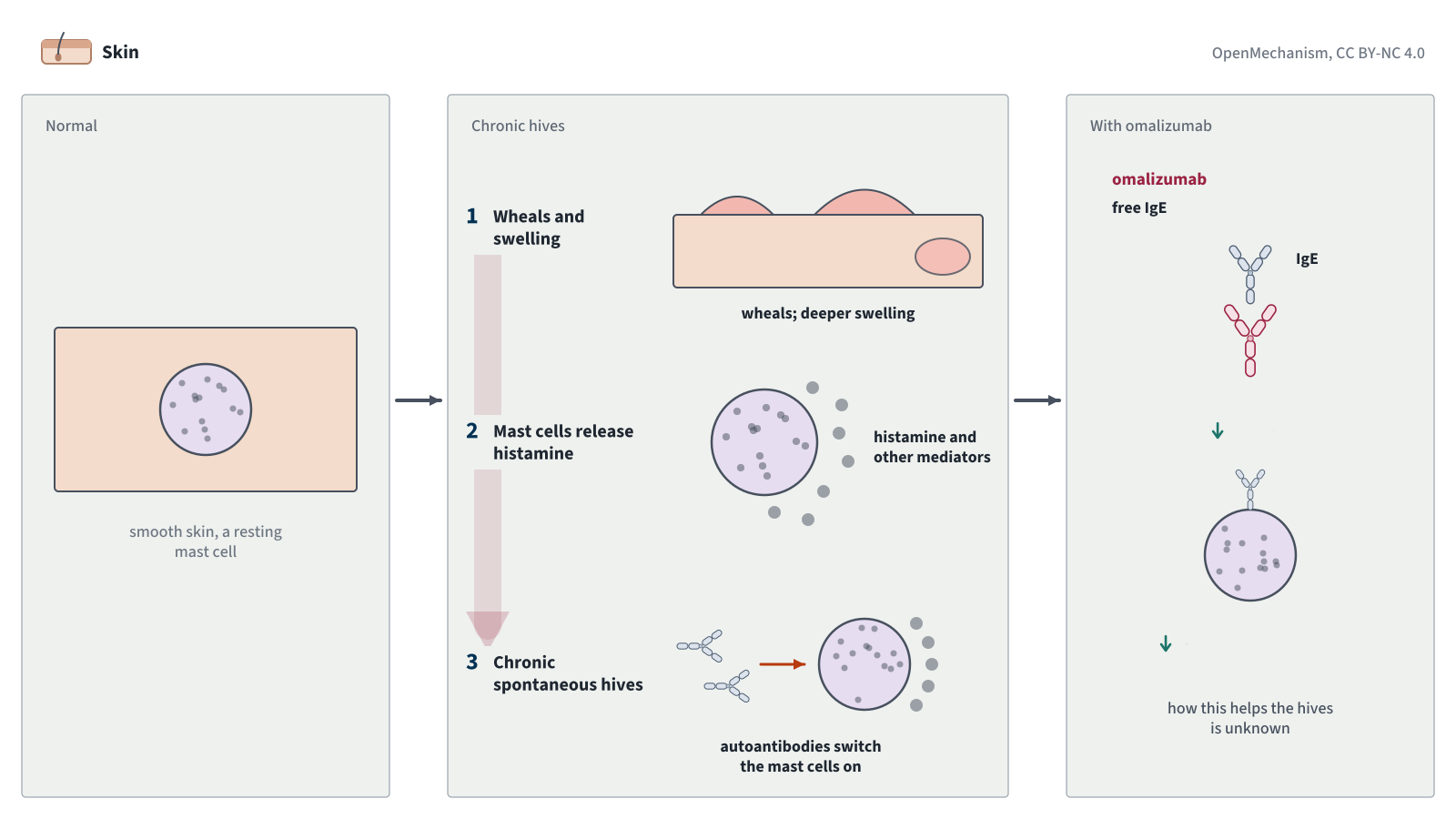
For teachers: download this drawing.
Key terms in this drawing
- IgE
- Immunoglobulin E. A type of antibody involved in allergic reactions.
- mast cell
- Mast cell. An immune cell in tissues such as the skin and the airways that releases histamine and other signals.
What goes wrong
Wheals and swelling. Hives is an inflammatory skin disorder that up to 20% of people have at some point; it causes wheals, deeper swelling (angioedema) or both.1
Mast cells release histamine. The wheals and swelling come from skin being activated and releasing histamine and other mediators.1
What the source says
“due to activation and degranulation of skin mast cells and the release of histamine and other mediators.”
Source 1Chronic spontaneous hives. Chronic spontaneous urticaria affects about 1% of people and lasts more than a year in most; in over half, or autoantibodies activate the mast cells.2
What the source says
“Chronic spontaneous urticaria affects approximately 1% of the general population worldwide”
Source 2“Chronic spontaneous urticaria persists for more than 1 year in most patients”
Source 2“of chronic spontaneous urticaria are mediated by mast cell-activating IgE and/or IgG autoantibodies (>50%).”
Source 2
Where medicines act
- A
Omalizumab: less free IgE
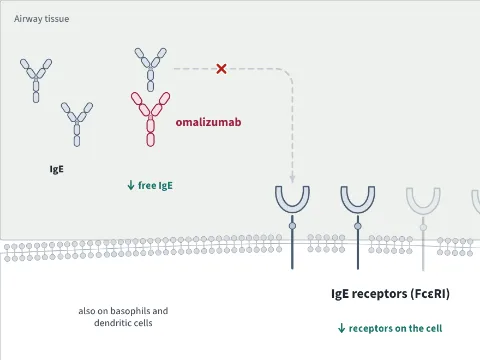
Omalizumab binds IgE and lowers free IgE, and IgE receptors on cells then decrease. It treats chronic spontaneous urticaria that persists despite antihistamines.3
What the source says
“Omalizumab binds to IgE and lowers free IgE levels.”
Source 3“Subsequently, IgE receptors (FcεRI) on cells down-regulate.”
Source 3“XOLAIR is indicated for the treatment of adults and adolescents 12 years of age and older with chronic spontaneous urticaria (CSU) who remain symptomatic despite H1 antihistamine treatment.”
Source 3
See also
Body systems: skin, hair & nails; and immune system.
Related medicines: cetirizine, hydroxyzine and dupilumab.
Other conditions: chronic sinusitis with nasal polyps, asthma, eczema (atopic dermatitis), food allergy, anxiety disorders and chronic obstructive pulmonary disease (COPD).
Sources
- 1UrticariaKolkhir P et al. Nat Rev Dis Primers 2022 (abstract). Saved copy
- 2Chronic spontaneous urticaria: a reviewKolkhir P et al. JAMA 2024 (abstract). Saved copy
- 3Xolair (omalizumab): FDA label1 Indications and Usage; 12.1 Mechanism of Action. Saved copy
Notes and limits
- How omalizumab improves chronic hives is unknown, and at least 30% of patients do not respond well enough.2,3
Notes that apply to every page are on How to read a page.
Spotted a mistake? Report an error (hello@openmechanism.com). Since launch, every published error we fix is listed on the corrections page.
Cite this page
Tran D. Chronic hives (urticaria) [Internet]. OpenMechanism; 2026 [updated 2026 Oct 16; cited 2026 Oct 16]. Available from: https://openmechanism.com/conditions/chronic-hives