Pemphigus
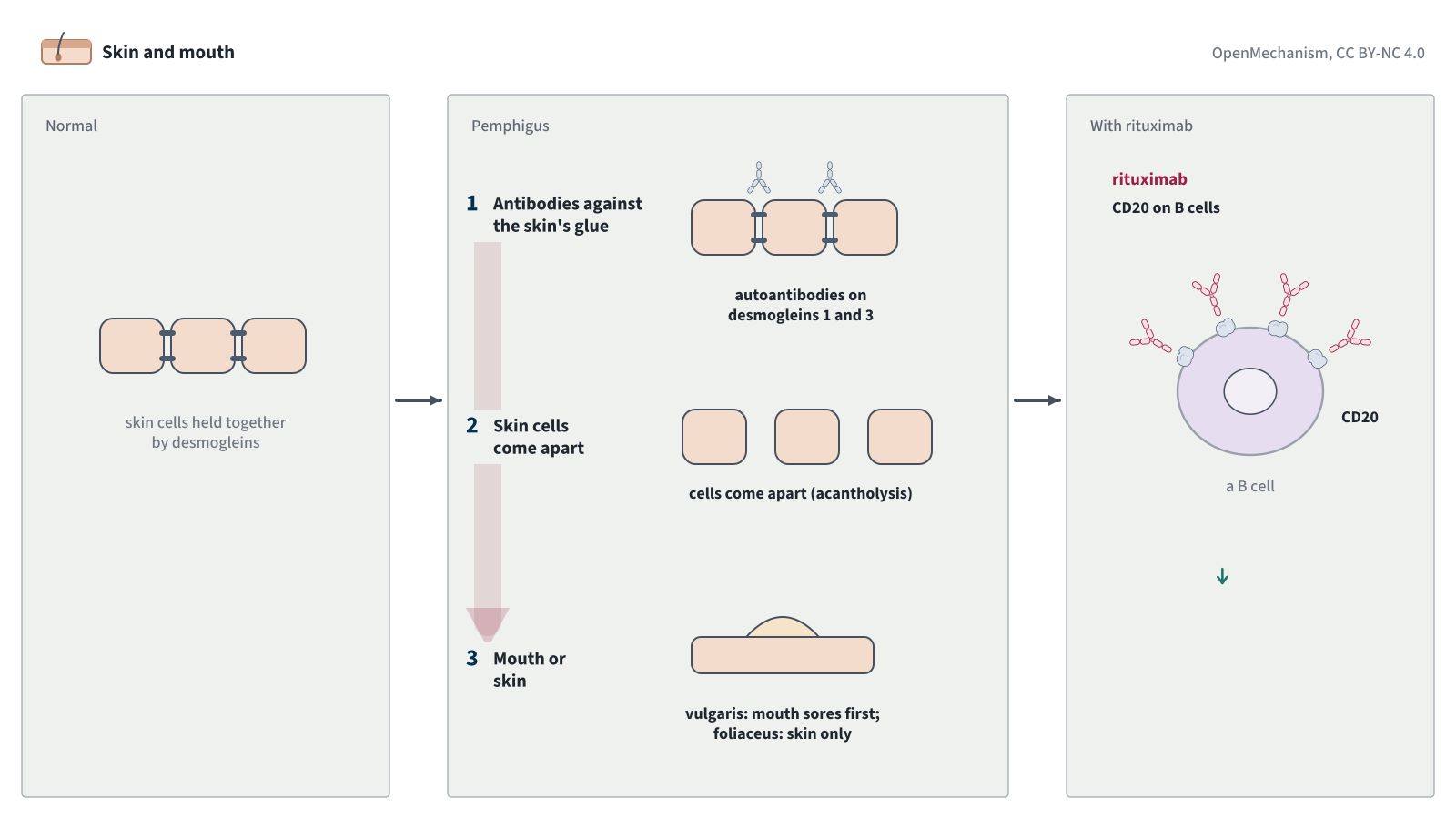
Pemphigus is a group of rare, severe autoimmune blistering diseases. Autoantibodies attack desmogleins 1 and 3, proteins that hold skin and mucosal cells together, and neighboring skin cells come apart (acantholysis). Pemphigus vulgaris often starts with painful mouth sores; pemphigus foliaceus affects only the skin. Rituximab destroys B cells, the cells that make antibodies.
- Where
- Skin and mouth
- Body systems
- Skin, hair & nails; Immune system
- Medicines
- 1 medicine
For teachers: download this drawing.
Key terms in this drawing
- CD20
- CD20 antigen. A molecule on the surface of B cells that rituximab targets.
What goes wrong
Antibodies against the skin's glue. Pemphigus is a group of rare, severe autoimmune blistering diseases: autoantibodies attack desmogleins 1 and 3, proteins that hold skin and mucosal cells together.1
What the source says
“Pemphigus consists of a group of rare and severe autoimmune blistering diseases mediated by pathogenic autoantibodies mainly directed against two desmosomal adhesion proteins, desmoglein (Dsg)1 and Dsg3 (also known as DG1 and DG3), which are present in the skin and surface-close mucosae.”
Source 1Skin cells come apart. When the autoantibodies bind, neighboring skin cells (keratinocytes) separate, a process called acantholysis.1
What the source says
“The binding of autoantibodies to Dsg proteins induces a separation of neighbouring keratinocytes, in a process known as acantholysis.”
Source 1Mouth or skin. Pemphigus vulgaris often starts with painful sores in the mouth; pemphigus foliaceus affects only the skin.1
What the source says
“The two main pemphigus variants are pemphigus vulgaris, which often originates with painful oral erosions, and pemphigus foliaceus, which is characterised by exclusive skin lesions.”
Source 1
Where medicines act
- A
Rituximab: the antibody-making B cells removed
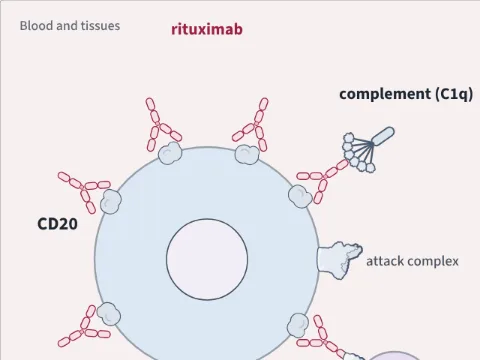
Rituximab binds on B cells and destroys them. In pemphigus, it brought complete remission off treatment in 90% of patients even as steroids were cut back fast. It treats moderate to severe pemphigus vulgaris.1,2
What the source says
“Rituximab is a monoclonal antibody that targets the CD20 antigen expressed on the surface of pre-B and mature B-lymphocytes.”
Source 2“Upon binding to CD20, rituximab mediates B-cell lysis.”
Source 2“Rituximab induces complete remission off therapy in 90% of patients, despite rapid tapering of corticosteroids”
Source 1“Moderate to severe Pemphigus Vulgaris (PV) in adult patients”
Source 2
See also
Body systems: skin, hair & nails; and immune system.
Also used for it: methylprednisolone (“Dermatologic diseases … pemphigus”3), hydrocortisone (“Dermatologic diseases … pemphigus”4) and dexamethasone (“Dermatologic Diseases … Pemphigus”5).
Related medicines: prednisone.
Other conditions: rheumatoid arthritis, psoriatic arthritis, ankylosing spondylitis, Crohn disease, juvenile idiopathic arthritis and lupus nephritis.
Sources
- 1PemphigusSchmidt E et al. Lancet 2019 (abstract). Saved copy
- 2Rituxan (rituximab): FDA label1 Indications and Usage; 12.1 Mechanism of Action. Saved copy
- 3Solu-Medrol (methylprednisolone sodium succinate): FDA labelIndications and Usage. Saved copy
- 4Solu-Cortef (hydrocortisone sodium succinate): FDA labelIndications and Usage. Saved copy
- 5Dexamethasone sodium phosphate injection: FDA labelIndications and Usage. Saved copy
Notes and limits
Notes that apply to every page are on How to read a page.
Spotted a mistake? Report an error (hello@openmechanism.com). Since launch, every published error we fix is listed on the corrections page.
Cite this page
Tran D. Pemphigus [Internet]. OpenMechanism; 2026 [updated 2026 Oct 16; cited 2026 Oct 16]. Available from: https://openmechanism.com/conditions/pemphigus