Eculizumab
Eculizumab binds protein and stops it being split. The membrane attack complex () cannot form, which reduces red blood cell destruction in .
- Acts on
- Complement C5, C5b9 terminal complement complex
- Where
- The complement system in PNH
- Used for
- Immune system
- Drug class
- Antibody medicines
Also called Soliris.
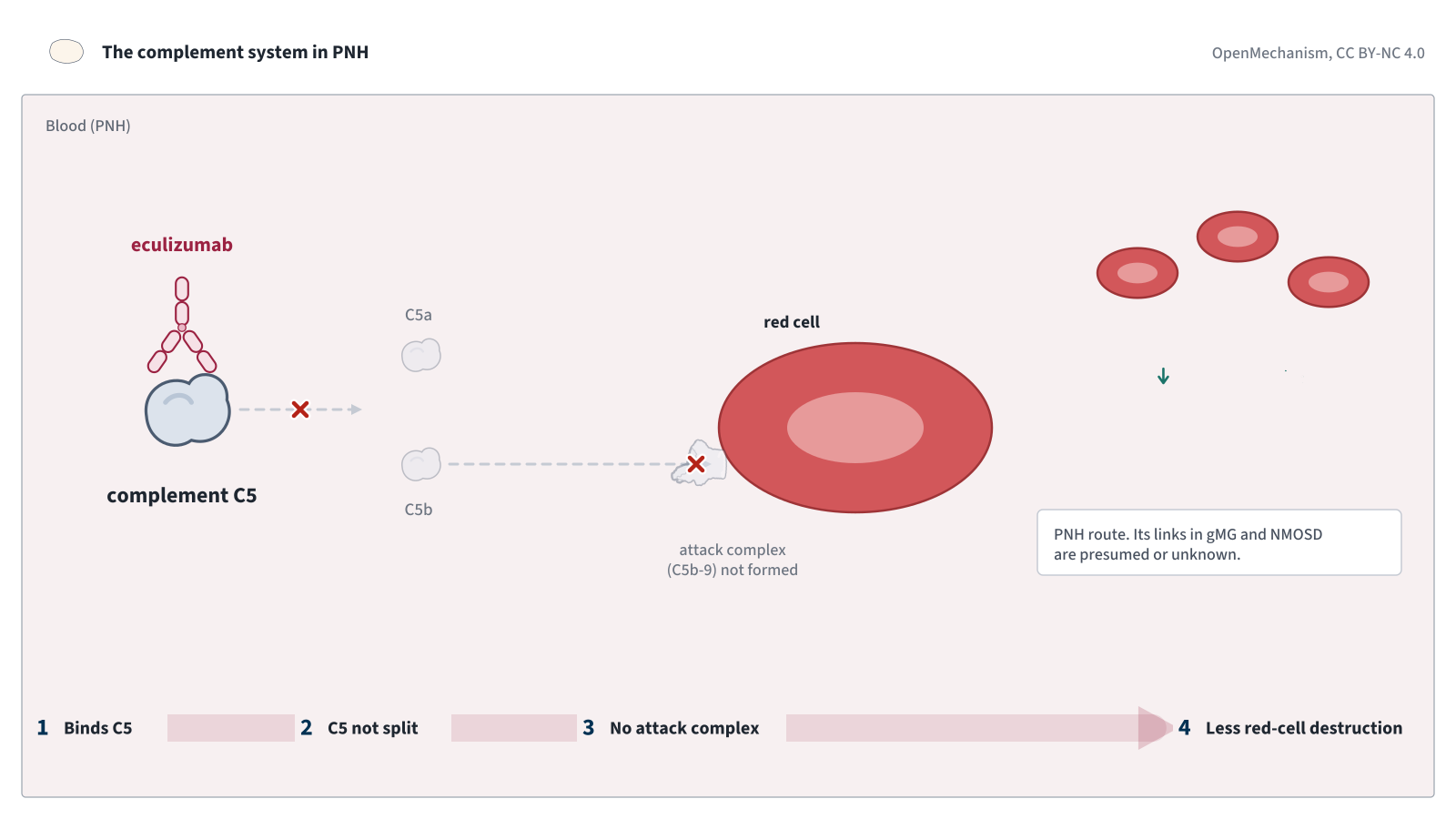
Key terms in this drawing (8)
- C5
- Complement component 5. A complement protein; when split, part of it helps build the membrane attack complex.
- C5a
- Complement component 5a. One of the two pieces that complement C5 is split into; eculizumab binds C5 and stops the split.
- C5b
- Complement component 5b. One of the two pieces that complement C5 is split into; eculizumab binds C5 and stops the split.
- C5b-9
- Terminal complement complex (C5b-9). The terminal complement complex; eculizumab prevents it from being made by stopping complement C5 being split.
- complement
- Complement. A set of blood proteins that can kill a cell an antibody has marked.
- gMG
- Generalized myasthenia gravis. Generalized myasthenia gravis; eculizumab is used for it in people with antibodies to the acetylcholine receptor.
- NMOSD
- Neuromyelitis optica spectrum disorder. An autoimmune disease in which antibodies attack aquaporin-4, the main water channel of the brain and spinal cord.
- PNH
- Paroxysmal nocturnal hemoglobinuria. A blood disease in which complement breaks open red blood cells.
How it works
Binds C5. Eculizumab binds C5 with high .1
C5 not split. C5 cleavage into and is inhibited.1
No attack complex. Reduced C5b generation prevents formation of the terminal C5b9 complex.1
Less red-cell destruction. The label describes inhibition of terminal-complement-mediated hemolysis in PNH.1
For teachers: download this drawing or build a slide deck.
See also
Condition pages: atypical hemolytic uremic syndrome (aHUS), myasthenia gravis, neuromyelitis optica (NMOSD) and paroxysmal nocturnal hemoglobinuria.
Other antibody medicines: adalimumab, bevacizumab, bezlotoxumab, blinatumomab, burosumab, denosumab, dupilumab, emicizumab and 14 more.
More medicines for immune system: anakinra, belatacept, cyclosporine, filgrastim, fingolimod, mycophenolate mofetil, sirolimus, tacrolimus and 2 more.
Explained: why eculizumab raises the risk of meningococcal infections.
Body system: immune system.
Inside the body: the nerve–muscle junction.
Sources
- 1Soliris (eculizumab): FDA label12.1 Mechanism of Action
- 2ChEMBL CHEMBL1201828Target and action classification: Complement C5 inhibitor
Also used for the drawing
The attack complex outline is traced from the electron microscopy structure below.
- 3The complement membrane attack complex (C5b-9) in its open form (cryo-EM)PDB 6H03; Menny, A. et al. Nat Commun 2018; 9:5316
Spotted a mistake? Report an error (hello@openmechanism.com). Since launch, every published error we fix is listed on the corrections page.
Notes and limits
- A schematic teaching drawing: not to scale, not exact structures, binding poses or a complete pathway, and not a guide to dosing, treatment or how a person will respond.
- The steps are in the order that explains them; one step is said to cause the next only where the source says so.
- Selected PNH route; mechanistic links in gMG and NMOSD are presumed/unknown in the label.
- The erythrocyte has no nucleus; terminal complex belongs at its plasma membrane.
All recorded limits are on the evidence page, and notes that apply to every page are on How to read a page. Version 1.0.0, not yet medically reviewed.
Cite this page
Tran D. Eculizumab [Internet]. OpenMechanism; 2026 [updated 2026 Oct 16; cited 2026 Oct 16]. Available from: https://openmechanism.com/medicines/eculizumab