Filgrastim
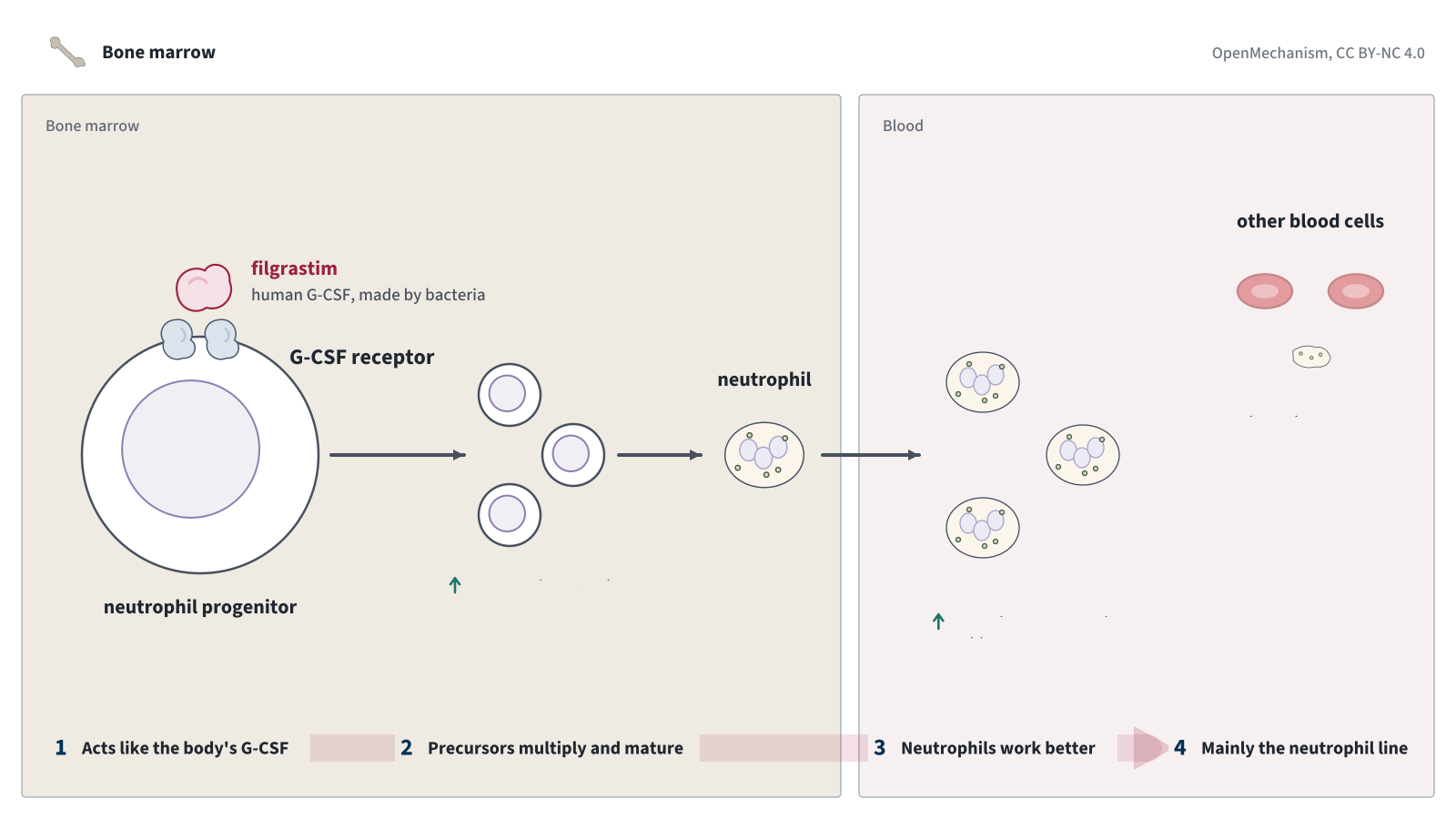
Filgrastim is human granulocyte colony-stimulating factor (G-CSF), made by bacteria carrying the human gene. It acts on neutrophil progenitors in the bone marrow, which multiply and mature into neutrophils, and it boosts some functions of mature neutrophils, such as engulfing particles. It has little direct effect on other blood cells.
- Acts on
- The G-CSF receptor on neutrophil progenitors
- Where
- Bone marrow
- Medicine type
- Protein
- Used for
- Immune system
- Drug class
- Neutrophil growth factors (G-CSF)
Also called Neupogen.
How it works
Acts like the body's G-CSF. Filgrastim is human granulocyte colony-stimulating factor (G-CSF) made by bacteria (E. coli) carrying the human gene; colony-stimulating factors act on blood-forming cells by binding specific receptors on their surface.1
Precursors multiply and mature. G-CSF regulates neutrophil production in the bone marrow: neutrophil progenitors multiply and mature (differentiate).1
Neutrophils work better. It also boosts some functions of mature neutrophils, such as their engulfing (phagocytic) ability.1
Mainly the neutrophil line. G-CSF has little direct effect on the making or the activity of other blood cell types.1
For teachers: download this drawing.
See also
Condition pages: acute myeloid leukemia.
Related drawings: epoetin alfa (drives red blood cell production in the same marrow).
Body system: immune system.
Sources
- 1Neupogen (filgrastim): FDA label11 Description; 12.1 Mechanism of Action
- 2ChEMBL CHEMBL1201567Target and action classification: Granulocyte colony stimulating factor receptor agonist
Spotted a mistake? Report an error (hello@openmechanism.com). Since launch, every published error we fix is listed on the corrections page.
Notes and limits
- A schematic teaching drawing: not to scale, not exact structures, binding poses or a complete pathway, and not a guide to dosing, treatment or how a person will respond.
All recorded limits are on the evidence page, and notes that apply to every page are on How to read a page. Version 1.0.0, not yet medically reviewed.
Cite this page
Tran D. Filgrastim [Internet]. OpenMechanism; 2026 [updated 2026 Oct 18; cited 2026 Oct 18]. Available from: https://openmechanism.com/medicines/filgrastim