Sirolimus
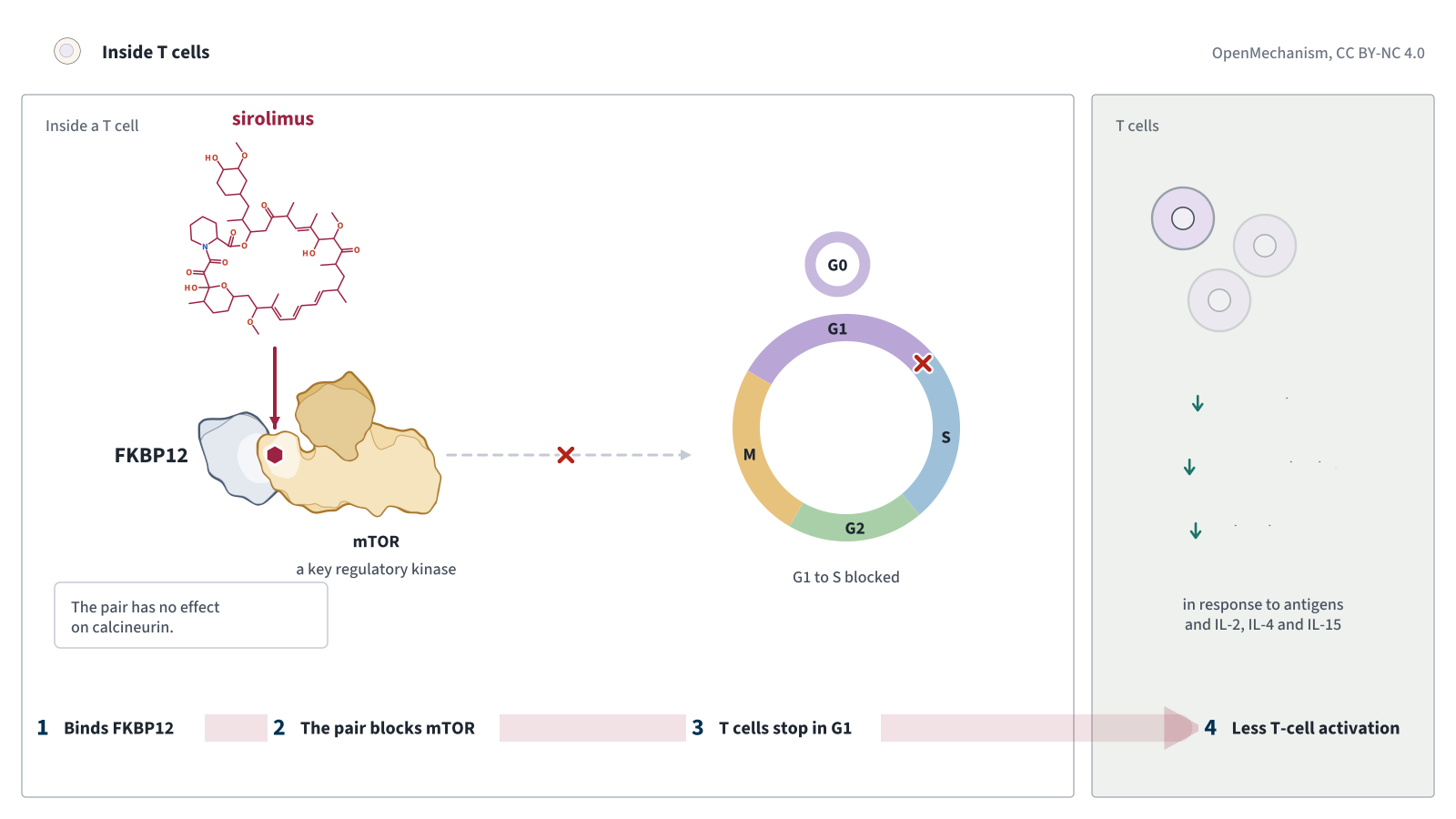
Inside cells, sirolimus binds the immunophilin , and the pair binds mTOR, a key regulatory kinase, and blocks its activation; it has no effect on calcineurin. driven by then cannot move from the G1 to the S phase of the cell cycle, so they multiply less, and antibody production falls too.
- Acts on
- FKBP-12 and mTOR
- Where
- T cells
- Medicine type
- Small molecule
- Used for
- Immune system
- Drug class
- Kinase inhibitors, mTOR inhibitors
Key terms in this drawing
- FKBP12
- FK506-binding protein 12. A protein inside cells that tacrolimus binds.
- IL-2
- Interleukin-2. One of the cytokines T cells produce; belatacept reduces its production (lab studies).
- IL-4
- Interleukin-4. A cytokine made by Th2 cells; with IL-13 it signals the switch from IgM to IgE antibodies.
- T cell
- T lymphocyte. A white blood cell of the immune system.
How it works
Binds FKBP12. Inside cells, sirolimus binds the immunophilin FKBP-12, making an immunosuppressive complex.1
The pair blocks mTOR. The complex binds mTOR, a key regulatory kinase, and blocks its activation; it has no effect on calcineurin.1
T cells stop in G1. This suppresses T-cell multiplication driven by cytokines: the cells cannot move from the G1 phase of the cell cycle to the S phase.1
Less T-cell activation. Sirolimus blocks T-cell activation and multiplication in response to antigens and cytokines (, and IL-15), by a mechanism unlike that of other immunosuppressants, and it also blocks antibody production.1
For teachers: download this drawing.
See also
Condition pages: transplant rejection.
Other kinase inhibitors: imatinib, osimertinib and tofacitinib.
Related drawings: tacrolimus (also binds FKBP12, but the pair blocks calcineurin).
Body system: immune system.
Sources
- 1Sirolimus tablets (Mylan): FDA label11 Description; 12.1 Mechanism of Action
- 2ChEMBL CHEMBL413Target and action classification: FK506-binding protein 1A inhibitor
Also used for the drawing
The FKBP12 and mTOR outlines are traced from the crystal structures below.
- 3Human FKBP12 with sirolimus (rapamycin), bound to the FRB part of mTORPDB 1FAP; Choi, J. et al. Science 1996; 273:239-242
- 4The catalytic part of human mTOR (from residue 1385) with mLST8 and an ATP analoguePDB 4JSP; Yang, H. et al. Nature 2013; 497:217-223
Spotted a mistake? Report an error (hello@openmechanism.com). Since launch, every published error we fix is listed on the corrections page.
Notes and limits
- A schematic teaching drawing: not to scale, not exact structures, binding poses or a complete pathway, and not a guide to dosing, treatment or how a person will respond.
- In the lung disease lymphangioleiomyomatosis (LAM), sirolimus blocks the activated mTOR pathway and so the multiplication of LAM cells (12.1).
All recorded limits are on the evidence page, and notes that apply to every page are on How to read a page. Version 1.0.0, not yet medically reviewed.
Cite this page
Tran D. Sirolimus [Internet]. OpenMechanism; 2026 [updated 2026 Oct 18; cited 2026 Oct 18]. Available from: https://openmechanism.com/medicines/sirolimus