Infliximab
Infliximab is an antibody that binds , both free and on cell surfaces, so TNF cannot activate its receptors. This reduces TNF-driven responses such as release of other inflammatory signals and movement of white blood cells.
- Acts on
- TNF alpha
- Where
- TNF and inflamed tissue
- Used for
- Immune system
- Drug class
- Antibody medicines
Also called Remicade.
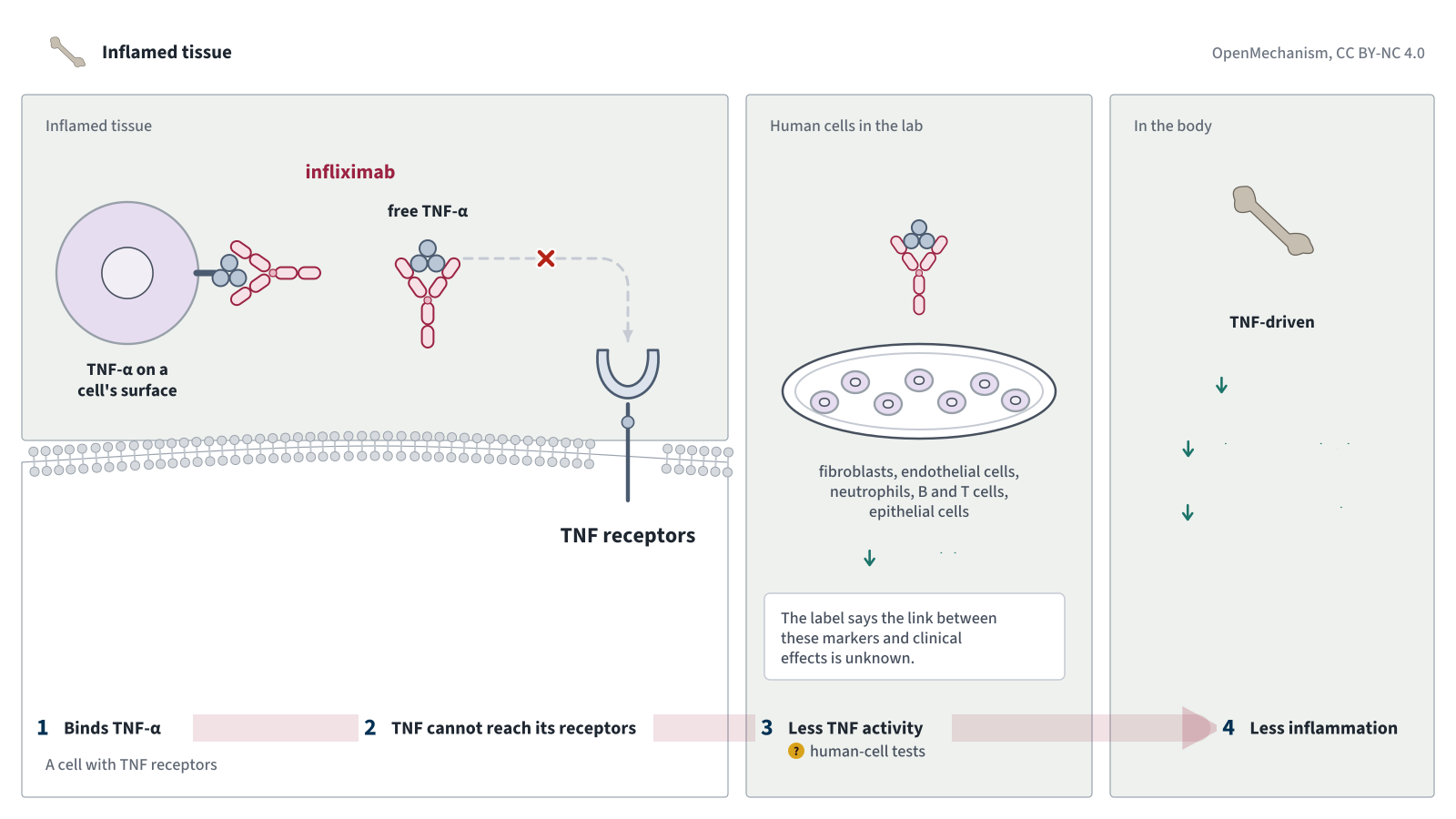
Step 3: human-cell tests
The Remicade (infliximab) label says: Infliximab inhibits the functional activity of TNFα in a wide variety of in vitro bioassays utilizing human fibroblasts, endothelial cells, neutrophils, B and T-lymphocytes and epithelial cells.
Source 1: Remicade (infliximab): FDA label, 12.1 Mechanism of Action
Clinical study: In a placebo-controlled trial in 428 people with active rheumatoid arthritis despite methotrexate, infliximab or placebo was added to methotrexate for 54 weeks; the trial measured symptoms and signs, quality of life and joint damage on X-rays, not TNF activity in human cells: In patients with persistently active rheumatoid arthritis despite methotrexate therapy, repeated doses of infliximab in combination with methotrexate provided clinical benefit and halted the progression of joint damage.
Lipsky PE et al., N Engl J Med 2000 (PMID 11096166)
This study was picked with a literature search and is not yet checked by our reviewer.
Key terms in this drawing
- IL-1
- Interleukin-1. A signaling molecule (cytokine) that drives inflammation.
- IL-6
- Interleukin-6. An inflammatory cytokine, released by tumor and immune cells, that plays a central part in anemia linked to cancer.
- T cell
- T lymphocyte. A white blood cell of the immune system.
- TNF
- Tumor necrosis factor (TNF-α). A signaling molecule (cytokine) that drives inflammation.
How it works
Binds TNF-α. Infliximab binds soluble and transmembrane TNF alpha.1
TNF cannot reach its receptors. Bound TNF cannot efficiently bind its receptors.1
Less TNF activity. Neutralization reduces TNF activity in the cited human-cell bioassays.1
Less inflammation. The affected TNF functions include inflammatory induction, leukocyte migration and acute-phase responses.1
For teachers: download this drawing or build a slide deck.
See also
Condition pages: ankylosing spondylitis, Crohn disease, psoriasis, psoriatic arthritis, rheumatoid arthritis and ulcerative colitis.
Other antibody medicines: adalimumab, bevacizumab, bezlotoxumab, blinatumomab, burosumab, denosumab, dupilumab, eculizumab and 14 more.
Explained: why TNF blockers such as adalimumab raise the risk of tuberculosis.
Body system: immune system.
Inside the body: skin renewal.
Sources
- 1Remicade (infliximab): FDA label12.1 Mechanism of Action
- 2ChEMBL CHEMBL1201581Target and action classification: TNF-alpha inhibitor
- 3Infliximab and methotrexate in the treatment of rheumatoid arthritis. Anti-Tumor Necrosis Factor Trial in Rheumatoid Arthritis with Concomitant Therapy Study GroupLipsky PE et al. N Engl J Med 2000 (abstract)
Spotted a mistake? Report an error (hello@openmechanism.com). Since launch, every published error we fix is listed on the corrections page.
Notes and limits
- A schematic teaching drawing: not to scale, not exact structures, binding poses or a complete pathway, and not a guide to dosing, treatment or how a person will respond.
- The steps are in the order that explains them; one step is said to cause the next only where the source says so.
- The label states that the relationship of these response markers to clinical mechanisms is unknown.
- Transmembrane-TNF cell lysis is a separate branch and is not treated as obligatory for every response.
All recorded limits are on the evidence page, and notes that apply to every page are on How to read a page. Version 1.0.0, not yet medically reviewed.
Cite this page
Tran D. Infliximab [Internet]. OpenMechanism; 2026 [updated 2026 Oct 15; cited 2026 Oct 15]. Available from: https://openmechanism.com/medicines/infliximab