Ankylosing spondylitis
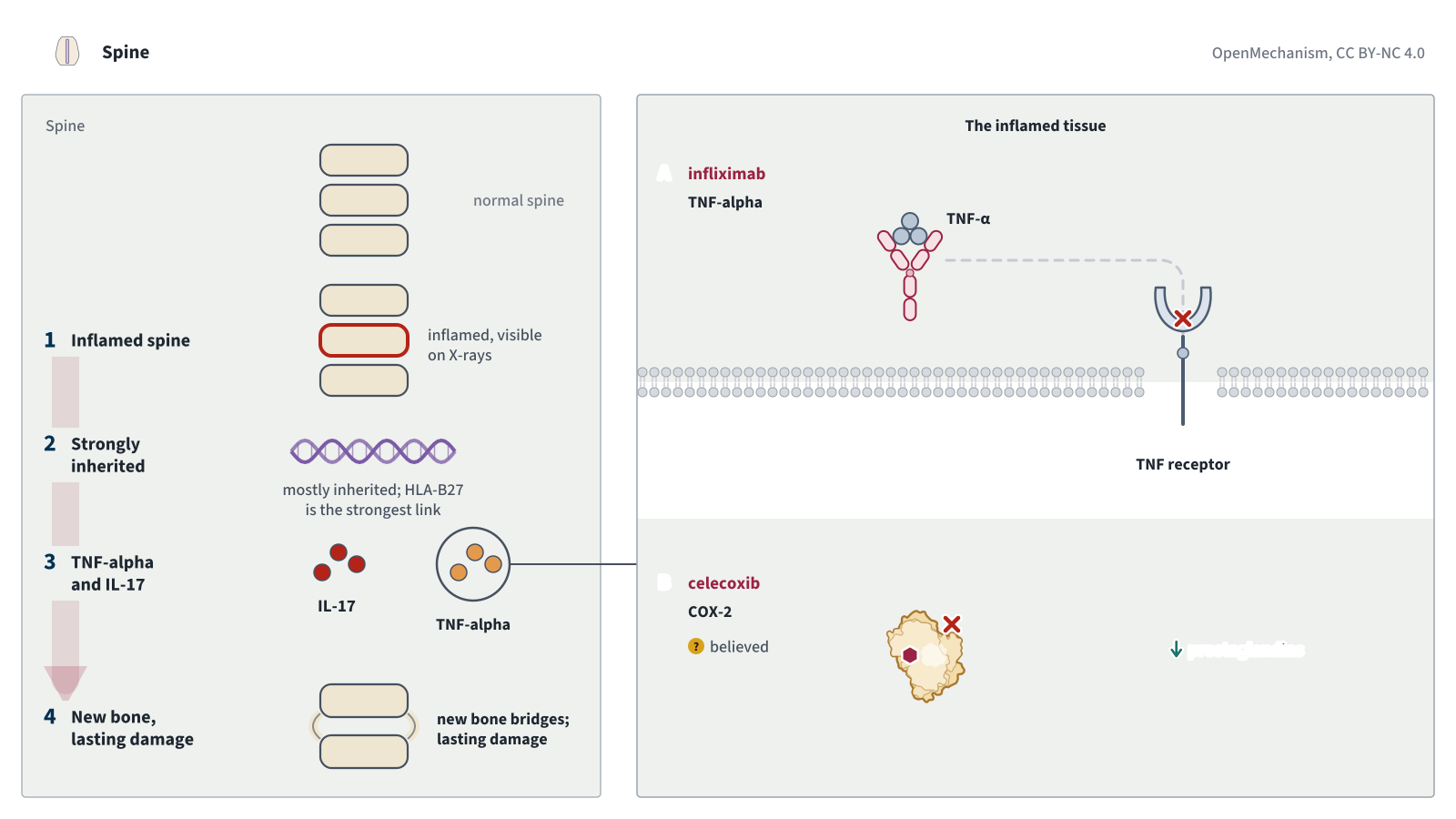
Ankylosing spondylitis is the form of axial spondyloarthritis visible on X-rays. It usually starts in a person's twenties, twice as often in men, and is strongly inherited, above all with HLA-B27. TNF-alpha and IL-17 appear to have a role in it, and inflammation is linked to new bone that causes lasting damage. Infliximab neutralizes TNF-alpha; celecoxib blocks COX-2.
- Where
- Spine
- Body systems
- Muscles, bones & joints; Immune system
- Medicines
- 2 medicines
Believed
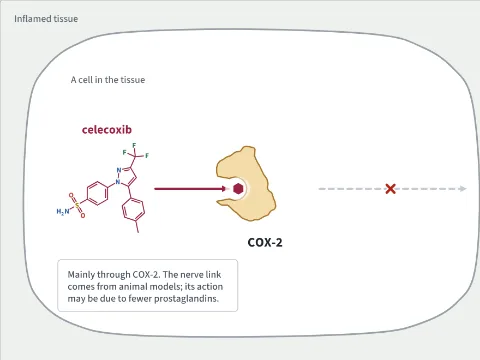
The Celebrex (celecoxib) label says: The mechanism of action of CELEBREX is believed to be due to inhibition of prostaglandin synthesis, primarily via inhibition of COX-2.
Source 3: Celebrex (celecoxib): FDA label, 1 Indications and Usage; 12.1 Mechanism of Action
Clinical study: In a 6-week randomized, double-blind trial of celecoxib, ketoprofen or placebo in 246 people with ankylosing spondylitis; the trial measured pain and function, not how celecoxib works: The results of this study confirm the clinically relevant antiinflammatory effect of celecoxib at a 200-mg daily dosage, with significant improvement of both pain and function in patients with AS.
Dougados M et al., Arthritis Rheum 2001 (PMID 11212158)
This study was picked with a literature search and is not yet checked by our reviewer.
For teachers: download this drawing.
Key terms in this drawing
- COX-2
- Cyclooxygenase-2. An enzyme that makes prostaglandins.
- HLA
- Human leukocyte antigen genes. Immune genes of the human major histocompatibility complex (MHC); their molecules present peptides to T cells. Variation in these genes may affect the risk of many diseases, including autoimmune ones.
- IL-17
- Interleukin-17. A cytokine that, with IL-23, is a key driver of psoriasis.
- TNF
- Tumor necrosis factor (TNF-α). A signaling molecule (cytokine) that drives inflammation.
What goes wrong
Inflamed spine. Ankylosing spondylitis is the form of axial spondyloarthritis visible on X-rays. It usually starts in a person's twenties, twice as often in men.1
What the source says
“The term axial spondyloarthritis covers both patients with non-radiographic and radiographic axial spondyloarthritis, which is also termed ankylosing spondylitis.”
Source 1“The disease usually starts in the third decade of life with a male to female ratio of two to one for radiographic axial spondyloarthritis”
Source 1Strongly inherited. More than 90% of the risk is inherited; the strongest gene link is .1
What the source says
“More than 90% heritabilty has been estimated, the highest genetic association being with HLA-B27.”
Source 1TNF-alpha and IL-17. On the evidence from trials, the signals and appear to have a role in causing it.1
What the source says
“On the basis of evidence from trials the cytokines tumour necrosis factor (TNF)-α and interleukin-17 appear to have a relevant role in pathogenesis.”
Source 1New bone, lasting damage. Inflammation is linked to new bone formation, which causes long-term damage; how the two interact is not yet clear.1
What the source says
“The mechanisms of interaction between inflammation and new bone formation is still not completely understood but clarification will be important for the prevention of long-term structural damage of the bone.”
Source 1
Where medicines act
- A
Infliximab: TNF-alpha neutralized
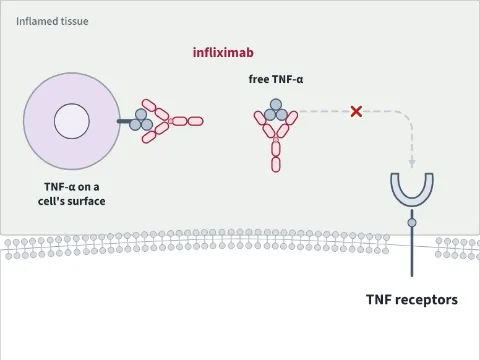
Infliximab binds TNF-alpha. It reduces the signs and symptoms of active ankylosing spondylitis in adults; TNF blockers and anti-inflammatory painkillers are both effective.1,2
What the source says
“Infliximab neutralizes the biological activity of TNFα by binding with high affinity to the soluble and transmembrane forms of TNFα and inhibits binding of TNFα with its receptors.”
Source 2“Ankylosing Spondylitis : reducing signs and symptoms in adult patients with active disease.”
Source 2“Non-steroidal anti-inflammatory drugs and TNF blockers are effective therapies.”
Source 1 - B
Celecoxib: COX-2 blocked
Celecoxib is believed to work by blocking prostaglandin synthesis, primarily through . It treats ankylosing spondylitis.3
See also
Body systems: muscles, bones & joints; and immune system.
Also used for it: methylprednisolone (“As adjunctive therapy for short-term administration (to tide the patient over an acute episode or exacerbation) in … ankylosing spondylitis”4); hydrocortisone (“As adjunctive therapy for short-term administration (to tide the patient over an acute episode or exacerbation) in … ankylosing spondylitis”5); dexamethasone (“As adjunctive therapy for short-term administration (to tide the patient over an acute episode or exacerbation) in: … Ankylosing spondylitis”6); and tofacitinib (for active ankylosing spondylitis after a TNF blocker: “XELJANZ tablets and XELJANZ XR are indicated for the treatment of adult patients with: … Active ankylosing spondylitis (AS), who have had an inadequate response or intolerance to one or more TNF blockers.”7).
Related medicines: diclofenac, naproxen, prednisone and adalimumab.
Other conditions: rheumatoid arthritis, juvenile idiopathic arthritis, psoriatic arthritis, ulcerative colitis, Crohn disease and gout.
Sources
- 1Axial spondyloarthritisSieper J, Poddubnyy D. Lancet 2017 (abstract). Saved copy
- 2Remicade (infliximab): FDA label1 Indications and Usage; 12.1 Mechanism of Action; 12.2 Pharmacodynamics. Saved copy
- 3Celebrex (celecoxib): FDA label1 Indications and Usage; 12.1 Mechanism of Action. Saved copy
- 4Solu-Medrol (methylprednisolone sodium succinate): FDA labelIndications and Usage. Saved copy
- 5Solu-Cortef (hydrocortisone sodium succinate): FDA labelIndications and Usage. Saved copy
- 6Dexamethasone sodium phosphate injection: FDA labelIndications and Usage. Saved copy
- 7Xeljanz (tofacitinib): FDA label1 Indications and Usage. Saved copy
- 8
- 9Human cyclooxygenase-2 (COX-2) with mefenamic acidPDB 5IKR; Orlando, B.J., Malkowski, M.G. J.Biol.Chem. 2016;291:15069-15081. The COX-2 outline in the drawing is traced from this structure. Saved copy
Notes and limits
- How HLA-B27 causes the disease is still not clear.1
Notes that apply to every page are on How to read a page.
Spotted a mistake? Report an error (hello@openmechanism.com). Since launch, every published error we fix is listed on the corrections page.
Cite this page
Tran D. Ankylosing spondylitis [Internet]. OpenMechanism; 2026 [updated 2026 Oct 18; cited 2026 Oct 18]. Available from: https://openmechanism.com/conditions/ankylosing-spondylitis