Crohn disease
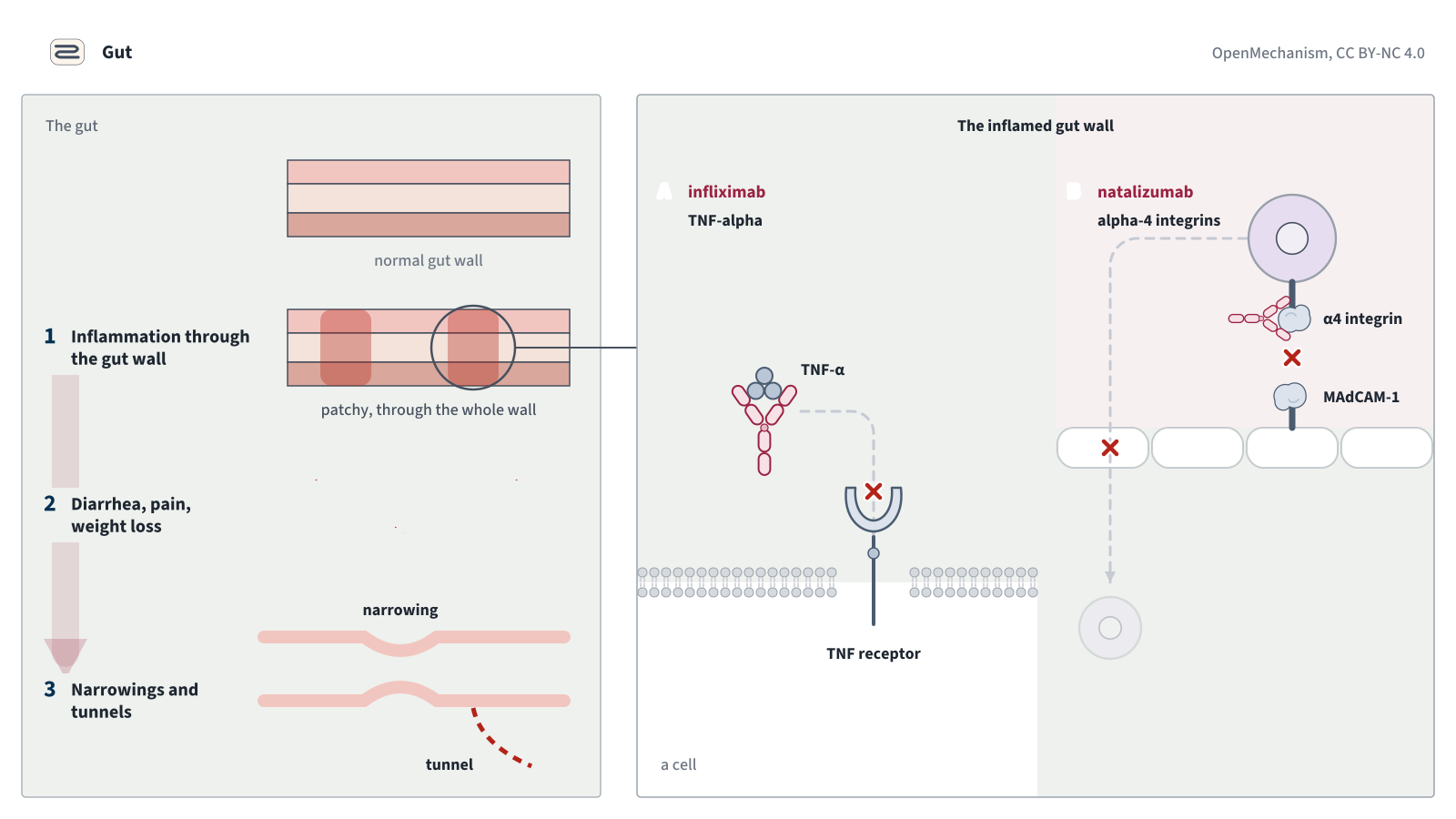
Crohn disease is a long-lasting inflammatory bowel disease of unknown cause: patchy inflammation goes through the whole gut wall, anywhere from mouth to anus. Symptoms may include diarrhea, belly pain and weight loss; it can narrow the bowel or tunnel through it. Infliximab neutralizes TNF-alpha; natalizumab stops white blood cells sticking to gut blood vessels and entering the tissue.
- Where
- Gut
- Body systems
- Stomach, gut & liver; Immune system
- Medicines
- 2 medicines
For teachers: download this drawing.
Key terms in this drawing
- MAdCAM-1
- Mucosal addressin cell adhesion molecule-1. A docking protein on the cells lining the gut's blood vessels; white blood cells bind it through their α4 integrins.
- TNF
- Tumor necrosis factor (TNF-α). A signaling molecule (cytokine) that drives inflammation.
What goes wrong
Inflammation through the gut wall. Crohn disease is a long-lasting inflammatory bowel disease of unknown cause, with patchy inflammation through the whole gut wall, anywhere from mouth to anus.1
What the source says
“Crohn disease is a chronic idiopathic inflammatory bowel disease condition characterized by skip lesions and transmural inflammation that can affect the entire gastrointestinal tract from the mouth to the anus.”
Source 1Diarrhea, pain, weight loss. Symptoms vary and may include diarrhea, belly pain, weight loss, nausea, vomiting and sometimes fever.1
What the source says
“Presenting symptoms are often variable and may include diarrhea, abdominal pain, weight loss, nausea, vomiting, and in certain cases fevers or chills.”
Source 1Narrowings and tunnels. It can stay inflammatory, narrow the bowel or tunnel through it; up to a third of people develop disease around the anus.1
Where medicines act
- A
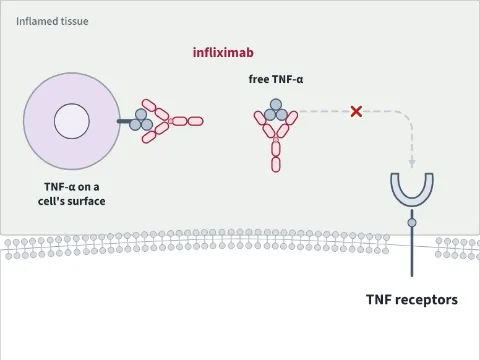
Infliximab: TNF-alpha neutralized
Infliximab binds , which among other things raises inflammatory and helps white cells migrate. It treats moderate to severe Crohn disease that has not responded to standard treatment.2
What the source says
“Infliximab neutralizes the biological activity of TNFα by binding with high affinity to the soluble and transmembrane forms of TNFα and inhibits binding of TNFα with its receptors.”
Source 2“Biological activities attributed to TNFα include: induction of pro-inflammatory cytokines such as interleukins (IL) 1 and 6, enhancement of leukocyte migration”
Source 2“reducing signs and symptoms and inducing and maintaining clinical remission in adult patients with moderately to severely active disease who have had an inadequate response to conventional therapy.”
Source 2 - B
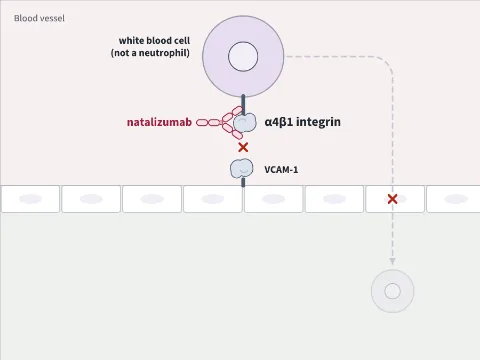
Natalizumab: white cells kept out of the gut
Natalizumab blocks alpha-4 integrins on white blood cells, so they cannot stick to on gut blood vessels and move into inflamed tissue. It treats moderate to severe Crohn disease when other treatments, including TNF blockers, have failed.3
What the source says
“Natalizumab binds to the α4-subunit of α4β1 and α4β7 integrins expressed on the surface of all leukocytes except neutrophils, and inhibits the α4-mediated adhesion of leukocytes to their counter-receptor(s).”
Source 3“mucosal addressin cell adhesion molecule-1 (MAdCAM-1) present on vascular endothelial cells of the gastrointestinal tract.”
Source 3“Disruption of these molecular interactions prevents transmigration of leukocytes across the endothelium into inflamed parenchymal tissue.”
Source 3“who have had an inadequate response to, or are unable to tolerate, conventional CD therapies and inhibitors of TNF-α.”
Source 3
See also
Body systems: stomach, gut & liver; and immune system.
Also used for it: methylprednisolone (“To tide the patient over a critical period of the disease in regional enteritis (systemic therapy)”4), hydrocortisone (“To tide the patient over a critical period of the disease in regional enteritis (systemic therapy)”5), dexamethasone (“To tide the patient over a critical period of the disease in: Ulcerative colitis (Systemic therapy) Regional enteritis (Systemic therapy)”6) and loperamide (for the chronic diarrhea of inflammatory bowel disease: “Loperamide hydrochloride capsules are indicated for the control and symptomatic relief of acute nonspecific diarrhea in patients 2 years of age and older and of chronic diarrhea in adults associated with inflammatory bowel disease.”7).
Related medicines: prednisone and adalimumab.
Other conditions: ulcerative colitis, ankylosing spondylitis, psoriatic arthritis, rheumatoid arthritis, juvenile idiopathic arthritis and lupus nephritis.
Side effects: why TNF blockers such as adalimumab raise the risk of tuberculosis; and why natalizumab raises the risk of PML, a brain infection.
Sources
- 1Crohn disease: epidemiology, diagnosis, and managementFeuerstein JD, Cheifetz AS. Mayo Clin Proc 2017 (abstract). Saved copy
- 2Remicade (infliximab): FDA label1 Indications and Usage; 12.1 Mechanism of Action. Saved copy
- 3Tysabri (natalizumab): FDA label1 Indications and Usage; 12.1 Mechanism of Action. Saved copy
- 4Solu-Medrol (methylprednisolone sodium succinate): FDA labelIndications and Usage. Saved copy
- 5Solu-Cortef (hydrocortisone sodium succinate): FDA labelIndications and Usage. Saved copy
- 6Dexamethasone sodium phosphate injection: FDA labelIndications and Usage. Saved copy
- 7Loperamide hydrochloride capsules: FDA labelIndications and Usage. Saved copy
Notes and limits
- Most people eventually need surgery, which does not cure it.1
Notes that apply to every page are on How to read a page.
Spotted a mistake? Report an error (hello@openmechanism.com). Since launch, every published error we fix is listed on the corrections page.
Cite this page
Tran D. Crohn disease [Internet]. OpenMechanism; 2026 [updated 2026 Oct 21; cited 2026 Oct 21]. Available from: https://openmechanism.com/conditions/crohn-disease