Psoriasis
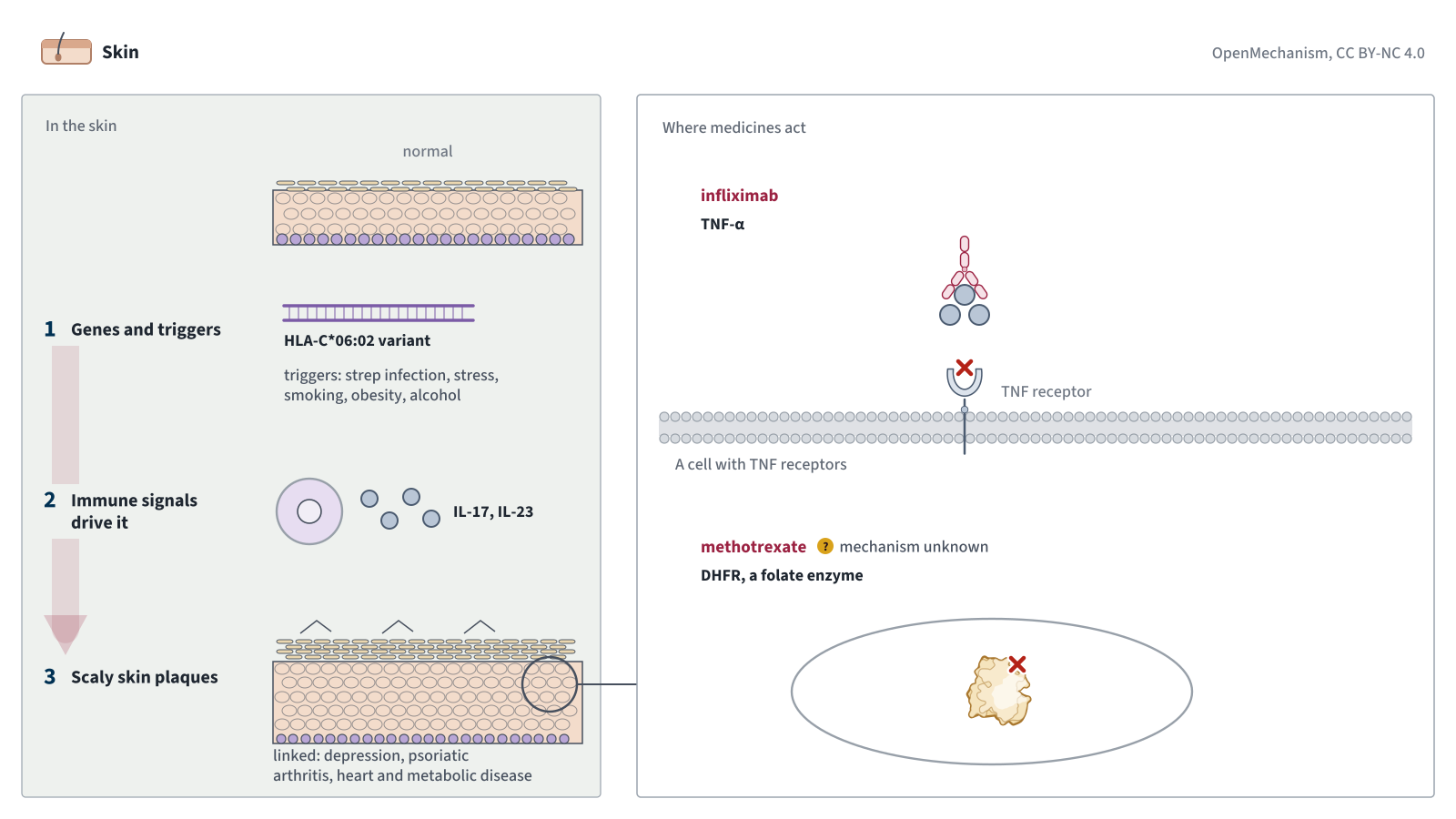
Psoriasis is a long-term scaly skin disease that can start at any age; about 125 million people have it. It comes from genetic risk, especially HLA-C*06:02, and triggers, and the immune signals IL-17 and IL-23 drive it. Infliximab neutralizes TNF-α; methotrexate blocks dihydrofolate reductase, though how it works in psoriasis is unknown.
- Where
- Skin
- Body systems
- Skin, hair & nails; Immune system
- Medicines
- 2 medicines
Mechanism unknown
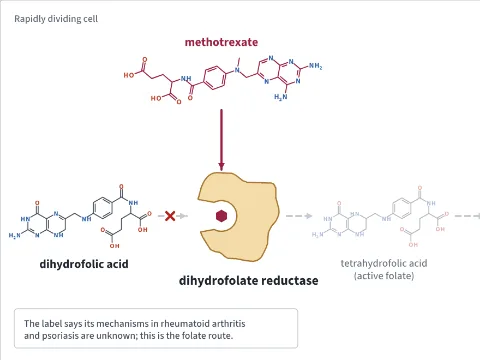
The Trexall (methotrexate) label says: Methotrexate inhibits dihydrofolic acid reductase. … The mechanism of action in rheumatoid arthritis and in psoriasis is unknown.
Source 3: Trexall (methotrexate): FDA label, 1 Indications and Usage; 12.1 Mechanism of Action
Clinical study: In a randomized, double-blind, placebo-controlled trial in 120 adults with moderate to severe plaque psoriasis, more had their psoriasis score fall by three quarters at week 16 with methotrexate injections (given with folic acid) than with placebo; the trial measured the effect, not how it works: At week 16, a PASI 75 response was achieved in 37 (41%) patients in the methotrexate group compared with three (10%) patients in the placebo group
Warren RB et al., Lancet 2017 (PMID 28012564)
This study was picked with a literature search and is not yet checked by our reviewer.
For teachers: download this drawing.
Key terms in this drawing (5)
- DHFR
- Dihydrofolate reductase. The enzyme that makes tetrahydrofolic acid from dihydrofolic acid; tetrahydrofolic acid helps make the building blocks of nucleic acids.
- HLA
- Human leukocyte antigen genes. Immune genes of the human major histocompatibility complex (MHC); their molecules present peptides to T cells. Variation in these genes may affect the risk of many diseases, including autoimmune ones.
- IL-17
- Interleukin-17. A cytokine that, with IL-23, is a key driver of psoriasis.
- IL-23
- Interleukin-23. A cytokine that inflammatory dendritic cells release to switch on IL-17-making T cells, as in psoriasis.
- TNF
- Tumor necrosis factor (TNF-α). A signaling molecule (cytokine) that drives inflammation.
What goes wrong
Genes and triggers. The common plaque form comes from genetic risk, especially the *06:02 variant, with triggers such as streptococcal infection, stress, smoking, obesity and alcohol.1
What the source says
“Its most common form, chronic plaque or psoriasis vulgaris, is a consequence of genetic susceptibility, particularly in the presence of the HLA-C*06:02 risk allele, and of environmental triggers such as streptococcal infection, stress, smoking, obesity, and alcohol consumption.”
Source 1Immune signals drive it. The immune signals and are key drivers.1
What the source says
“Immunological and genetic studies have identified IL-17 and IL-23 as key drivers of psoriasis pathogenesis.”
Source 1Scaly skin plaques. The result is a long-term scaly (papulosquamous) skin disease, most often chronic plaque psoriasis, that can start at any age. It is linked to depression, psoriatic arthritis and heart and metabolic disease.1
What the source says
“Psoriasis is a common, chronic papulosquamous skin disease occurring worldwide, presenting at any age”
Source 1“Its most common form, chronic plaque or psoriasis vulgaris”
Source 1“It is associated with several important medical conditions, including depression, psoriatic arthritis, and cardiometabolic syndrome.”
Source 1
Where medicines act
- A
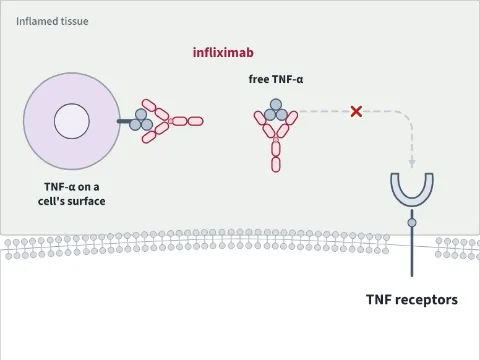
Infliximab targets TNF-α
Binds and stops it binding its receptors.1,2
Used forChronic severe plaque psoriasis: adults
What the label says
“Infliximab neutralizes the biological activity of TNFα by binding with high affinity to the soluble and transmembrane forms of TNFα and inhibits binding of TNFα with its receptors.”
Source 2“Immune targeting of these cytokines and of TNFα by biological therapies has revolutionised the care of severe chronic plaque disease.”
Source 1“treatment of adult patients with chronic severe (i.e., extensive and/or disabling) plaque psoriasis”
Source 2 - B
Methotrexate targets dihydrofolate reductase (DHFR)
Blocks dihydrofolate reductase (), a folate enzyme; how it works in psoriasis is unknown.3
Used forSevere psoriasis: adults
See also
Body systems: skin, hair & nails; and immune system.
Zoom in: skin renewal.
Also used for it: dexamethasone (“Dermatologic Diseases … Severe psoriasis”4).
Related medicines: prednisone, adalimumab and cyclosporine.
Other conditions: acne, rheumatoid arthritis, psoriatic arthritis, ankylosing spondylitis, Crohn disease and juvenile idiopathic arthritis.
Side effects: why TNF blockers such as adalimumab raise the risk of tuberculosis.
Sources
- 1PsoriasisGriffiths CEM et al. Lancet 2021 (abstract). Saved copy
- 2Remicade (infliximab): FDA label1 Indications and Usage; 12.1 Mechanism of Action. Saved copy
- 3Trexall (methotrexate): FDA label1 Indications and Usage; 12.1 Mechanism of Action. Saved copy
- 4Dexamethasone sodium phosphate injection: FDA labelIndications and Usage. Saved copy
- 5Pathophysiology, clinical presentation, and treatment of psoriasis: a reviewArmstrong AW, Read C. JAMA 2020 (abstract). Saved copy
- 6
- 7Dihydrofolate reductase (DHFR) with methotrexate and NADPHPDB 1U72; Cody, V. et al. Acta Crystallogr.,Sect.D 2005;61:147-155. The DHFR outline in the drawing is traced from this structure. Saved copy
Notes and limits
- Psoriasis cannot currently be cured.1
Notes that apply to every page are on How to read a page.
Spotted a mistake? Report an error (hello@openmechanism.com). Since launch, every published error we fix is listed on the corrections page.
Cite this page
Tran D. Psoriasis [Internet]. OpenMechanism; 2026 [updated 2026 Oct 21; cited 2026 Oct 21]. Available from: https://openmechanism.com/conditions/psoriasis