Cyclosporine
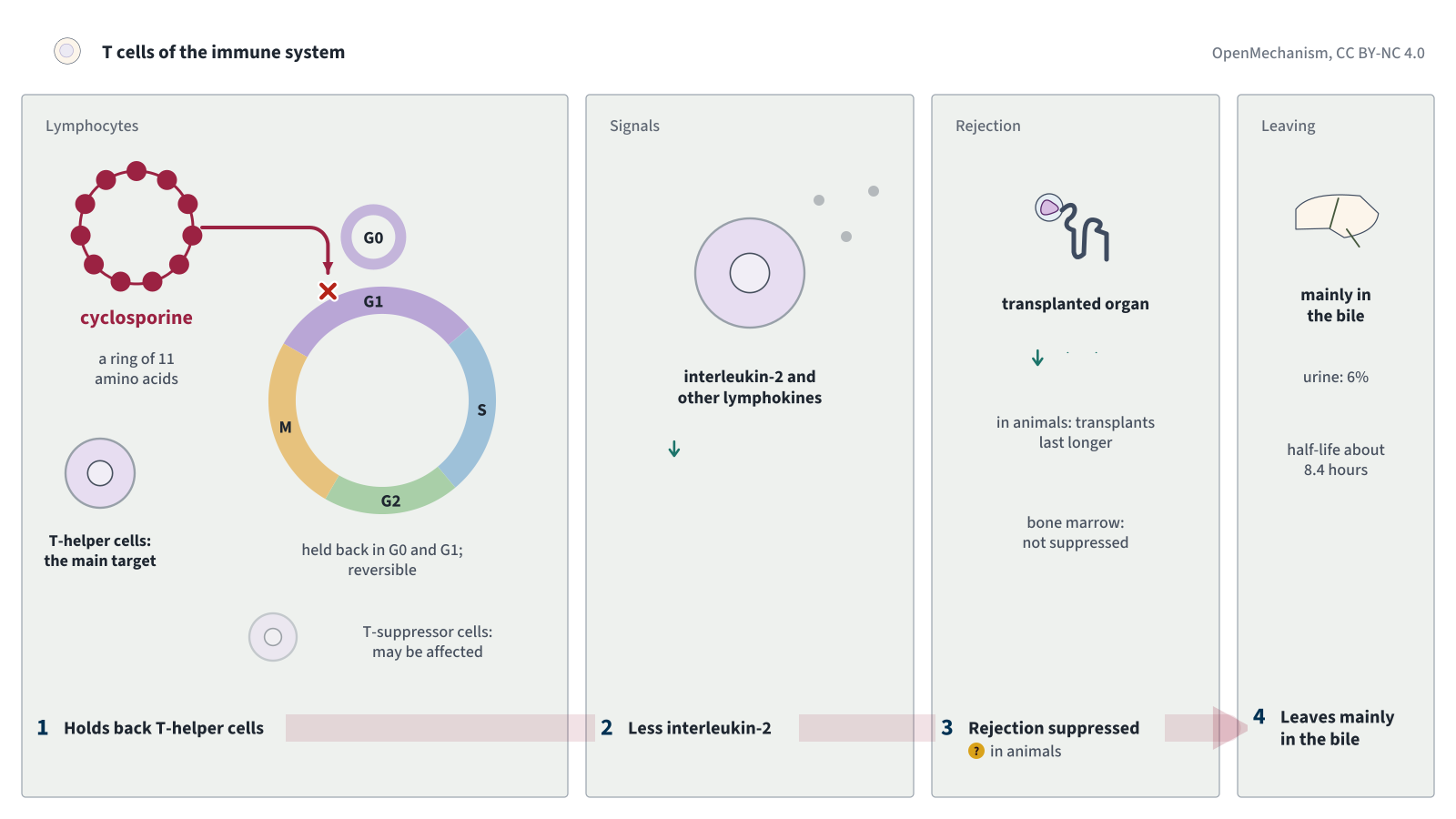
Cyclosporine reversibly holds back lymphocytes early in their cell cycle, mainly the T-helper cells, and cuts their release of signals such as interleukin-2. In animals it prevents rejection of many transplanted organs; it is used to prevent rejection of kidney, liver and heart transplants and for severe rheumatoid arthritis and psoriasis. It does not suppress the bone marrow, and it leaves the body mainly in the bile.
- Acts on
- Immunocompetent lymphocytes, mainly T-helper cells
- Where
- T cells of the immune system
- Medicine type
- Protein
- Used for
- Immune system
Also called Neoral.
Step 3: in animals
The Neoral (cyclosporine) label says: Cyclosporine is a potent immunosuppressive agent that in animals prolongs survival of allogeneic transplants involving skin, kidney, liver, heart, pancreas, bone marrow, small intestine, and lung.
Clinical study: In a randomized trial in 209 people given a kidney from a deceased donor, cyclosporine with prednisone was compared with standard therapy (azathioprine with prednisone): Predicted graft survival at one year was 80.4 per cent in patients receiving cyclosporine and 64.0 per cent in those receiving standard therapy
Canadian Multicentre Transplant Study Group, N Engl J Med 1983 (PMID 6350878)
This study was picked with a literature search and is not yet checked by our reviewer.
Key terms in this drawing
- half-life
- Half-life. The time it takes for the amount in the blood to fall by half.
- T cell
- T lymphocyte. A white blood cell of the immune system.
How it works
Holds back T-helper cells. Cyclosporine, a cyclic polypeptide of 11 amino acids made by the fungus Beauveria nivea, works by specific and reversible inhibition of immunocompetent lymphocytes in the G0 and G1 phases of the cell cycle. T lymphocytes are preferentially inhibited; the T-helper cell is the main target, although T-suppressor cells may also be suppressed.1
Less interleukin-2. Cyclosporine also inhibits the production and release of lymphokines, including interleukin-2.1
Rejection suppressed. In many animal species, cyclosporine suppresses some antibody-based (humoral) immunity and, to a greater extent, cell-mediated reactions such as transplant rejection and delayed hypersensitivity, and it prolongs the survival of transplanted skin, kidney, liver, heart, pancreas, bone marrow, small intestine and lung. It does not suppress the bone marrow in animal models or people. It is used to prevent rejection of kidney, liver and heart transplants, and for severe rheumatoid arthritis and psoriasis.1
Leaves mainly in the bile. Absorption by mouth is incomplete and varies between people; its immunosuppressive activity comes mainly from the parent drug. It leaves mainly in the bile, with only 6% of a dose in the urine, and its terminal is about 8.4 hours (5 to 18).1
For teachers: download this drawing.
See also
Condition pages: psoriasis, rheumatoid arthritis and transplant rejection.
Explained: colchicine with clarithromycin and why statins can cause muscle problems.
Body system: immune system.
Sources
- 1Neoral (cyclosporine) capsules and oral solution: FDA labelDescription; Indications and Usage; Clinical Pharmacology; Pharmacokinetics
- 2ChEMBL CHEMBL160Target and action classification: Cyclophilin A modulator
- 3A randomized clinical trial of cyclosporine in cadaveric renal transplantationCanadian Multicentre Transplant Study Group. N Engl J Med 1983 (abstract)
Spotted a mistake? Report an error (hello@openmechanism.com). Since launch, every published error we fix is listed on the corrections page.
Notes and limits
- A schematic teaching drawing: not to scale, not exact structures, binding poses or a complete pathway, and not a guide to dosing, treatment or how a person will respond.
- The label's account of transplant survival and of many of these immune reactions comes from animal studies.
All recorded limits are on the evidence page, and notes that apply to every page are on How to read a page. Version 1.0.0, not yet medically reviewed.
Cite this page
Tran D. Cyclosporine [Internet]. OpenMechanism; 2026 [updated 2026 Oct 14; cited 2026 Oct 14]. Available from: https://openmechanism.com/medicines/cyclosporine