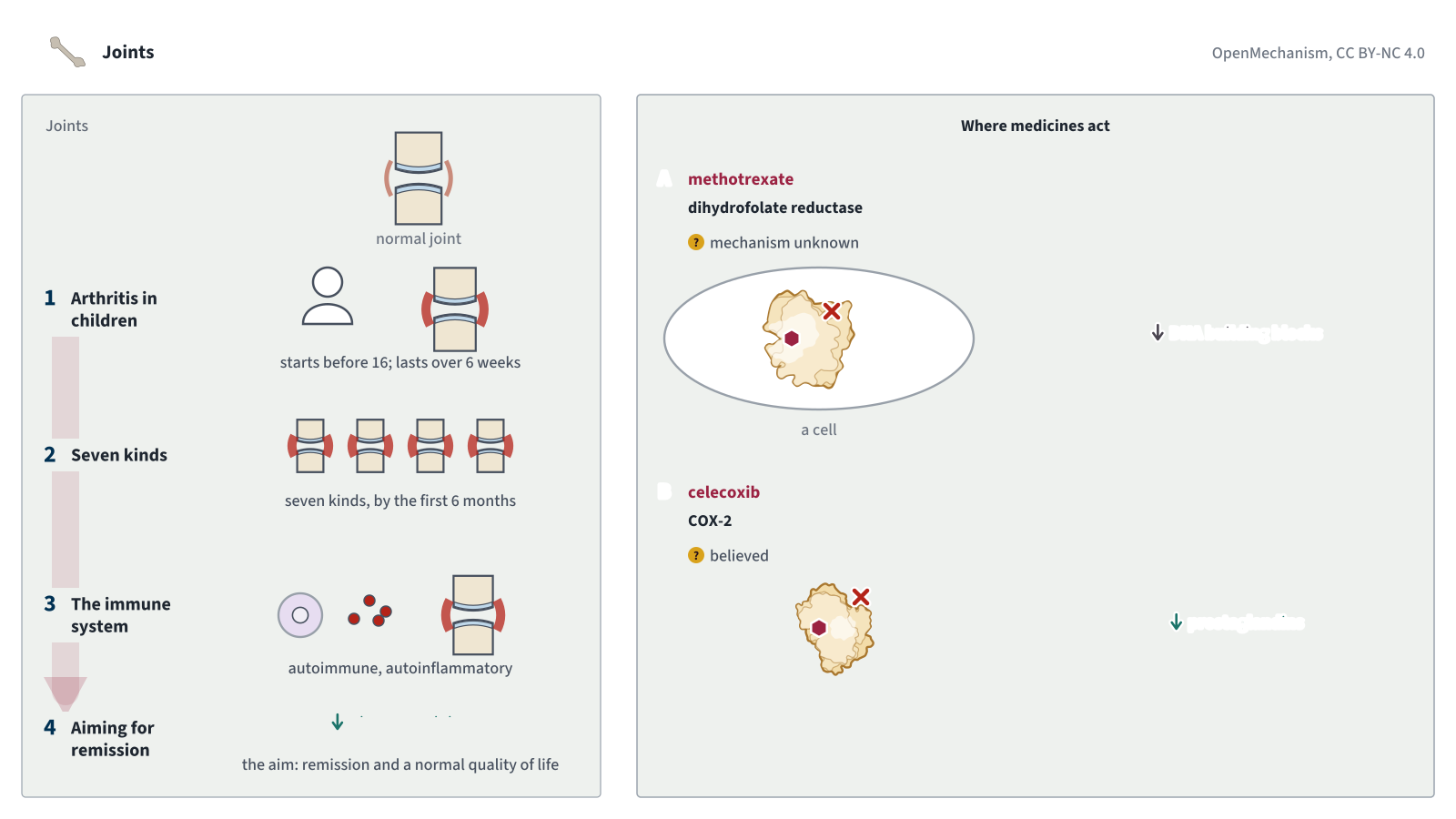
Juvenile idiopathic arthritis is arthritis of unknown cause that lasts more than 6 weeks and starts before age 16; it is the most common long-term inflammatory joint disease of childhood, with seven recognized kinds. Autoimmune and autoinflammatory mechanisms are involved in how it develops. Methotrexate blocks a folate enzyme, though its label gives no mechanism for JIA and says how it works in rheumatoid arthritis is unknown; celecoxib is believed to work mainly by blocking COX-2.
What goes wrong in juvenile idiopathic arthritis, and where medicines act. Schematic, not to scale. DHFR outline from the structure with methotrexate and NADPH. COX-2 outline from the structure with mefenamic acid. License CC BY-NC 4.0.
?Mechanism unknown
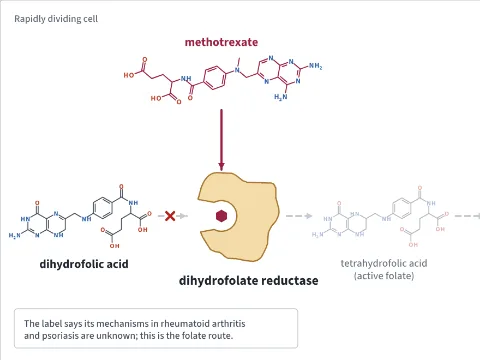
The Trexall (methotrexate) label says: Methotrexate inhibits dihydrofolic acid reductase. … The mechanism of action in rheumatoid arthritis and in psoriasis is unknown.
Clinical study: In Giannini and colleagues' 1992 report of a six-month randomized, double-blind trial in 127 children with resistant juvenile rheumatoid arthritis (114 counted in the analysis of how well it worked), who took methotrexate by mouth once a week (10 mg per square meter of body-surface area, the low dose, or 5 mg per square meter, the very low dose) or placebo; the trial measured improvement, not how methotrexate works: According to a composite index of several response variables, 63 percent of the children who received low-dose methotrexate improved, as compared with 32 percent of those in the very-low-dose group and 36 percent of those in the placebo group (P = 0.013).Giannini EH et al., N Engl J Med 1992 (PMID 1549149)
?Believed
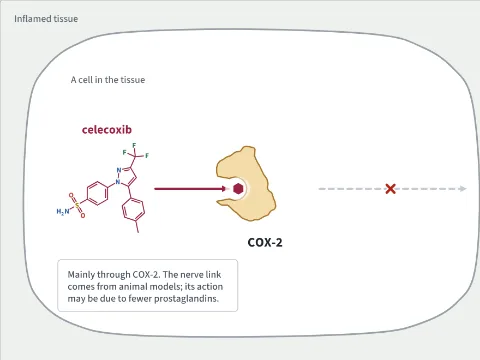
The Celebrex (celecoxib) label says: The mechanism of action of CELEBREX is believed to be due to inhibition of prostaglandin synthesis, primarily via inhibition of COX-2.
Clinical study: In Foeldvari and colleagues' 2009 report of a 12-week randomized, double-blind noninferiority trial comparing celecoxib with naproxen in children with juvenile rheumatoid arthritis; the trial measured signs and symptoms, not how celecoxib works: Celecoxib 3 mg/kg bid and 6 mg/kg bid were at least as effective as naproxen 7.5 mg/kg bid in treating the signs and symptoms of JRA over 12 weeks.Foeldvari I et al., J Rheumatol 2009 (PMID 19012356)
Cyclooxygenase-2. An enzyme that makes prostaglandins.
DNA
Deoxyribonucleic acid. The molecule that stores genes.
What goes wrong
Arthritis in children. It is arthritis of unknown cause lasting more than 6 weeks that starts before age 16, the most common long-term inflammatory joint disease of childhood. It was formerly known as juvenile rheumatoid arthritis.1,2
What the source says
“Juvenile idiopathic arthritis (JIA) is an umbrella term for arthritis of unknown origin, lasting for >6 weeks with onset before 16 years of age.”
“Juvenile idiopathic arthritis, formerly known as juvenile rheumatoid arthritis, is a heterogeneous group of diseases characterized by onset of chronic arthritis in childhood.”
Seven kinds. Under the International League Against Rheumatism (ILAR) classification, seven separate kinds are recognized, based on how it shows in the first 6 months.1
What the source says
“According to the International League Against Rheumatism (ILAR) classification, seven mutually exclusive categories of JIA exist based on disease manifestations during the first 6 months of disease.”
Aiming for remission. Treatment with medicines aims to calm the disease fast, to inactive disease or remission, with few side effects and a normal quality of life.1
What the source says
“The goal of drug therapy in JIA is to rapidly reduce disease activity to inactive disease or clinical remission, minimize drug side effects and achieve a quality of life comparable to that of healthy peers.”
Methotrexate blocks dihydrofolate reductase, which cells need to make building blocks; its label gives no mechanism for JIA and says how it works in rheumatoid arthritis is unknown. Its label lists it for children with polyarticular juvenile idiopathic arthritis (pJIA).3
“Dihydrofolates must be reduced to tetrahydrofolates by this enzyme before they can be utilized as carriers of one-carbon groups in the synthesis of purine nucleotides and thymidylate.”
Celecoxib is believed to work by blocking prostaglandin synthesis, mainly through ; prostaglandins are mediators of inflammation. Its label lists it for the signs and symptoms of juvenile rheumatoid arthritis (JRA) in patients 2 years and older.4
What the source says
“The mechanism of action of CELEBREX is believed to be due to inhibition of prostaglandin synthesis, primarily via inhibition of COX-2.”
Also used for it: meloxicam (“Meloxicam is indicated for relief of the signs and symptoms of pauciarticular or polyarticular course Juvenile Rheumatoid Arthritis in patients who weigh ≥ 60 kg”5); naproxen (“Naproxen Tablets are indicated for: the relief of the signs and symptoms of: … polyarticular juvenile idiopathic arthritis”6); prednisone (“As adjunctive therapy for short-term administration (to tide the patient over an acute episode or exacerbation) in: … Rheumatoid arthritis, including juvenile rheumatoid arthritis”7); adalimumab (“HUMIRA is indicated for reducing signs and symptoms of moderately to severely active polyarticular juvenile idiopathic arthritis in patients 2 years of age and older.”8); methylprednisolone (by injection when oral therapy is not feasible: “As adjunctive therapy for short-term administration (to tide the patient over an acute episode or exacerbation) in … rheumatoid arthritis, including juvenile rheumatoid arthritis”9); hydrocortisone (by injection when oral therapy is not feasible: “As adjunctive therapy for short-term administration (to tide the patient over an acute episode or exacerbation) in … rheumatoid arthritis, including juvenile rheumatoid arthritis”10); dexamethasone (by injection when oral therapy is not feasible: “As adjunctive therapy for short-term administration (to tide the patient over an acute episode or exacerbation) in: … Rheumatoid arthritis, including juvenile rheumatoid arthritis”11); tofacitinib (for active polyarticular course juvenile idiopathic arthritis in children aged 2 and older when one or more TNF blockers did not work well enough or were not tolerated: “XELJANZ (tablets and oral solution) are indicated for the treatment of pediatric patients 2 years of age and older with: … Active polyarticular course juvenile idiopathic arthritis (pcJIA), who have had an inadequate response or intolerance to one or more TNF blockers.”12); and tocilizumab (for active polyarticular or systemic juvenile idiopathic arthritis in patients aged 2 and older: “ACTEMRA ® (tocilizumab) is indicated for the treatment of active polyarticular juvenile idiopathic arthritis in patients 2 years of age and older. … ACTEMRA ® (tocilizumab) is indicated for the treatment of active systemic juvenile idiopathic arthritis in patients 2 years of age and older.”13).
text 0d8c3ddcc17b…; drawings 9949d13de40e…; notes 3693c7fe4cc0…
AI source check
Claude Opus 5.5 (AI source check), 13 November 2026: 39 statements compared with their sources, 5 flagged for the reviewer. An automated check, not a medical review.
Conflict of interest
Methylprednisolone: Pfizer, the reviewer's former employer, makes or markets this medicine. Hydrocortisone: Pfizer, the reviewer's former employer, makes or markets this medicine. Tofacitinib: Pfizer, the reviewer's former employer, makes or markets this medicine. Details
Next review due
14 May 2028
Cite this page
Tran D. Juvenile idiopathic arthritis [Internet]. OpenMechanism; 2026 [updated 2026 Nov 13; cited 2026 Nov 13]. Available from: https://openmechanism.com/conditions/juvenile-idiopathic-arthritis