Fingolimod
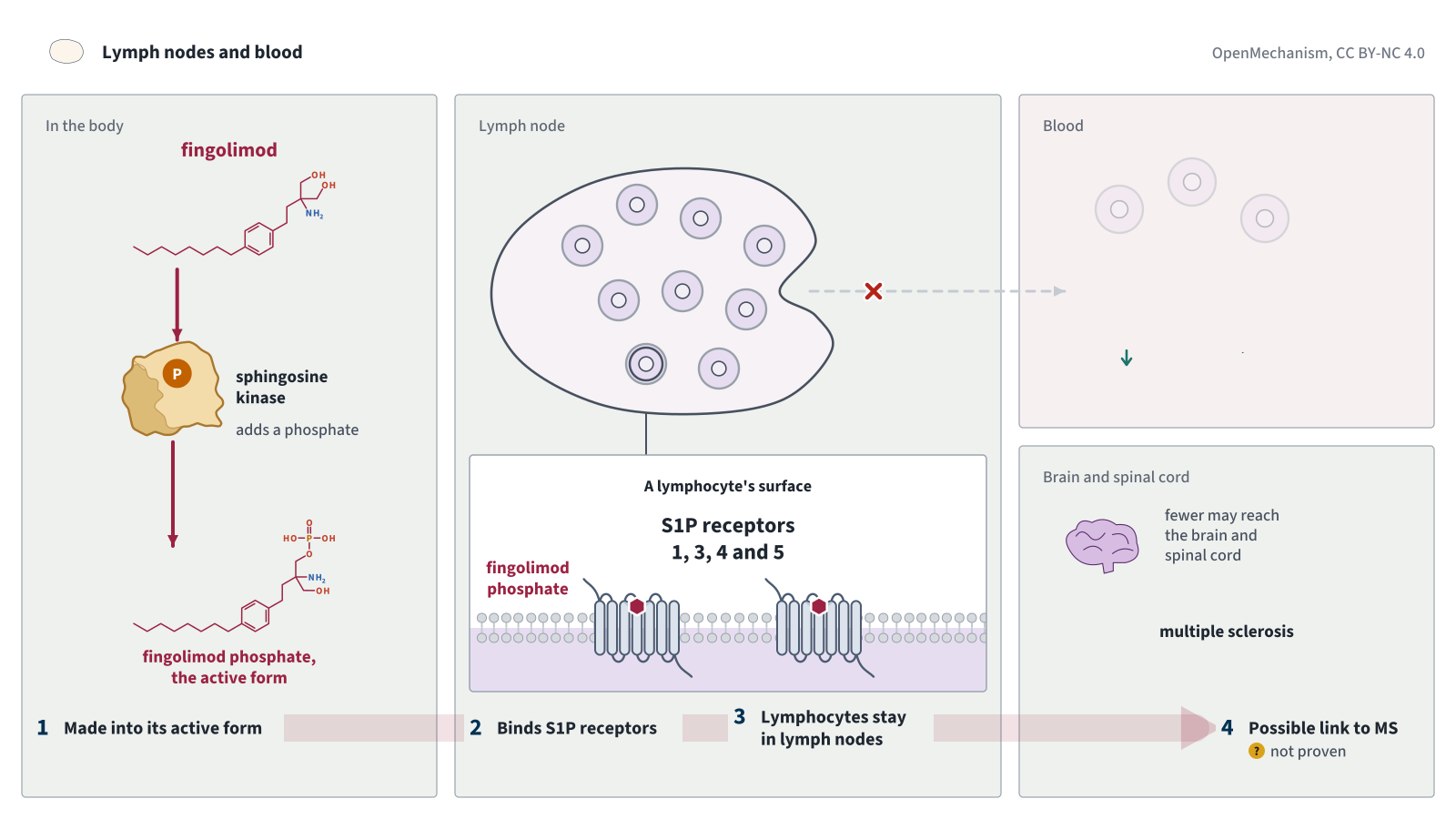
The body converts fingolimod into an active form that binds receptors. This stops lymphocytes leaving lymph nodes, so fewer are in the blood. Fewer reaching the brain and spinal cord may help in multiple sclerosis, but the label says the exact mechanism is unknown.
- Acts on
- S1P receptors 1, 3, 4 and 5
- Where
- Lymph nodes and blood
- Medicine type
- Small molecule
- Used for
- Immune system
Also called Gilenya.
Step 4: not proven
The Gilenya (fingolimod) label says: The mechanism by which fingolimod exerts therapeutic effects in multiple sclerosis is unknown, but may involve reduction of lymphocyte migration into the central nervous system.
Source 1: Gilenya (fingolimod HCl): FDA label, 12.1 Mechanism of Action
Clinical study: In a 24-month double-blind trial of fingolimod (0.5 or 1.25 mg a day) or placebo in 1272 people with relapsing-remitting multiple sclerosis; the trial measured relapses, disability and MRI findings, not how fingolimod works: As compared with placebo, both doses of oral fingolimod improved the relapse rate, the risk of disability progression, and end points on MRI.
Kappos L et al., N Engl J Med 2010 (PMID 20089952)
This study was picked with a literature search and is not yet checked by our reviewer.
Key terms in this drawing
- S1P
- Sphingosine-1-phosphate. A signaling lipid; its receptors let lymphocytes leave lymph nodes.
How it works
Made into its active form. Sphingosine kinase produces fingolimod-phosphate.1
Binds S1P receptors. The phosphorylated species binds with high to S1P receptors 1, 3, 4 and 5.1
Lymphocytes stay in lymph nodes. This source-described modulation restricts exit from lymph nodes and lowers peripheral-blood lymphocyte numbers.1
Possible link to MS. Reduced migration into the may contribute to the effect; the therapeutic mechanism remains unknown.1
For teachers: download this drawing or build a slide deck.
See also
Condition pages: multiple sclerosis.
Body system: immune system.
Sources
- 1Gilenya (fingolimod HCl): FDA label12.1 Mechanism of Action
- 2ChEMBL CHEMBL314854Target and action classification: Sphingosine 1-phosphate receptor agonist; Sphingosine 1-phosphate receptor binding agent
- 3A placebo-controlled trial of oral fingolimod in relapsing multiple sclerosisKappos L et al. N Engl J Med 2010 (abstract)
Also used for the drawing
The sphingosine kinase outline is traced from the crystal structure below.
- 4Human sphingosine kinase 1 with sphingosinePDB 3VZB; Wang, Z. et al. Structure 2013; 21:798-809
Spotted a mistake? Report an error (hello@openmechanism.com). Since launch, every published error we fix is listed on the corrections page.
Notes and limits
- A schematic teaching drawing: not to scale, not exact structures, binding poses or a complete pathway, and not a guide to dosing, treatment or how a person will respond.
- Other medicines in the same family may not follow every step or share the same clinical endpoint.
- The steps are in the order that explains them; one step is said to cause the next only where the source says so.
- The selected passage does not establish a complete receptor internalization or subtype-specific signaling trajectory.
- Parent fingolimod and its active phosphate must be separate actors.
All recorded limits are on the evidence page, and notes that apply to every page are on How to read a page. Version 1.0.0, not yet medically reviewed.
Cite this page
Tran D. Fingolimod [Internet]. OpenMechanism; 2026 [updated 2026 Oct 15; cited 2026 Oct 15]. Available from: https://openmechanism.com/medicines/fingolimod