Food allergy
In food allergy, tolerance of a normally harmless food protein breaks down. In the IgE-mediated kind, IgE on mast cells and basophils makes them release chemical signals when the food arrives. Reactions can involve the gut, skin and lungs; the most severe is anaphylaxis. Omalizumab keeps IgE off its receptor and, alongside avoiding the food, reduces reactions after accidental exposure.
- Where
- Gut, skin and lungs
- Body systems
- Immune system; Stomach, gut & liver
- Medicines
- 1 medicine
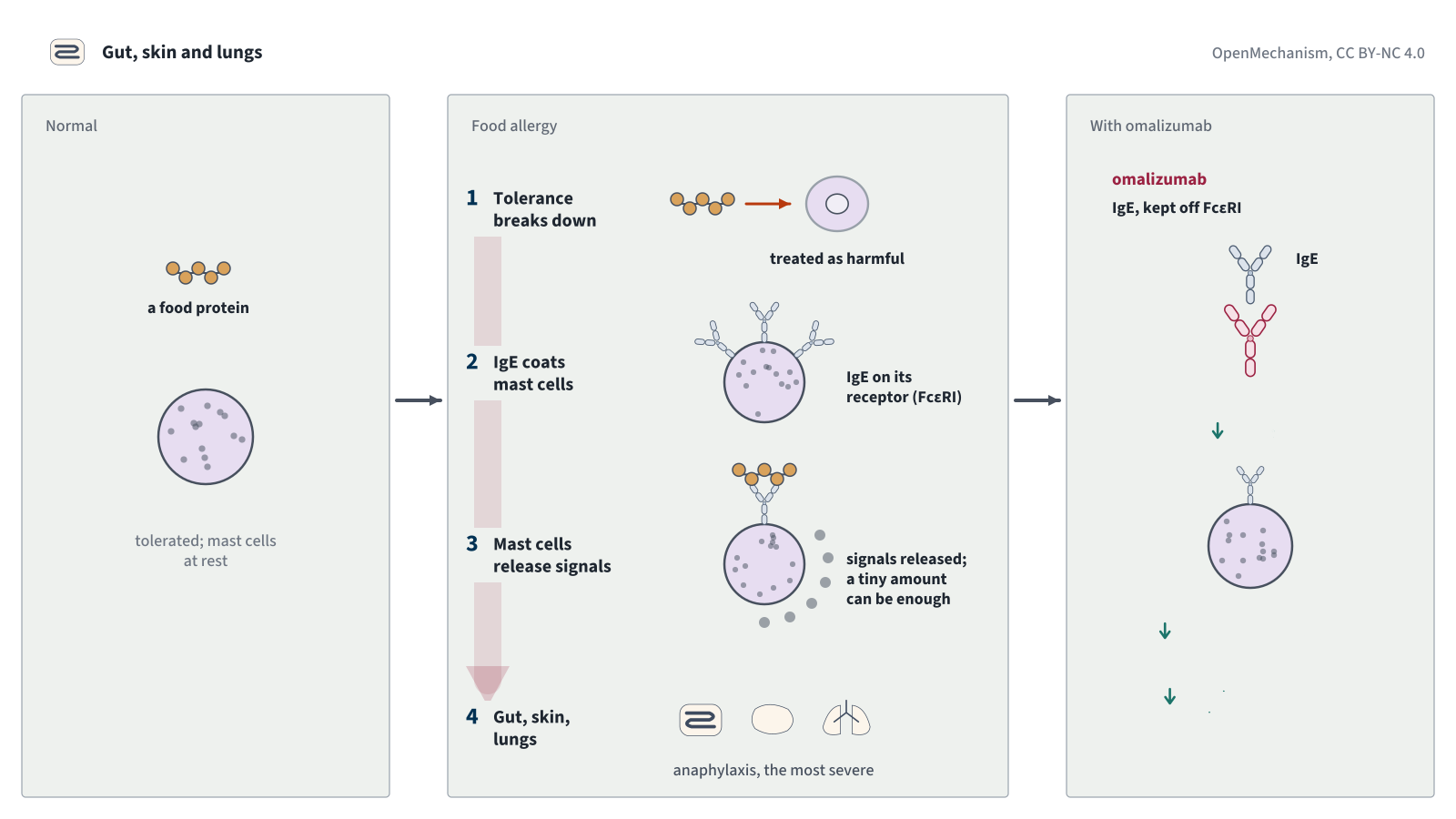
For teachers: download this drawing.
Key terms in this drawing
- FcεRI
- High-affinity IgE receptor (Fc-epsilon RI). The receptor on mast cells, basophils and dendritic cells that holds IgE.
- IgE
- Immunoglobulin E. A type of antibody involved in allergic reactions.
- mast cell
- Mast cell. An immune cell in tissues such as the skin and the airways that releases histamine and other signals.
What goes wrong
Tolerance breaks down. Food allergy is a harmful, potentially deadly immune reaction to food proteins that are normally harmless. The body's tolerance of the food breaks down, leading to reactions that do or do not involve antibodies.1,2
What the source says
“Food allergy is a pathological, potentially deadly, immune reaction triggered by normally innocuous food protein antigens.”
Source 1“the breakdown of clinical and immunological tolerance against food antigens, which can result in either immunoglobulin E (IgE)-mediated reactions or non-IgE-mediated reactions.”
Source 2IgE coats mast cells. In the IgE-mediated kind, the body makes IgE against the food, and the IgE fixes to its receptors () on and basophils. This starts immediate allergic reactions.3
What the source says
“Antigen-specific IgE production, with subsequent fixation of IgE to FcepsilonRI receptors on mast cells and basophils, is central to the initiation and propagation of immediate hypersensitivity reactions.”
Source 3Mast cells release signals. Mast cells and basophils release chemical signals (mediators), most often set off through IgE. In some people a tiny amount of a food is enough.4,5
Gut, skin, lungs. Reactions can affect the gut, skin and lungs. The most severe, sometimes fatal, is anaphylaxis: a rapid reaction with life-threatening airway, breathing or circulation problems.2,5
What the source says
“Food allergies manifest in a variety of clinical conditions within the gastrointestinal tract, skin and lungs, with the most dramatic and sometimes fatal manifestation being anaphylactic shock.”
Source 2“Anaphylaxis is a severe systemic hypersensitivity reaction that is rapid in onset; characterized by life-threatening airway, breathing, and/or circulatory problems; and usually associated with skin and mucosal changes.”
Source 5
Where medicines act
- A
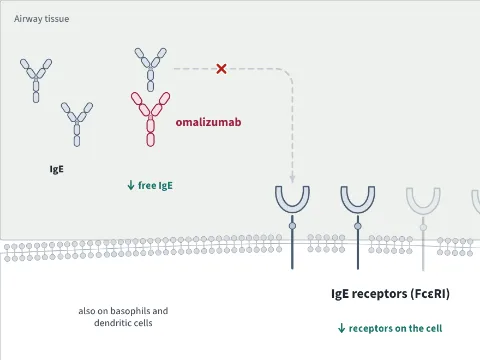
Omalizumab: IgE kept off mast cells
Omalizumab stops IgE binding its receptor (FcεRI) on mast cells, basophils and dendritic cells, which then carry fewer receptors. It reduces allergic reactions, including anaphylaxis, after accidental exposure to a food in people aged 1 and over, together with avoiding the food.6
What the source says
“Omalizumab inhibits the binding of IgE to the high-affinity IgE receptor (FcεRI) on the surface of mast cells, basophils, and dendritic cells, resulting in FcεRI down-regulation on these cells.”
Source 6“XOLAIR is indicated for the reduction of allergic reactions (Type I), including anaphylaxis, that may occur with accidental exposure to one or more foods in adult and pediatric patients aged 1 year and older with IgE-mediated food allergy.”
Source 6“XOLAIR is to be used in conjunction with food allergen avoidance.”
Source 6
See also
Body systems: immune system; and stomach, gut & liver.
Zoom in: an allergic reaction to food.
Also used for it: epinephrine (“Emergency treatment of allergic reactions (Type I), including anaphylaxis, which may result from insect stings or bites, foods, drugs, sera, diagnostic testing substances and other allergens, as well as idiopathic anaphylaxis or exercise-induced anaphylaxis.”8).
Other conditions: eczema (atopic dermatitis), chronic hives (urticaria), chronic sinusitis with nasal polyps, asthma, shock and Crohn disease.
Side effects: why fast vancomycin infusions cause flushing.
Sources
- 1Food allergy: immune mechanisms, diagnosis and immunotherapyYu W, Freeland DMH, Nadeau KC. Nat Rev Immunol 2016 (abstract). Saved copy
- 2Food allergyRenz H et al. Nat Rev Dis Primers 2018 (abstract). Saved copy
- 3IgE, mast cells, basophils, and eosinophilsStone KD, Prussin C, Metcalfe DD. J Allergy Clin Immunol 2010 (abstract). Saved copy
- 4Pathophysiology of anaphylaxisKhan BQ, Kemp SF. Curr Opin Allergy Clin Immunol 2011 (abstract). Saved copy
- 5The pathophysiology of anaphylaxisReber LL, Hernandez JD, Galli SJ. J Allergy Clin Immunol 2017 (abstract). Saved copy
- 6Xolair (omalizumab): FDA label1.3 IgE-Mediated Food Allergy; 12.1 Mechanism of Action. Saved copy
- 7Food allergy: a review and update on epidemiology, pathogenesis, diagnosis, prevention, and managementSicherer SH, Sampson HA. J Allergy Clin Immunol 2018 (abstract). Saved copy
- 8Adrenalin (epinephrine) injection: FDA label1 Indications and Usage. Saved copy
Notes and limits
- Omalizumab is not a treatment for an allergic reaction in an emergency, including anaphylaxis.6
- In reviews from 2016 and 2018, standard care, avoiding the food and treating whole-body reactions with adrenaline (epinephrine), was called not optimal, with many treatments still in trials; omalizumab's label now covers IgE-mediated food allergy, to reduce reactions after accidental exposure, together with avoiding the food.1,6,7
- Firm figures on how common it is are lacking.7
Notes that apply to every page are on How to read a page.
Spotted a mistake? Report an error (hello@openmechanism.com). Since launch, every published error we fix is listed on the corrections page.
Cite this page
Tran D. Food allergy [Internet]. OpenMechanism; 2026 [updated 2026 Oct 20; cited 2026 Oct 20]. Available from: https://openmechanism.com/conditions/food-allergy