CAPS and DIRA
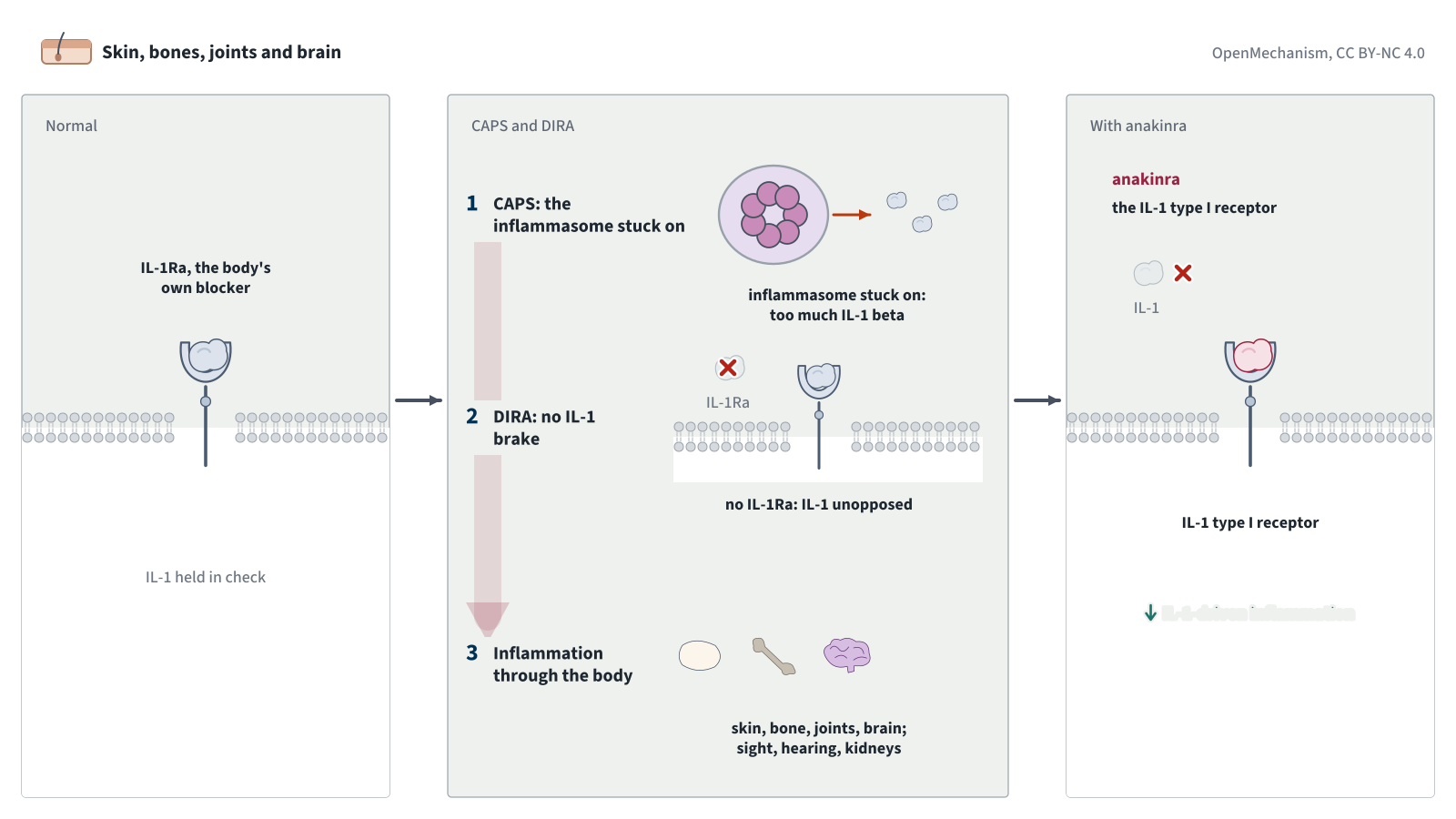
In CAPS and DIRA, rare inherited diseases, interleukin-1 (IL-1) runs unchecked, inflaming the whole body. In CAPS, whose three forms run from familial cold autoinflammatory syndrome to NOMID, a gain-of-function NLRP3 change makes the cryopyrin inflammasome release too much IL-1 beta. In DIRA, cells cannot release the body's own IL-1 blocker. Anakinra, a man-made copy, treats NOMID and DIRA.
- Where
- Skin, bones, joints and brain
- Body systems
- Immune system; Skin, hair & nails; Muscles, bones & joints
- Medicines
- 1 medicine
For teachers: download this drawing.
Key terms in this drawing
- CAPS
- Cryopyrin-associated periodic syndromes. Inherited inflammatory diseases in which an overactive NLRP3 gene makes the cryopyrin inflammasome release too much IL-1β.
- DIRA
- Deficiency of the interleukin-1 receptor antagonist. An inherited inflammatory disease in which, because of mutations in the IL1RN gene, the body cannot release IL-1Ra.
- IL-1
- Interleukin-1. A signaling molecule (cytokine) that drives inflammation.
- IL-1Ra
- Interleukin-1 receptor antagonist. The body's own blocker of the IL-1 receptor; anakinra is a recombinant form of it.
What goes wrong
CAPS: the inflammasome stuck on. In , a gain-of-function change in the gene, which makes cryopyrin, switches on the cryopyrin inflammasome, a protein complex inside cells. Too much beta is released.1,2
What the source says
“CAPS results from a gain-of-function mutation of the NLRP3 gene coding for cryopyrin, which forms intracellular protein complexes known as inflammasomes.”
Source 1“Gain-of-function mutations in NLRP3 in CAPS patients lead to activation of the cryopyrin inflammasome, resulting in the inappropriate release of inflammatory cytokines including IL-1β”
Source 2DIRA: no IL-1 brake. In , an inherited change in both copies of the IL1RN gene means cells cannot release the (), the body's own IL-1 blocker. IL-1 then acts unopposed.3,4
What the source says
“DIRA is an autosomal recessive monogenic autoinflammatory disease caused by mutations in the IL1RN gene leading to loss of secretion of the interleukin-1 receptor antagonist (IL-1Ra).”
Source 3“The IL1RN mutations resulted in a truncated protein that is not secreted, thereby rendering cells hyperresponsive to interleukin-1beta stimulation.”
Source 4“The absence of interleukin-1-receptor antagonist allows unopposed action of interleukin-1”
Source 4Inflammation through the body. Both inflame the whole body. CAPS affects the skin, muscles and joints, and brain; its most severe forms can harm sight, hearing, the nerves and the kidneys. DIRA starts in newborns, with life-threatening inflammation of the skin and bone.2,4,5
What the source says
“characterized by systemic, cutaneous, musculoskeletal, and central nervous system inflammation”
Source 2“In the most severe forms, they may develop serious organ damage such as visual and hearing impairment, neurological deterioration and renal insufficiency.”
Source 5“neonatal onset of sterile multifocal osteomyelitis, periostitis, and pustulosis”
Source 4“resulting in life-threatening systemic inflammation with skin and bone involvement”
Source 4
Where medicines act
- A
Anakinra: IL-1 receptor blocked
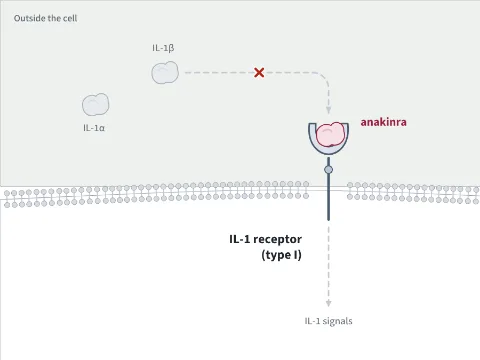
Anakinra is a man-made form of the body's IL-1 receptor antagonist. It stops IL-1 alpha and beta from binding the IL-1 type I receptor. It treats NOMID, the form of CAPS that starts in newborns, and DIRA.3
What the source says
“KINERET (anakinra) is a recombinant , nonglycosylated form of the human interleukin-1 receptor antagonist (IL-1Ra).”
Source 3“KINERET blocks the biologic activity of IL-1 alpha and beta by competitively inhibiting IL-1 binding to the interleukin-1 type I receptor (IL-1RI)”
Source 3“KINERET is indicated for the treatment of Neonatal-Onset Multisystem Inflammatory Disease (NOMID).”
Source 3“KINERET is indicated for the treatment of Deficiency of Interleukin-1 Receptor Antagonist (DIRA)”
Source 3
See also
Body systems: immune system; skin, hair & nails; and muscles, bones & joints.
Other conditions: rheumatoid arthritis and psoriatic arthritis.
Sources
- 1Cryopyrin-associated periodic syndrome: an update on diagnosis and treatment responseYu JR, Leslie KS. Curr Allergy Asthma Rep 2011 (abstract). Saved copy
- 2CAPS and NLRP3Booshehri LM, Hoffman HM. J Clin Immunol 2019 (abstract). Saved copy
- 3Kineret (anakinra): FDA label1.2 CAPS; 1.3 DIRA; 11 Description; 12.1 Mechanism of Action. Saved copy
- 4An autoinflammatory disease with deficiency of the interleukin-1-receptor antagonistAksentijevich I et al. N Engl J Med 2009 (abstract). Saved copy
- 5Anakinra for cryopyrin-associated periodic syndromeKoné-Paut I, Galeotti C. Expert Rev Clin Immunol 2014 (abstract). Saved copy
Notes and limits
- CAPS has three forms; anakinra's label names only NOMID.1
- Diagnosis of CAPS is often delayed.1
- DIRA was first described in nine children from six families; it is very rare.4
Notes that apply to every page are on How to read a page.
Spotted a mistake? Report an error (hello@openmechanism.com). Since launch, every published error we fix is listed on the corrections page.
Cite this page
Tran D. CAPS and DIRA [Internet]. OpenMechanism; 2026 [updated 2026 Oct 16; cited 2026 Oct 16]. Available from: https://openmechanism.com/conditions/caps-and-dira