Natalizumab
Natalizumab binds α4 integrins on white blood cells other than neutrophils. This stops them sticking to on blood-vessel walls and moving into inflamed tissue. The label proposes this may explain its effect in multiple sclerosis, but the full mechanism is not defined.
- Acts on
- α4β1 and α4β7 integrins
- Where
- White blood cells and blood-vessel walls
- Used for
- Immune system
- Drug class
- Antibody medicines
Also called Tysabri.
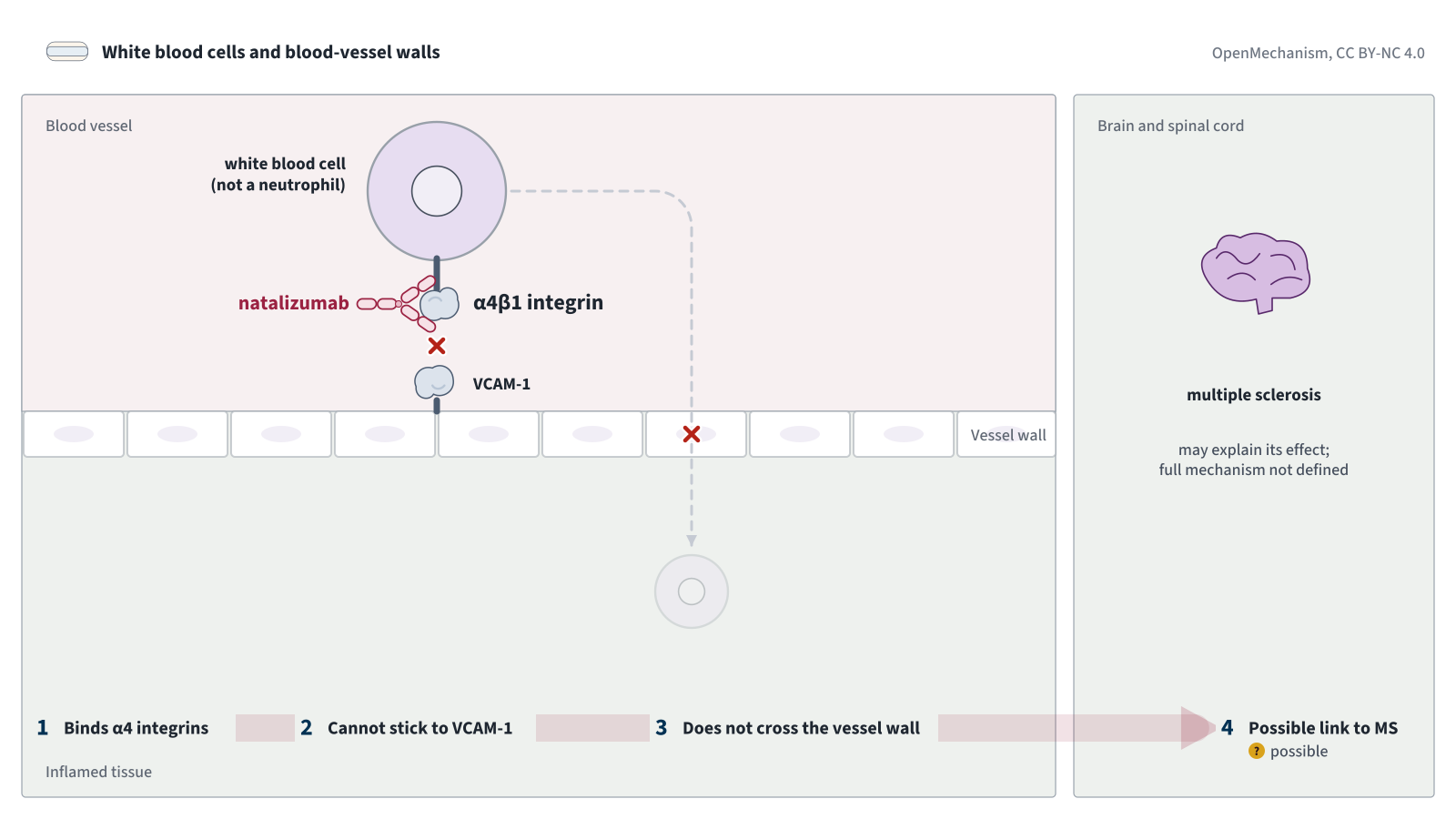
Step 4: possible
The Tysabri (natalizumab) label says: The specific mechanism(s) by which TYSABRI exerts its effects in multiple sclerosis and Crohn's disease have not been fully defined. … The clinical effect of natalizumab in multiple sclerosis may be secondary to blockade of the molecular interaction of α4β1-integrin expressed by inflammatory cells with VCAM-1 on vascular endothelial cells, and with CS-1 and/or osteopontin expressed by parenchymal cells in the brain.
Source 1: Tysabri (natalizumab): FDA label, 12.1 Mechanism of Action
Clinical study: In a two-year randomized, placebo-controlled phase 3 trial (AFFIRM) of natalizumab in 942 people with relapsing multiple sclerosis; the trial measured relapses and the progression of disability, not how natalizumab works: Natalizumab reduced the risk of the sustained progression of disability and the rate of clinical relapse in patients with relapsing multiple sclerosis.
Polman CH et al., N Engl J Med 2006 (PMID 16510744)
This study was picked with a literature search and is not yet checked by our reviewer.
Key terms in this drawing
- VCAM-1
- Vascular cell adhesion molecule 1. A protein on blood-vessel walls that white blood cells stick to.
How it works
Binds α4 integrins. Natalizumab engages the α4 subunit of α4β1 and α4β7 integrins on leukocytes except neutrophils.1
Cannot stick to VCAM-1. The selected branch disrupts α4β1-mediated binding to endothelial VCAM-1.1
Does not cross the vessel wall. Disruption of adhesion prevents leukocyte transmigration across the endothelium into inflamed tissue.1
Possible link to MS. The label proposes that this blockade may explain the effect in multiple sclerosis; its complete clinical mechanism is not defined.1
For teachers: download this drawing or build a slide deck.
See also
Condition pages: Crohn disease and multiple sclerosis.
Other antibody medicines: adalimumab, bevacizumab, bezlotoxumab, blinatumomab, burosumab, denosumab, dupilumab, eculizumab and 14 more.
Explained: why natalizumab raises the risk of PML, a brain infection.
Body system: immune system.
Sources
- 1Tysabri (natalizumab): FDA label12.1 Mechanism of Action
- 2ChEMBL CHEMBL1201607Target and action classification: Integrin alpha-4/beta-1 inhibitor; Integrin alpha-4/beta-7 inhibitor
- 3A randomized, placebo-controlled trial of natalizumab for relapsing multiple sclerosisPolman CH et al. N Engl J Med 2006 (abstract)
Spotted a mistake? Report an error (hello@openmechanism.com). Since launch, every published error we fix is listed on the corrections page.
Notes and limits
- A schematic teaching drawing: not to scale, not exact structures, binding poses or a complete pathway, and not a guide to dosing, treatment or how a person will respond.
- Other medicines in the same family may not follow every step or share the same clinical endpoint.
- The steps are in the order that explains them; one step is said to cause the next only where the source says so.
- This scene selects the α4β1/VCAM-1 route; the α4β7/MAdCAM-1 intestinal route is a separate branch.
- Animal migration and plaque results are not assumed to establish human clinical significance.
All recorded limits are on the evidence page, and notes that apply to every page are on How to read a page. Version 1.0.0, not yet medically reviewed.
Cite this page
Tran D. Natalizumab [Internet]. OpenMechanism; 2026 [updated 2026 Oct 15; cited 2026 Oct 15]. Available from: https://openmechanism.com/medicines/natalizumab