Eczema (atopic dermatitis)
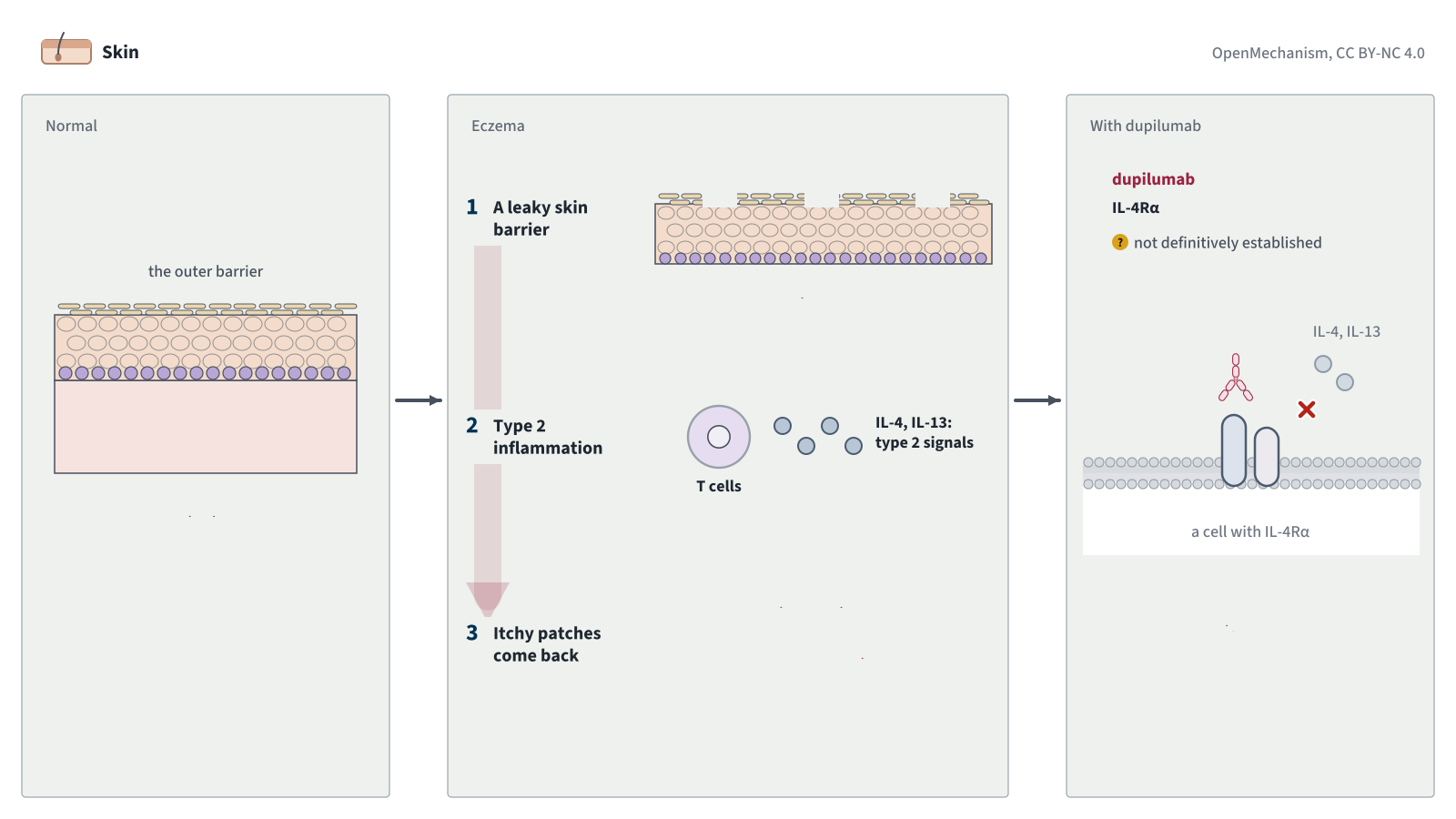
In eczema, or atopic dermatitis, a faulty skin barrier and T-cell-driven inflammation, mostly of the type 2 kind, give recurrent itchy patches. A 2016 review calls topical corticosteroids still the first-line treatment for flares; dupilumab blocks the shared receptor of two type 2 signals, IL-4 and IL-13.
- Where
- Skin
- Body systems
- Skin, hair & nails; Immune system
- Medicines
- 1 medicine
Not definitively established
The Dupixent (dupilumab) label says: The mechanism of dupilumab action has not been definitively established.
Source 3: Dupixent (dupilumab): FDA label, 1.1 Atopic Dermatitis; 12.1 Mechanism of Action
Clinical study: In two 16-week randomized, placebo-controlled phase 3 trials (SOLO 1 and SOLO 2) in 671 and 708 adults with moderate-to-severe atopic dermatitis not controlled by topical treatment; the trials measured skin clearing, not how dupilumab works: In SOLO 1, the primary outcome occurred in 85 patients (38%) who received dupilumab every other week and in 83 (37%) who received dupilumab weekly, as compared with 23 (10%) who received placebo
Simpson EL et al., N Engl J Med 2016 (PMID 27690741)
This study was picked with a literature search and is not yet checked by our reviewer.
For teachers: download this drawing.
Key terms in this drawing
- IL-13
- Interleukin-13. A cytokine made by Th2 cells; with IL-4 it signals the switch from IgM to IgE antibodies.
- IL-4
- Interleukin-4. A cytokine made by Th2 cells; with IL-13 it signals the switch from IgM to IgE antibodies.
- IL-4Rα
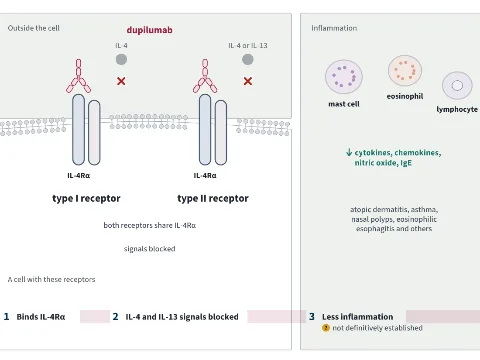
- Interleukin-4 receptor alpha subunit. The receptor part shared by the IL-4 and IL-13 receptors; dupilumab binds it and blocks both signals.
- T cell
- T lymphocyte. A white blood cell of the immune system.
What goes wrong
A leaky skin barrier. Defects of the skin's outer barrier, the epidermis, are central to atopic dermatitis, on a strong genetic background.1,2
What the source says
“Originally regarded as a childhood disorder mediated by an imbalance towards a T-helper-2 response and exaggerated IgE responses to allergens, it is now recognised as a lifelong disposition with variable clinical manifestations and expressivity, in which defects of the epidermal barrier are central.”
Source 1“The pathophysiology is complex and involves a strong genetic predisposition, epidermal dysfunction, and T-cell driven inflammation.”
Source 2Type 2 inflammation. drive the inflammation. Type 2 mechanisms dominate, though several immune pathways take part; inflammation driven by the type 2 signals and is an important part of how the disease develops.2,3
What the source says
“The pathophysiology is complex and involves a strong genetic predisposition, epidermal dysfunction, and T-cell driven inflammation.”
Source 2“Although type-2 mechanisms are dominant, there is increasing evidence that the disorder involves multiple immune pathways.”
Source 2“Inflammation driven by IL-4 and IL-13 is an important component in the pathogenesis of asthma, AD, CRSwNP, EoE, PN, COPD, CSU, BP, and AFRS.”
Source 3Itchy patches come back. The result is a chronic inflammatory skin disease with intense itch and eczema patches that keep coming back.1,2
What the source says
“Atopic dermatitis is a common inflammatory skin disorder characterised by recurrent eczematous lesions and intense itch.”
Source 2“Atopic dermatitis (also known as atopic eczema) is a chronic inflammatory skin disease that is characterised by intense itching and recurrent eczematous lesions.”
Source 1
Where medicines act
In the skin's inflammation
- A
Dupilumab targets IL-4Rα
Binds , blocking IL-4 and IL-13 signals; how it works is not definitively established.3
Used forModerate-to-severe atopic dermatitis: from 6 months of age, when topical prescription treatments are not enough or not advisable
What the label says
“Atopic Dermatitis for the treatment of adult and pediatric patients aged 6 months and older with moderate-to-severe AD whose disease is not adequately controlled with topical prescription therapies or when those therapies are not advisable. DUPIXENT can be used with or without topical corticosteroids.”
Source 3“Dupilumab is a human monoclonal IgG4 antibody that inhibits interleukin-4 (IL-4) and interleukin-13 (IL-13) signaling by specifically binding to the IL-4Rα subunit shared by the IL-4 and IL-13 receptor complexes.”
Source 3“The mechanism of dupilumab action has not been definitively established.”
Source 3
See also
Body systems: skin, hair & nails; and immune system.
Related medicines: clobetasol and triamcinolone.
Other conditions: food allergy, asthma, acne, chronic hives (urticaria), chronic sinusitis with nasal polyps and chronic obstructive pulmonary disease (COPD).
Sources
- 1Atopic dermatitisWeidinger S, Novak N. Lancet 2016 (abstract). Saved copy
- 2Atopic dermatitisLangan SM, Irvine AD, Weidinger S. Lancet 2020 (abstract). Saved copy
- 3Dupixent (dupilumab): FDA label1.1 Atopic Dermatitis; 12.1 Mechanism of Action. Saved copy
- 4Two Phase 3 Trials of Dupilumab versus Placebo in Atopic DermatitisSimpson EL et al. N Engl J Med 2016 (abstract). Saved copy
Notes and limits
- A 2020 review says there is currently no cure. A 2016 review says prevention and treatment focus on restoring the skin barrier, best done with emollients, and that topical corticosteroids are still the first-line treatment for flares and are also used with topical calcineurin inhibitors to keep remission.1,2
- Eczema raises the risk of food allergy, asthma, allergic rhinitis and mental health disorders.2
Notes that apply to every page are on How to read a page.
Spotted a mistake? Report an error (hello@openmechanism.com). Since launch, every published error we fix is listed on the corrections page.
Cite this page
Tran D. Eczema (atopic dermatitis) [Internet]. OpenMechanism; 2026 [updated 2026 Nov 18; cited 2026 Nov 18]. Available from: https://openmechanism.com/conditions/eczema