Tacrolimus
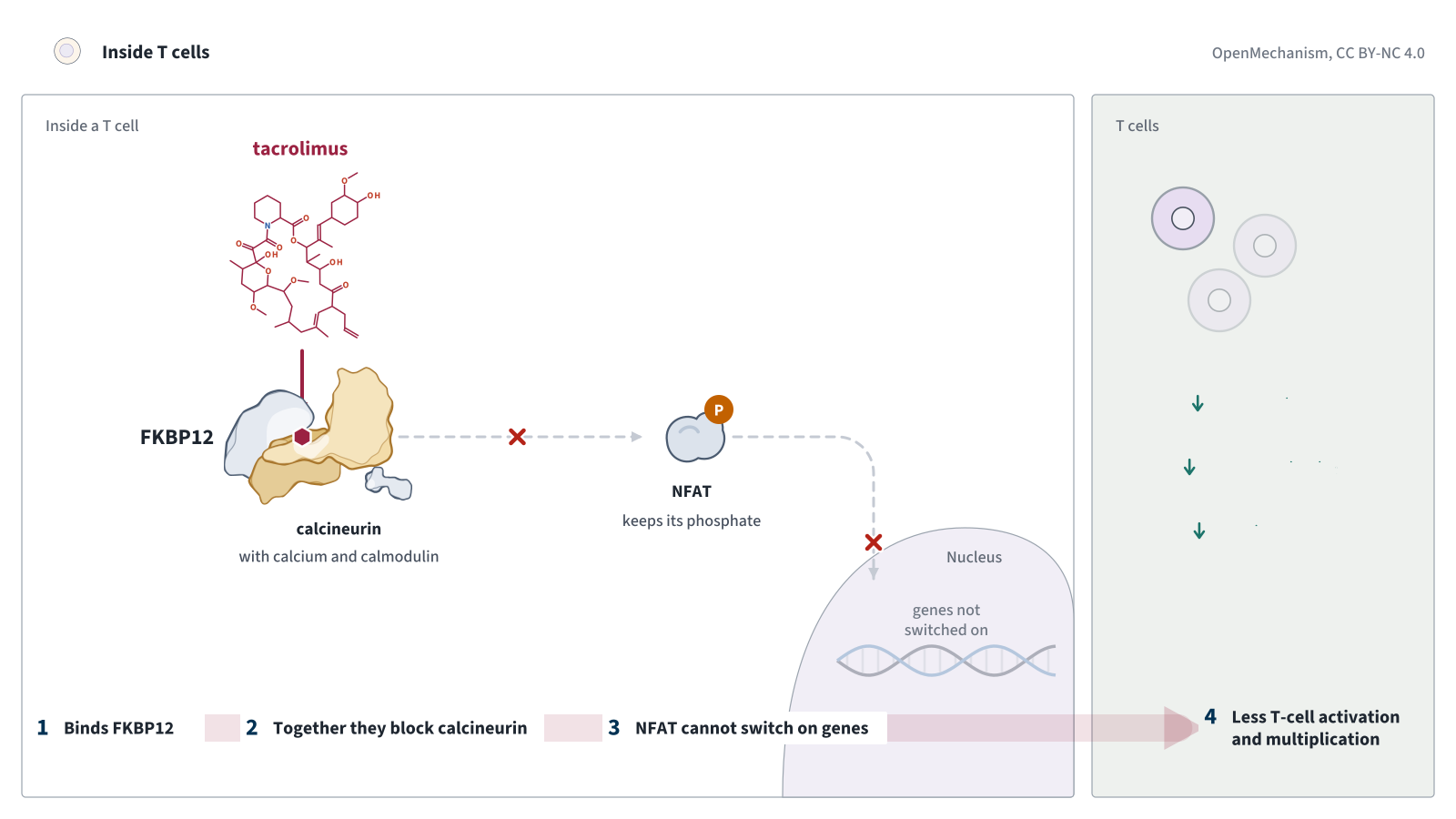
Tacrolimus binds the protein inside cells, and together they block calcineurin. Without calcineurin, cannot switch on immune-signal genes, so are less activated and multiply less.
- Acts on
- FKBP12
- Where
- Inside T cells
- Medicine type
- Small molecule
- Used for
- Immune system
Also called Prograf.
Key terms in this drawing
- cytokines
- Cytokines. Signal molecules involved in inflammation, such as interleukin-2, interferon-γ, interleukin-4 and TNF-α, which T cells make.
- FKBP12
- FK506-binding protein 12. A protein inside cells that tacrolimus binds.
- NFAT
- Nuclear factor of activated T cells. A protein that switches on immune-signal genes in T cells.
- T cell
- T lymphocyte. A white blood cell of the immune system.
How it works
Binds FKBP12. Tacrolimus binds intracellular FKBP12.1
Together they block calcineurin. The source describes a tacrolimus-FKBP12 complex with calcium, calmodulin and calcineurin that inhibits phosphatase activity.1
NFAT cannot switch on genes. Inhibition prevents dephosphorylation and translocation of factors including NFAT.1
Less T-cell activation and multiplication. Cytokine production and T-lymphocyte activation and proliferation are inhibited.1
For teachers: download this drawing or build a slide deck.
See also
Condition pages: transplant rejection.
Explained: tacrolimus and the CYP3A5 gene.
Related drawings: sirolimus (also binds FKBP12, but the pair blocks mTOR).
Body system: immune system.
Inside the body: t cells and a transplanted kidney.
Sources
- 1Prograf (tacrolimus): FDA label12.1 Mechanism of Action
- 2ChEMBL CHEMBL269732Target and action classification: FK506-binding protein 1A inhibitor
Also used for the drawing
The FKBP12, calcineurin and calmodulin outlines are traced from the crystal structures below.
- 3Bovine calcineurin A and B with FKBP12 and tacrolimusPDB 1TCO; Griffith, J.P. et al. Cell(Cambridge,Mass.) 1995; 82:507-522
- 4Human calmodulin with four calcium ionsPDB 1CLL; Chattopadhyaya, R. et al. J.Mol.Biol. 1992; 228:1177-1192
Spotted a mistake? Report an error (hello@openmechanism.com). Since launch, every published error we fix is listed on the corrections page.
Notes and limits
- A schematic teaching drawing: not to scale, not exact structures, binding poses or a complete pathway, and not a guide to dosing, treatment or how a person will respond.
- Other medicines in the same family may not follow every step or share the same clinical endpoint.
- The steps are in the order that explains them; one step is said to cause the next only where the source says so.
- This is drug-assisted protein-complex action, not replacement of FKBP12 or direct DNA editing.
- Complex membership is label-supported; its drawn stoichiometry and molecular geometry remain illustrative.
All recorded limits are on the evidence page, and notes that apply to every page are on How to read a page. Version 1.0.0, not yet medically reviewed.
Cite this page
Tran D. Tacrolimus [Internet]. OpenMechanism; 2026 [updated 2026 Oct 16; cited 2026 Oct 16]. Available from: https://openmechanism.com/medicines/tacrolimus