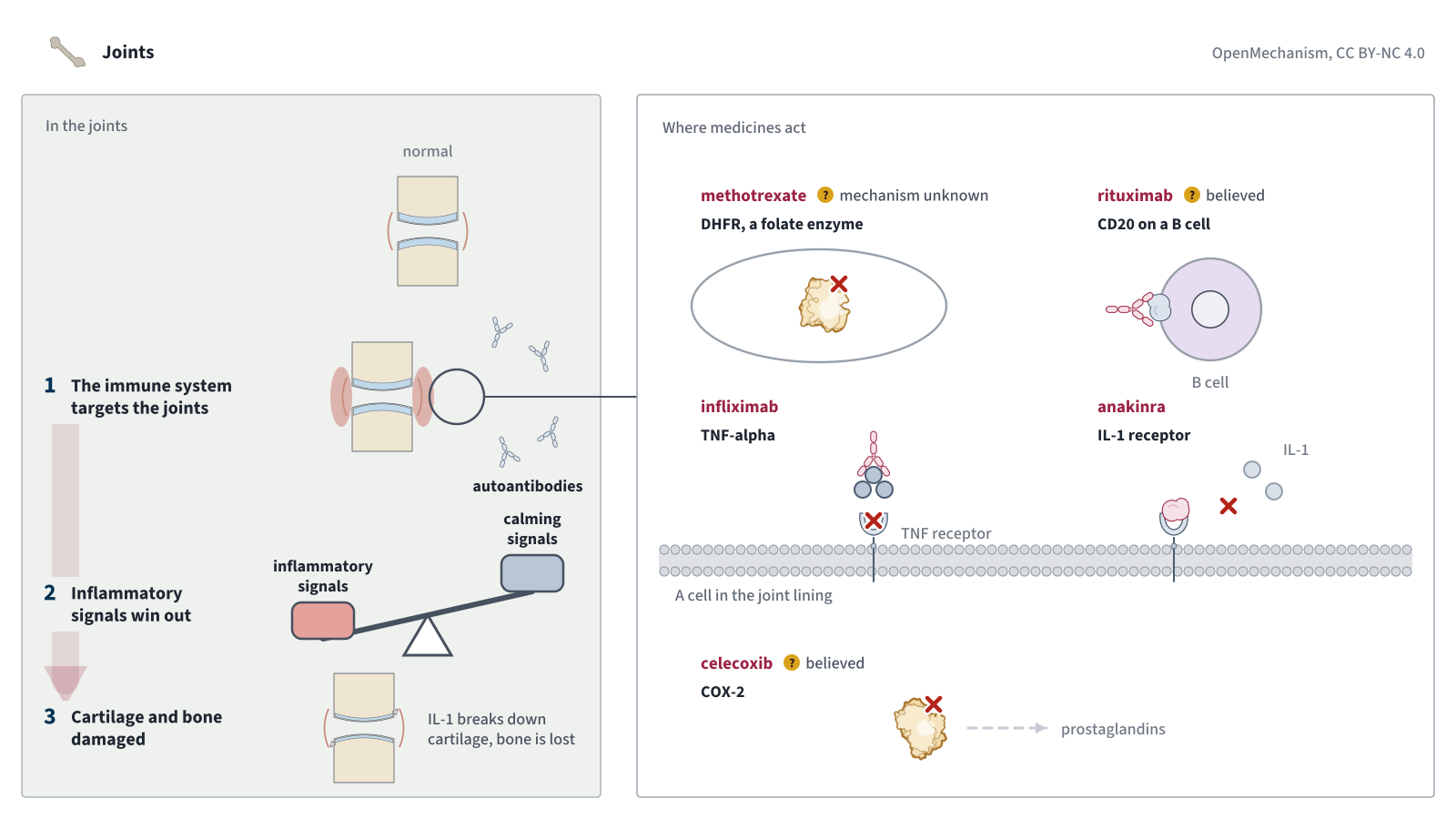
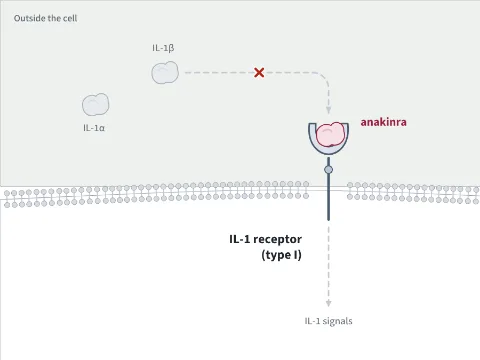
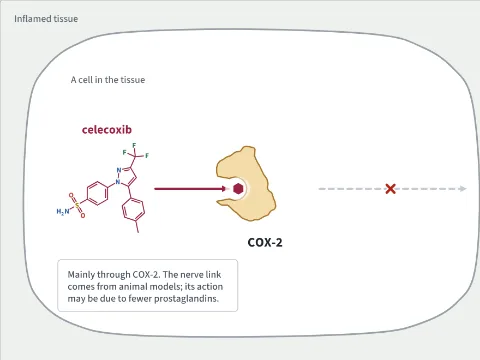
Rheumatoid arthritis is a long-lasting autoimmune disease that mainly inflames the joints, with autoantibodies against the body's own molecules. Inflammatory cytokines outweigh calming ones, which favors long-lasting inflammation and can lead to cartilage and bone damage. Medicines block a folate enzyme (methotrexate; its label says how it works in rheumatoid arthritis is unknown), remove B cells (rituximab), or block inflammatory signals: TNF-alpha, IL-1, and, it is believed, prostaglandins, mainly through COX-2.
What goes wrong in rheumatoid arthritis, and where medicines act. Schematic, not to scale. DHFR outline from the structure with methotrexate and NADPH. COX-2 outline from the structure with mefenamic acid. License CC BY-NC 4.0.
?Mechanism unknown
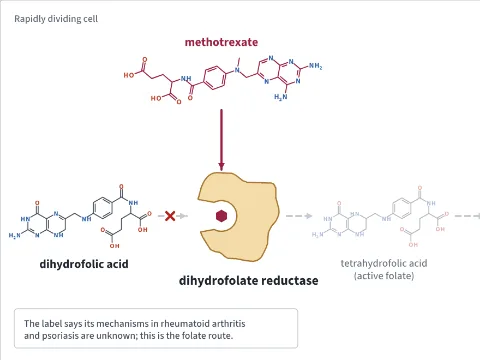
The Trexall (methotrexate) label says: Methotrexate inhibits dihydrofolic acid reductase. … The mechanism of action in rheumatoid arthritis and in psoriasis is unknown.
Clinical study: In van Ede and colleagues' 2001 report of a 48-week randomized, double-blind, placebo-controlled trial in 434 people with active rheumatoid arthritis starting methotrexate (7.5 mg a week at first, raised up to 25 mg a week if the response was not enough) with folic acid (1 mg a day) or folinic acid (2.5 mg a week), each doubled once methotrexate reached 15 mg a week, or placebo; the trial measured side effects and disease activity, not how methotrexate works: Parameters of disease activity improved equally in all groups. … Slightly higher dosages of MTX were prescribed to obtain similar improvement in disease activity in the folate supplementation groups.van Ede AE et al., Arthritis Rheum 2001 (PMID 11465701)
?Believed
The Rituxan (rituximab) label says: B cells are believed to play a role in the pathogenesis of rheumatoid arthritis (RA) and associated chronic synovitis.
Clinical study: In Edwards and colleagues' 2004 randomized, double-blind trial in 161 people with active rheumatoid arthritis despite methotrexate, rituximab (1000 mg on days 1 and 15, alone, with cyclophosphamide 750 mg on days 3 and 17, or with methotrexate) was compared with methotrexate alone (10 mg or more a week); the trial measured improvement in symptoms, not the role of B cells: At week 24, the proportion of patients with 50 percent improvement in disease symptoms according to the ACR criteria, the primary end point, was significantly greater with the rituximab-methotrexate combination (43 percent, P=0.005) and the rituximab-cyclophosphamide combination (41 percent, P=0.005) than with methotrexate alone (13 percent).Edwards JC et al., N Engl J Med 2004 (PMID 15201414)
?Believed
The Celebrex (celecoxib) label says: The mechanism of action of CELEBREX is believed to be due to inhibition of prostaglandin synthesis, primarily via inhibition of COX-2.
Clinical study: In Simon and colleagues' 1999 report of a 12-week randomized, double-blind trial of celecoxib (100, 200 or 400 mg twice a day), naproxen (500 mg twice a day) or placebo in 1149 adults with rheumatoid arthritis, of whom 688 finished; the trial measured signs and symptoms and stomach and duodenal ulcers on endoscopy, not how celecoxib works: All dosages of celecoxib and naproxen significantly improved the signs and symptoms of arthritis compared with placebo.Simon LS et al., JAMA 1999 (PMID 10580457)
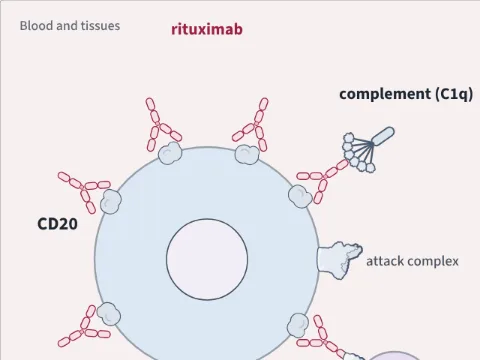
CD20 antigen. A molecule on the surface of B cells that rituximab targets.
COX-2
Cyclooxygenase-2. An enzyme that makes prostaglandins.
DHFR
Dihydrofolate reductase. The enzyme that makes tetrahydrofolic acid from dihydrofolic acid; tetrahydrofolic acid helps make the building blocks of nucleic acids.
IL-1
Interleukin-1. A signaling molecule (cytokine) that drives inflammation.
IL-1 receptor
Interleukin-1 receptor (type I). The receptor that IL-1α and IL-1β act on to drive inflammation.
TNF
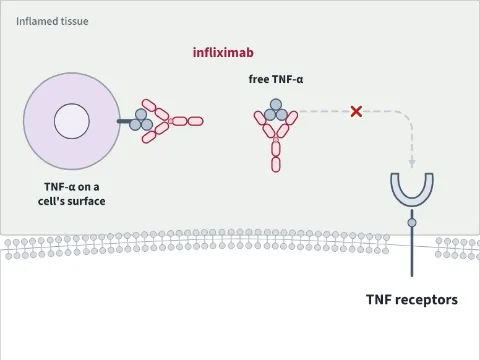
Tumor necrosis factor (TNF-α). A signaling molecule (cytokine) that drives inflammation.
What goes wrong
The immune system targets the joints. Rheumatoid arthritis is a long-lasting, inflammatory autoimmune disease that mainly affects the joints, with autoantibodies against the body's own molecules.1
What the source says
“Rheumatoid arthritis (RA) is a chronic, inflammatory, autoimmune disease that primarily affects the joints and is associated with autoantibodies that target various molecules including modified self-epitopes.”
Inflammatory signals win out. In the joints, inflammatory outweigh calming ones, and this imbalance favors autoimmunity, long-lasting inflammation and so joint damage.2
What the source says
“In rheumatoid joints, it is well known that an imbalance between pro- and anti-inflammatory cytokine activities favours the induction of autoimmunity, chronic inflammation and thereby joint damage.”
Cartilage and bone damaged. Rheumatoid arthritis can damage cartilage and bone and cause disability; , for one, breaks down cartilage and drives bone loss.3,4
What the source says
“Rheumatoid arthritis is a chronic inflammatory joint disease, which can cause cartilage and bone damage as well as disability.”
“IL-1 has a broad range of activities including cartilage degradation by its induction of the rapid loss of proteoglycans, as well as stimulation of bone resorption.”
Binds on B cells and leads to their destruction (B-cell lysis); B cells are thought to help drive the disease, for example by making autoantibodies.6
Used forModerately to severely active rheumatoid arthritis: adults, with methotrexate, after one or more TNF blockers have not worked well enough
What the label says
“Rituximab is a monoclonal antibody that targets the CD20 antigen expressed on the surface of pre-B and mature B-lymphocytes. Upon binding to CD20, rituximab mediates B-cell lysis.”
“Rheumatoid Arthritis (RA) in combination with methotrexate in adult patients with moderately-to severely-active RA who have inadequate response to one or more TNF antagonist therapies”
Binds , neutralizing it and inhibiting its binding to its receptors.7
Used forModerately to severely active rheumatoid arthritis: adults, with methotrexate
What the label says
“Infliximab neutralizes the biological activity of TNFα by binding with high affinity to the soluble and transmembrane forms of TNFα and inhibits binding of TNFα with its receptors.”
“Rheumatoid Arthritis in combination with methotrexate : reducing signs and symptoms, inhibiting the progression of structural damage, and improving physical function in adult patients with moderately to severely active disease.”
Blocks the activity of IL-1 alpha and beta by competing with them for their receptor (IL-1RI).4
Used forModerately to severely active rheumatoid arthritis: ages 18 and over, after one or more disease-modifying medicines (DMARDs) have failed; alone or with DMARDs other than TNF blockers
What the label says
“KINERET blocks the biologic activity of IL-1 alpha and beta by competitively inhibiting IL-1 binding to the interleukin-1 type I receptor (IL-1RI)”
“Reduction in signs and symptoms and slowing the progression of structural damage in moderately to severely active rheumatoid arthritis, in patients 18 years of age or older who have failed 1 or more disease modifying antirheumatic drugs (DMARDs)”
Also used for it: meloxicam (“Meloxicam is indicated for relief of the signs and symptoms of rheumatoid arthritis”9); diclofenac (delayed-release tablets: “For relief of the signs and symptoms of rheumatoid arthritis”10); naproxen (“Naproxen Tablets are indicated for: the relief of the signs and symptoms of: rheumatoid arthritis”11); prednisone (“As adjunctive therapy for short-term administration (to tide the patient over an acute episode or exacerbation) in: … Rheumatoid arthritis, including juvenile rheumatoid arthritis”12); adalimumab (“HUMIRA is indicated for reducing signs and symptoms, inducing major clinical response, inhibiting the progression of structural damage, and improving physical function in adult patients with moderately to severely active rheumatoid arthritis.”13); cyclosporine (“Neoral is indicated for the treatment of patients with severe active, rheumatoid arthritis where the disease has not adequately responded to methotrexate.”14); hydroxychloroquine (“PLAQUENIL is indicated for the treatment of acute and chronic rheumatoid arthritis in adults.”15); methylprednisolone (by injection when oral therapy is not feasible: “As adjunctive therapy for short-term administration (to tide the patient over an acute episode or exacerbation) in … rheumatoid arthritis, including juvenile rheumatoid arthritis”16); hydrocortisone (by injection when oral therapy is not feasible: “As adjunctive therapy for short-term administration (to tide the patient over an acute episode or exacerbation) in … rheumatoid arthritis, including juvenile rheumatoid arthritis”17); dexamethasone (by injection when oral therapy is not feasible: “As adjunctive therapy for short-term administration (to tide the patient over an acute episode or exacerbation) in: … Rheumatoid arthritis, including juvenile rheumatoid arthritis”18); tofacitinib (for moderately to severely active rheumatoid arthritis in adults when one or more TNF blockers did not work well enough or were not tolerated: “XELJANZ tablets and XELJANZ XR (extended-release tablets) are indicated for the treatment of adult patients with moderately to severely active rheumatoid arthritis (RA), who have had an inadequate response or intolerance to one or more TNF blockers.”19); and tocilizumab (for moderately to severely active rheumatoid arthritis in adults when one or more disease-modifying medicines (DMARDs) did not work well enough: “ACTEMRA ® (tocilizumab) is indicated for the treatment of adult patients with moderately to severely active rheumatoid arthritis who have had an inadequate response to one or more Disease-Modifying Anti-Rheumatic Drugs (DMARDs).”20).
It remains less clear which cytokines may be the best targets in advance, and although the outlook for most people is now favorable, many still do not respond to current treatments.2,3
text e823178c5808…; drawings dbd5c252213a…; notes 40e4555315a0…
AI source check
Claude Opus 5.5 (AI source check), 13 November 2026: 67 statements compared with their sources, 8 flagged for the reviewer. An automated check, not a medical review.
Conflict of interest
Methylprednisolone: Pfizer, the reviewer's former employer, makes or markets this medicine. Hydrocortisone: Pfizer, the reviewer's former employer, makes or markets this medicine. Tofacitinib: Pfizer, the reviewer's former employer, makes or markets this medicine. Details
Next review due
14 May 2028
Cite this page
Tran D. Rheumatoid arthritis [Internet]. OpenMechanism; 2026 [updated 2026 Nov 13; cited 2026 Nov 13]. Available from: https://openmechanism.com/conditions/rheumatoid-arthritis