Paroxysmal nocturnal hemoglobinuria
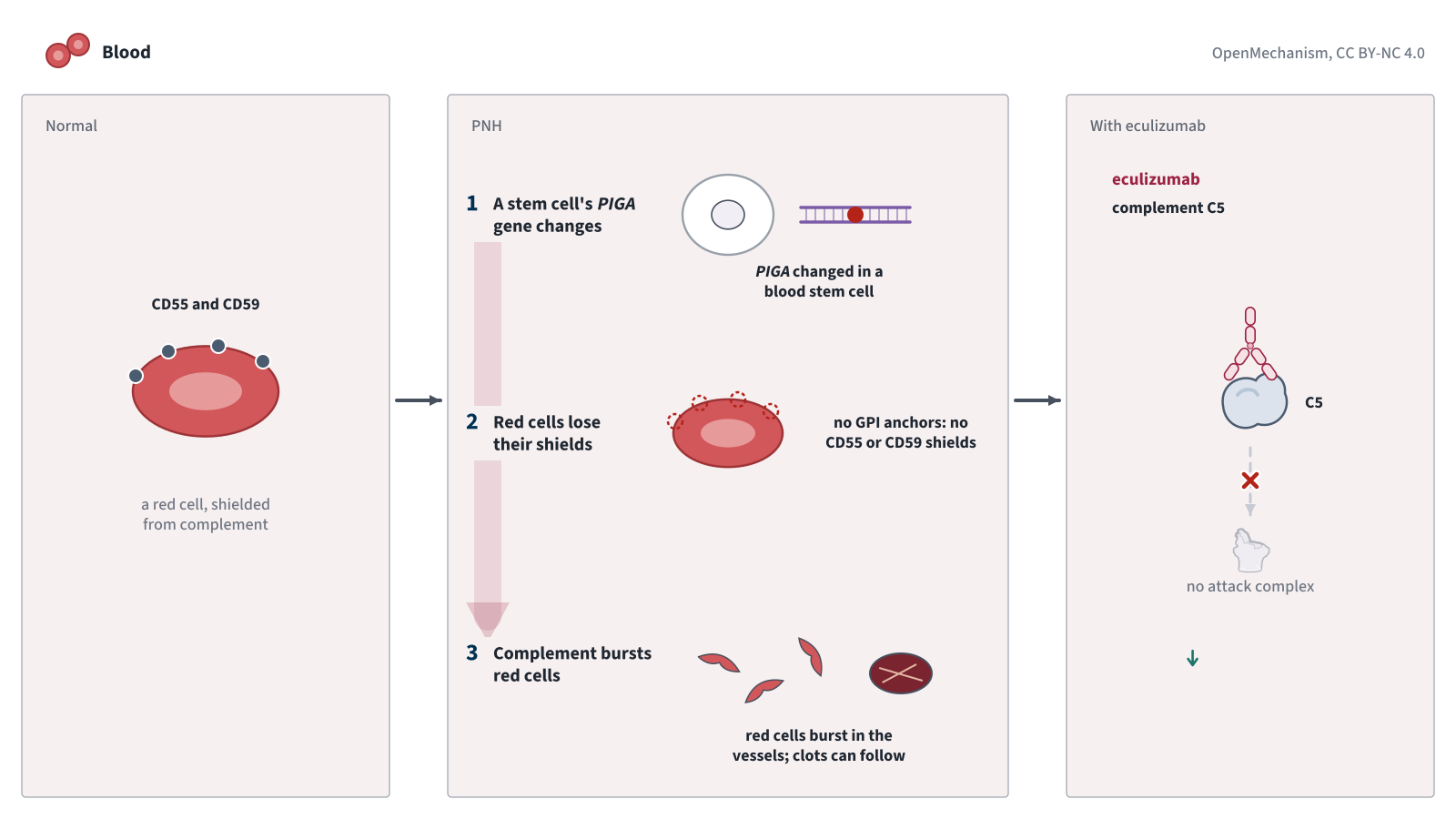
Paroxysmal nocturnal hemoglobinuria (PNH) begins with a change in the PIGA gene of a blood stem cell. Its descendants' red cells lack CD55 and CD59, two proteins that shield cells from complement, so complement bursts them inside the blood vessels, which can lead to clots. Eculizumab binds complement protein C5 and stops the final attack complex forming.
- Where
- Blood
- Body systems
- Blood & clotting, Immune system
- Medicines
- 1 medicine
For teachers: download this drawing.
Key terms in this drawing (7)
- C5
- Complement component 5. A complement protein; when split, part of it helps build the membrane attack complex.
- CD55
- Complement decay-accelerating factor (CD55). A GPI-anchored protein on blood cells that holds back complement; PNH cells lack it.
- CD59
- CD59 glycoprotein. A GPI-anchored protein on blood cells that holds back complement; PNH cells lack it.
- complement
- Complement. A set of blood proteins that can kill a cell an antibody has marked.
- GPI
- Glycosylphosphatidylinositol anchor. An anchor that some proteins, such as CD55 and CD59, are attached by; PIGA mutations leave cells short of them.
- PIGA
- PIGA gene. A gene for making GPI anchors; acquired mutations in it, in blood stem cells, cause PNH.
- PNH
- Paroxysmal nocturnal hemoglobinuria. A blood disease in which complement breaks open red blood cells.
What goes wrong
A stem cell's PIGA gene changes. is caused by acquired changes in the gene in one or more blood stem cells.1
What the source says
“PNH is caused by somatic mutations in PIGA (which encodes phosphatidylinositol N-acetylglucosaminyltransferase subunit A) in one or more HSC clones.”
Source 1Red cells lose their shields. Without PIGA, the cells lack GPI-anchored proteins, including and , which normally hold back.1
What the source says
“PIGA mutations lead to a deficiency of GPI-anchored proteins, such as complement decay-accelerating factor (also known as CD55) and CD59 glycoprotein (CD59), which are both complement inhibitors.”
Source 1Complement bursts red cells. Without CD55 and CD59, red cells burst inside blood vessels, which can lead to clots and causes much of the illness and death.1
What the source says
“The loss of CD55 and CD59 renders PNH erythrocytes susceptible to intravascular haemolysis, which can lead to thrombosis and to much of the morbidity and mortality of PNH.”
Source 1
Where medicines act
- A
Eculizumab: complement stopped at C5
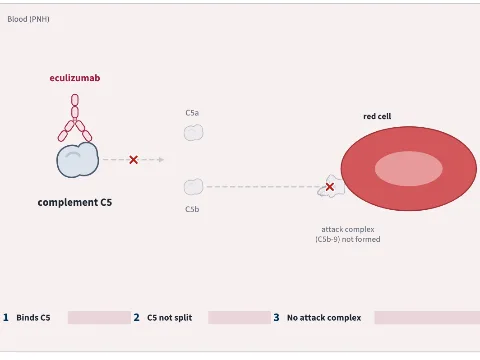
Eculizumab binds complement protein and stops it being split, so the final attack complex () cannot form and red cells are not burst. It treats PNH to reduce hemolysis.2
What the source says
“is a monoclonal antibody that specifically binds to the complement protein C5 with high affinity, thereby inhibiting its cleavage to C5a and C5b and preventing the generation of the terminal complement complex C5b-9.”
Source 2“SOLIRIS inhibits terminal complement-mediated intravascular hemolysis in PNH patients”
Source 2“SOLIRIS is indicated for the treatment of patients with paroxysmal nocturnal hemoglobinuria (PNH) to reduce hemolysis.”
Source 2
See also
Body systems: blood & clotting and immune system.
Other conditions: atypical hemolytic uremic syndrome (aHUS), myasthenia gravis, neuromyelitis optica (NMOSD), acute lymphoblastic leukemia, chronic lymphocytic leukemia and Hodgkin lymphoma.
Side effects: why eculizumab raises the risk of meningococcal infections.
Sources
- 1Paroxysmal nocturnal haemoglobinuriaHill A et al. Nat Rev Dis Primers 2017 (abstract). Saved copy
- 2Soliris (eculizumab): FDA label1 Indications and Usage; 12.1 Mechanism of Action. Saved copy
- 3The complement membrane attack complex (C5b-9) in its open form (cryo-EM)PDB 6H03; Menny, A. et al. Nat Commun 2018;9:5316. The attack complex outline in the drawing is traced from this structure. Saved copy
Notes and limits
- PNH varies widely, from quiet to life-threatening.1
Notes that apply to every page are on How to read a page.
Spotted a mistake? Report an error (hello@openmechanism.com). Since launch, every published error we fix is listed on the corrections page.
Cite this page
Tran D. Paroxysmal nocturnal hemoglobinuria [Internet]. OpenMechanism; 2026 [updated 2026 Oct 21; cited 2026 Oct 21]. Available from: https://openmechanism.com/conditions/paroxysmal-nocturnal-hemoglobinuria