Ulcerative colitis
Ulcerative colitis is lifelong inflammation of the rectum and colon. It is thought to start in people with a genetic tendency after environmental exposures, with the gut lining's barrier, gut microbes and an overactive immune response all involved. It usually shows as bloody diarrhea. Infliximab, which neutralizes TNF-alpha, treats moderate to severe disease.
- Where
- Colon and rectum
- Body systems
- Stomach, gut & liver; Immune system
- Medicines
- 1 medicine
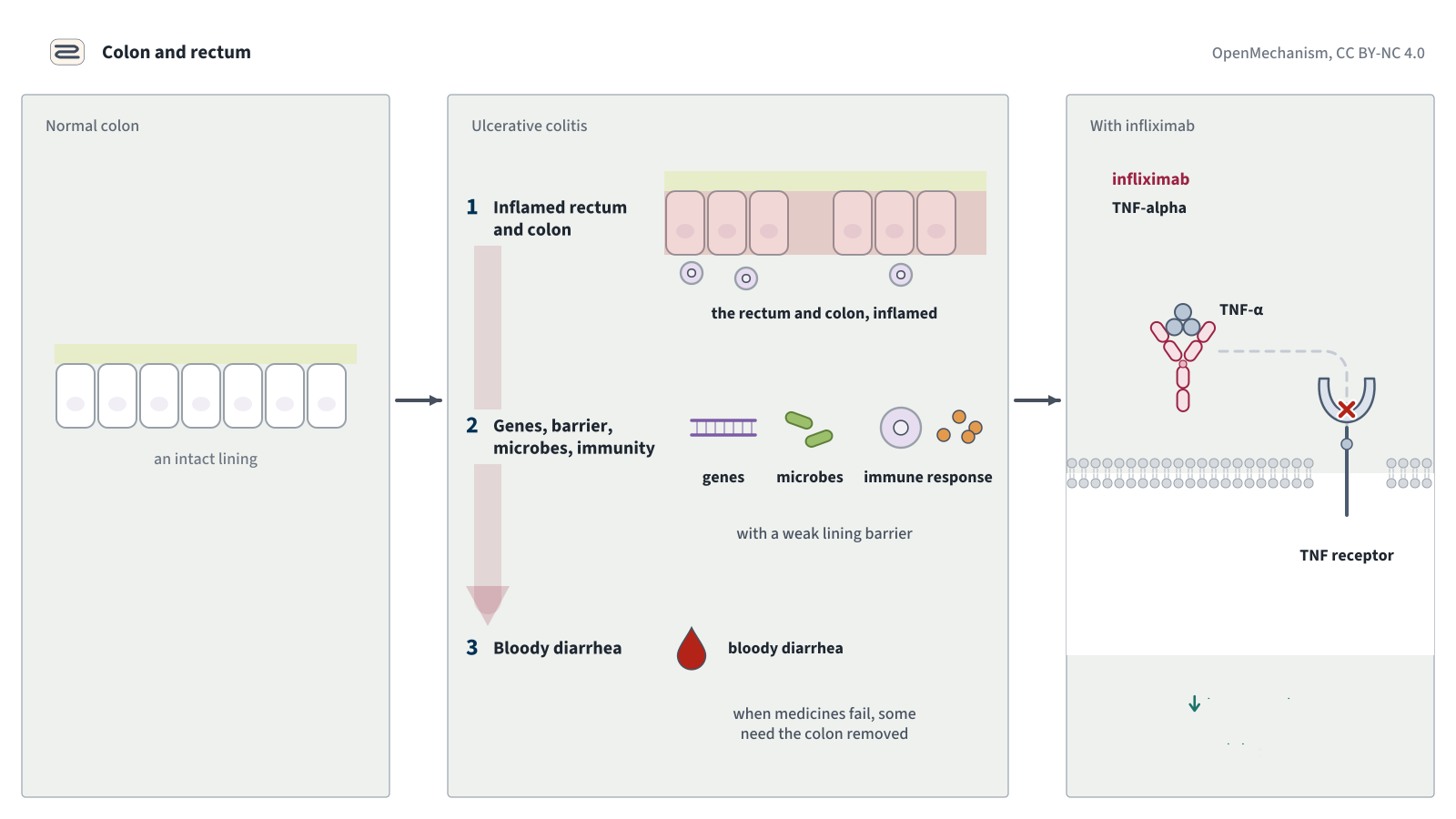
For teachers: download this drawing.
Key terms in this drawing
- TNF
- Tumor necrosis factor (TNF-α). A signaling molecule (cytokine) that drives inflammation.
What goes wrong
Inflamed rectum and colon. Ulcerative colitis is a lifelong inflammatory disease of the rectum and colon. About 5 million people had it in 2023, and new cases are rising worldwide.1
Genes, barrier, microbes, immunity. It is thought to start in people with a genetic tendency after environmental exposures. Defects in the gut lining's barrier, the gut microbes and an overactive immune response are strongly implicated.1
What the source says
“Ulcerative colitis is thought to occur in people with a genetic predisposition following environmental exposures; gut epithelial barrier defects, the microbiota, and a dysregulated immune response are strongly implicated.”
Source 1Bloody diarrhea. People usually first notice bloody diarrhea. When medicines fail, 10 to 20% still need the colon and rectum removed.1
Where medicines act
- A
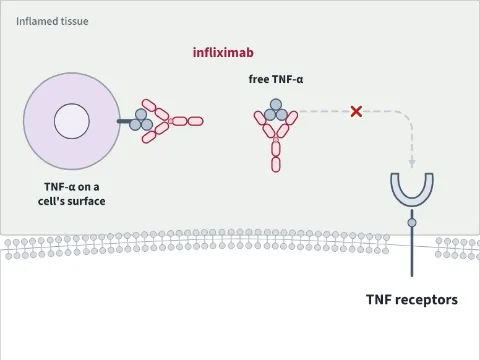
Infliximab: TNF-alpha neutralized
Infliximab binds . Anti-TNF treatment has improved results since the early 2000s; infliximab treats moderate to severe ulcerative colitis that has not responded to standard treatment, and helps the lining heal.2,3
What the source says
“Infliximab neutralizes the biological activity of TNFα by binding with high affinity to the soluble and transmembrane forms of TNFα and inhibits binding of TNFα with its receptors.”
Source 2“Since the early 2000s, anti-tumour necrosis factor (TNF) treatment has significantly improved treatment outcomes.”
Source 3“reducing signs and symptoms, inducing and maintaining clinical remission and mucosal healing, and eliminating corticosteroid use in adult patients with moderately to severely active disease who have had an inadequate response to conventional therapy.”
Source 2
See also
Body systems: stomach, gut & liver; and immune system.
Also used for it: methylprednisolone (“To tide the patient over a critical period of the disease in regional enteritis (systemic therapy) and ulcerative colitis.”4); hydrocortisone (“To tide the patient over a critical period of the disease in regional enteritis (systemic therapy) and ulcerative colitis.”5); dexamethasone (“To tide the patient over a critical period of the disease in: Ulcerative colitis (Systemic therapy)”6); loperamide (for the chronic diarrhea of inflammatory bowel disease: “Loperamide hydrochloride capsules are indicated for the control and symptomatic relief of acute nonspecific diarrhea in patients 2 years of age and older and of chronic diarrhea in adults associated with inflammatory bowel disease.”7); and tofacitinib (for moderately to severely active ulcerative colitis after a TNF blocker: “XELJANZ tablets and XELJANZ XR are indicated for the treatment of adult patients with: … Moderately to severely active ulcerative colitis (UC), who have had an inadequate response or intolerance to one or more TNF blockers.”8).
Related medicines: mesalamine, prednisone and adalimumab.
Other conditions: Crohn disease, ankylosing spondylitis, psoriatic arthritis, rheumatoid arthritis, juvenile idiopathic arthritis and lupus nephritis.
Side effects: why TNF blockers such as adalimumab raise the risk of tuberculosis.
Sources
- 1Ulcerative colitisLe Berre C et al. Lancet 2023 (abstract). Saved copy
- 2Remicade (infliximab): FDA label1 Indications and Usage; 12.1 Mechanism of Action. Saved copy
- 3Ulcerative colitisKobayashi T et al. Nat Rev Dis Primers 2020 (abstract). Saved copy
- 4Solu-Medrol (methylprednisolone sodium succinate): FDA labelIndications and Usage. Saved copy
- 5Solu-Cortef (hydrocortisone sodium succinate): FDA labelIndications and Usage. Saved copy
- 6Dexamethasone sodium phosphate injection: FDA labelIndications and Usage. Saved copy
- 7Loperamide hydrochloride capsules: FDA labelIndications and Usage. Saved copy
- 8Xeljanz (tofacitinib): FDA label1 Indications and Usage. Saved copy
Notes and limits
- Its cause is not known, and knowing it is needed for a cure.3
Notes that apply to every page are on How to read a page.
Spotted a mistake? Report an error (hello@openmechanism.com). Since launch, every published error we fix is listed on the corrections page.
Cite this page
Tran D. Ulcerative colitis [Internet]. OpenMechanism; 2026 [updated 2026 Oct 21; cited 2026 Oct 21]. Available from: https://openmechanism.com/conditions/ulcerative-colitis