Cetirizine
Cetirizine, a metabolite of hydroxyzine, works mainly by blocking histamine outside the brain and spinal cord, with no measurable for other receptors in laboratory tests. In rats, little of it entered the brain, and in mice it did not significantly occupy the brain's H1 receptors. The label for this oral solution lists it for relieving the symptoms of year-round (perennial) allergic rhinitis in children 6 to 23 months old, and for treating the uncomplicated skin signs of chronic hives (chronic idiopathic urticaria) in children 6 months to 5 years old.
- Acts on
- Histamine H1 receptors (peripheral)
- Where
- Tissues outside the brain and spinal cord
- Medicine type
- Small molecule
- Used for
- Lungs & airways
- Drug class
- Antihistamines
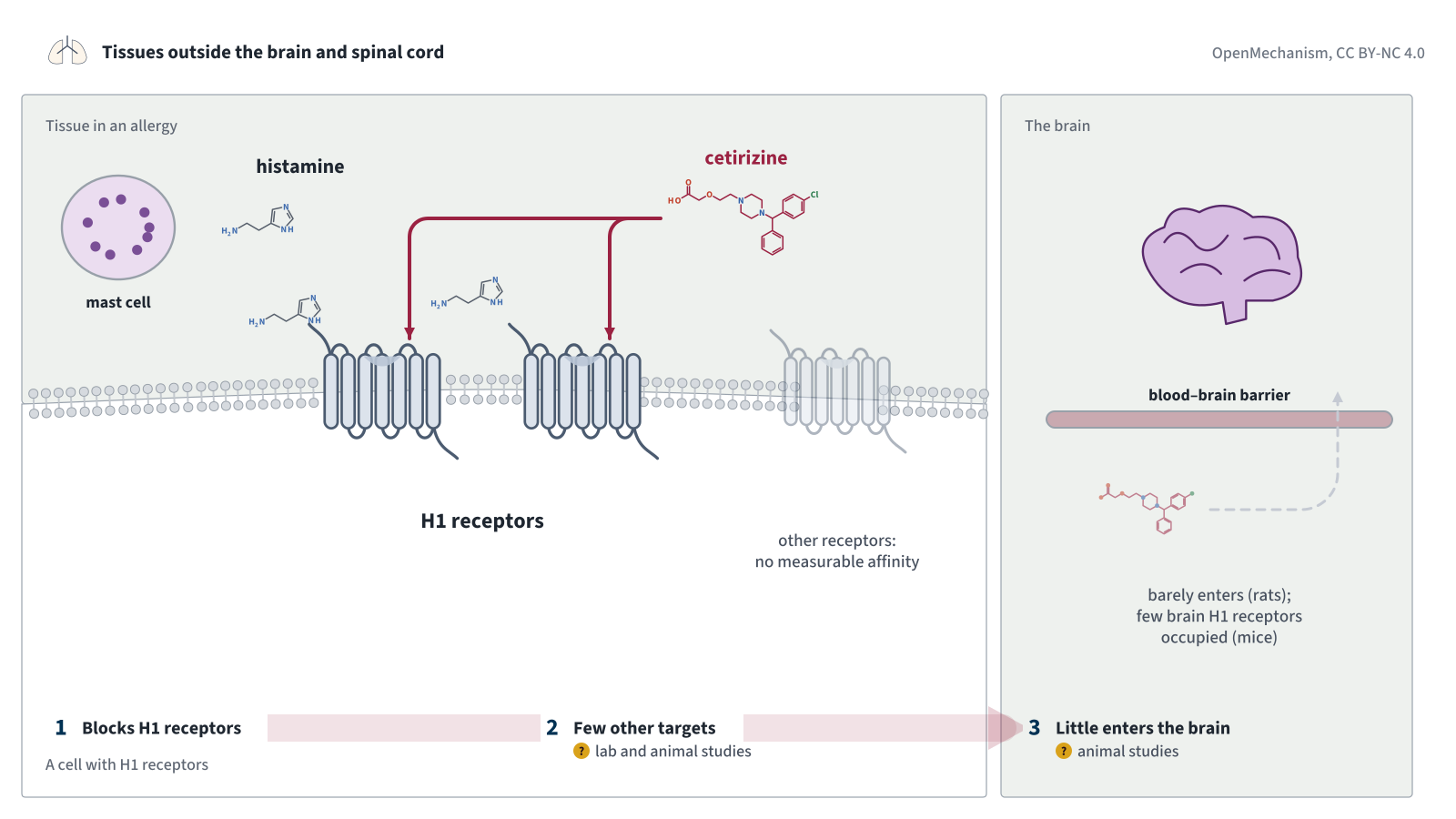
Step 2: lab and animal studies
The cetirizine label says: In vivo and ex vivo animal models have shown negligible anticholinergic and anti-serotonergic activity. In clinical studies, however, dry mouth was more common with cetirizine than with placebo. In vitro receptor binding studies have shown no measurable affinity for other than H 1 receptors.
Step 3: animal studies
The cetirizine label says: Autoradiographic studies with radiolabeled cetirizine in the rat have shown negligible penetration into the brain. Ex vivo experiments in the mouse have shown that systemically administered cetirizine does not significantly occupy cerebral H 1 receptors.
Study: In Tashiro and colleagues' 2004 double-blind, placebo-controlled crossover study in 20 healthy Japanese volunteers, brain imaging (PET) in 12 of them measured the share of the brain's histamine H1 receptors occupied (H1RO) after one dose of cetirizine 20 mg or fexofenadine 120 mg: H1RO was negligible with fexofenadine (-0.1%) but moderately high with cetirizine (26.0%).
Tashiro M et al., J Clin Pharmacol 2004 (PMID 15286093)
Clinical study: In Howarth and colleagues' 1999 double-blind, placebo-controlled trial, 821 people with seasonal allergic rhinitis took cetirizine 10 mg, fexofenadine 120 or 180 mg, or placebo once daily for 2 weeks (722 completed the study); the trial measured symptoms and side effects, not the brain's H1 receptors: There was no major side effect, but the combined incidence of drowsiness or fatigue was greater with ce-tirizine (9%) than with placebo (4%) (P =.07) or fexofenadine (4%) (P =.02).
Howarth PH et al., J Allergy Clin Immunol 1999 (PMID 10550734)
Key terms in this drawing
- affinity
- Binding affinity. How strongly a molecule binds its target.
- H1 receptor
- Histamine H1 receptor. A histamine receptor; medicines that block it (antihistamines) treat allergies and often make people sleepy.
- mast cell
- Mast cell. An immune cell in tissues such as the skin and the airways that releases histamine and other signals.
How it works
Blocks H1 receptors. Cetirizine, a human metabolite of hydroxyzine, is an antihistamine: its main effects come from selectively blocking histamine H1 receptors outside the brain and spinal cord (peripheral H1 receptors). Its antihistamine activity is documented in animal and human models.1
Few other targets. In laboratory binding studies it showed no measurable affinity for receptors other than H1, and animal models showed negligible anticholinergic and anti-serotonin activity; in clinical studies, however, dry mouth was more common than with placebo.1
Little enters the brain. In rats, radiolabeled cetirizine barely entered the brain, and in mice it did not significantly occupy the brain's H1 receptors.1
For teachers: download this drawing.
See also
Condition pages: chronic hives (urticaria).
Other antihistamines: hydroxyzine and meclizine.
Body system: lungs & airways.
Sources
- 1Cetirizine hydrochloride oral solution: FDA labelIndications and Usage; Clinical Pharmacology: Mechanism of Action
- 2ChEMBL CHEMBL1000Target and action classification: Histamine H1 receptor antagonist
- 3Double-blind, placebo-controlled study comparing the efficacy and safety of fexofenadine hydrochloride (120 and 180 mg once daily) and cetirizine in seasonal allergic rhinitisHowarth PH et al. J Allergy Clin Immunol 1999 (abstract)
- 4
Spotted a mistake? Report an error (hello@openmechanism.com). Since launch, every published error we fix is listed on the corrections page.
Notes and limits
- A schematic teaching drawing: not to scale, not exact structures, binding poses or a complete pathway, and not a guide to dosing, treatment or how a person will respond.
- The steps are in the order that explains them; one step is said to cause the next only where the source says so.
- The label's evidence that little cetirizine reaches the brain or its H1 receptors comes from studies in rats and mice.
All recorded limits are on the evidence page, and notes that apply to every page are on How to read a page. Version 1.0.1, medically reviewed by Daniel Tran, PharmD, on 13 November 2026.
Cite this page
Tran D. Cetirizine [Internet]. OpenMechanism; 2026 [updated 2026 Nov 13; cited 2026 Nov 13]. Available from: https://openmechanism.com/medicines/cetirizine