Psoriatic arthritis
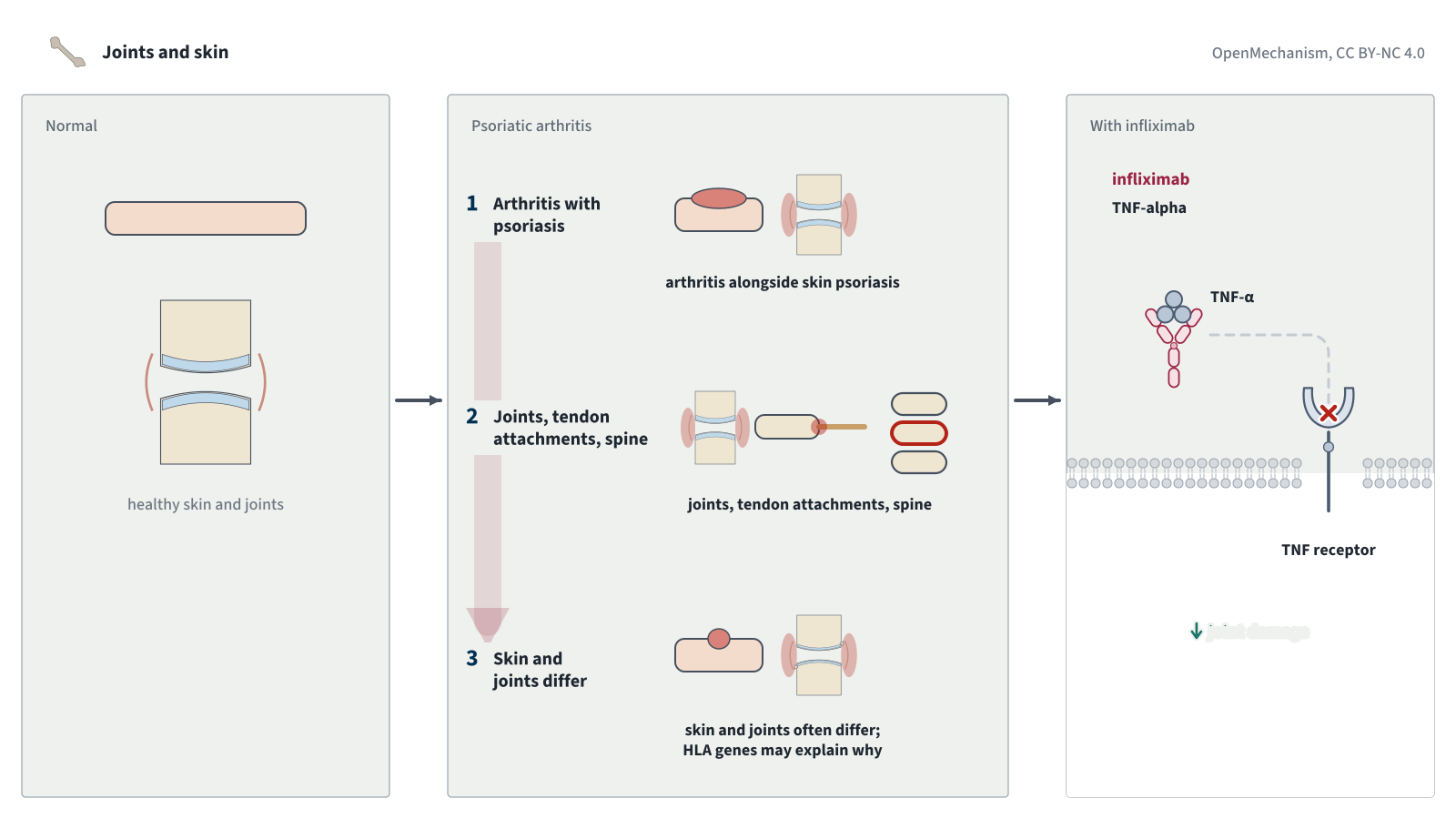
Psoriatic arthritis affects about 30% of people with psoriasis: inflammation of the joints, where tendons attach, or the spine. How bad the joints are often does not match how bad the skin is, which may come down to genes in the HLA region. New targeted treatments have improved both joints and skin. Infliximab neutralizes TNF-alpha and slows joint damage.
- Where
- Joints and skin
- Body systems
- Muscles, bones & joints; Immune system; Skin, hair & nails
- Medicines
- 1 medicine
For teachers: download this drawing.
Key terms in this drawing
- HLA
- Human leukocyte antigen genes. Immune genes of the human major histocompatibility complex (MHC); their molecules present peptides to T cells. Variation in these genes may affect the risk of many diseases, including autoimmune ones.
- TNF
- Tumor necrosis factor (TNF-α). A signaling molecule (cytokine) that drives inflammation.
What goes wrong
Arthritis with psoriasis. Psoriatic arthritis is a varied inflammatory disease that develops in about 30% of people with psoriasis.1
What the source says
“Psoriatic arthritis (PsA) is a complex inflammatory disease with heterogeneous clinical features, which complicates psoriasis in 30% of patients.”
Source 1Joints, tendon attachments, spine. It shows as inflammation in joints, where tendons attach to bone (entheses), or the spine, alongside skin or nail psoriasis.1
What the source says
“Diagnosis is most commonly made by identifying inflammatory musculoskeletal features in joints, entheses or the spine in the presence of skin and/or nail psoriasis”
Source 1Skin and joints differ. Joint inflammation often does not match how bad the skin is; differences in genes, especially in the region, may explain why.1
What the source says
“In many patients, there may be little or no relationship between severity of musculoskeletal inflammation and severity of skin or nail psoriasis.”
Source 1“The reason for this disease heterogeneity may be explained by differences in genotype, especially in the HLA region.”
Source 1
Where medicines act
- A
Infliximab: TNF-alpha neutralized
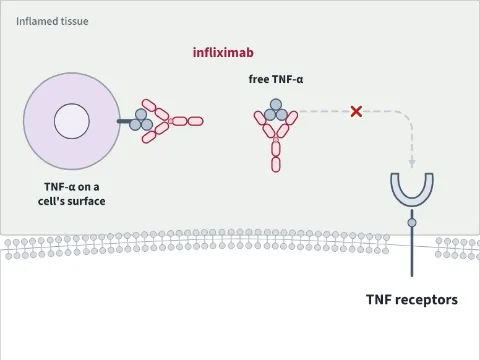
Infliximab binds . It reduces the signs and symptoms of active psoriatic arthritis, slows joint damage and improves function; it lowered and blood vessels in the joint lining and skin.2
What the source says
“Infliximab neutralizes the biological activity of TNFα by binding with high affinity to the soluble and transmembrane forms of TNFα and inhibits binding of TNFα with its receptors.”
Source 2“Psoriatic Arthritis : reducing signs and symptoms of active arthritis, inhibiting the progression of structural damage, and improving physical function in adult patients.”
Source 2“In PsA, treatment with REMICADE resulted in a reduction in the number of T-cells and blood vessels in the synovium and psoriatic skin lesions”
Source 2
See also
Body systems: muscles, bones & joints; immune system; and skin, hair & nails.
Also used for it: methylprednisolone (“As adjunctive therapy for short-term administration (to tide the patient over an acute episode or exacerbation) in … psoriatic arthritis”3); hydrocortisone (“As adjunctive therapy for short-term administration (to tide the patient over an acute episode or exacerbation) in … psoriatic arthritis”4); dexamethasone (“As adjunctive therapy for short-term administration (to tide the patient over an acute episode or exacerbation) in: … Psoriatic arthritis”5); and tofacitinib (for active psoriatic arthritis after a TNF blocker: “XELJANZ (tablets and oral solution) is indicated for the treatment of adult and pediatric patients 2 years of age and older with active psoriatic arthritis (PsA), who have had an inadequate response or intolerance to one or more TNF blockers.”6).
Related medicines: prednisone and adalimumab.
Other conditions: ankylosing spondylitis, rheumatoid arthritis, ulcerative colitis, juvenile idiopathic arthritis, Crohn disease and pemphigus.
Sources
- 1Psoriatic arthritisFitzGerald O et al. Nat Rev Dis Primers 2021 (abstract). Saved copy
- 2Remicade (infliximab): FDA label1 Indications and Usage; 12.1 Mechanism of Action; 12.2 Pharmacodynamics. Saved copy
- 3Solu-Medrol (methylprednisolone sodium succinate): FDA labelIndications and Usage. Saved copy
- 4Solu-Cortef (hydrocortisone sodium succinate): FDA labelIndications and Usage. Saved copy
- 5Dexamethasone sodium phosphate injection: FDA labelIndications and Usage. Saved copy
- 6Xeljanz (tofacitinib): FDA label1 Indications and Usage. Saved copy
Notes and limits
- There is no diagnostic test, and how psoriasis turns into arthritis is unclear.1
Notes that apply to every page are on How to read a page.
Spotted a mistake? Report an error (hello@openmechanism.com). Since launch, every published error we fix is listed on the corrections page.
Cite this page
Tran D. Psoriatic arthritis [Internet]. OpenMechanism; 2026 [updated 2026 Oct 18; cited 2026 Oct 18]. Available from: https://openmechanism.com/conditions/psoriatic-arthritis